


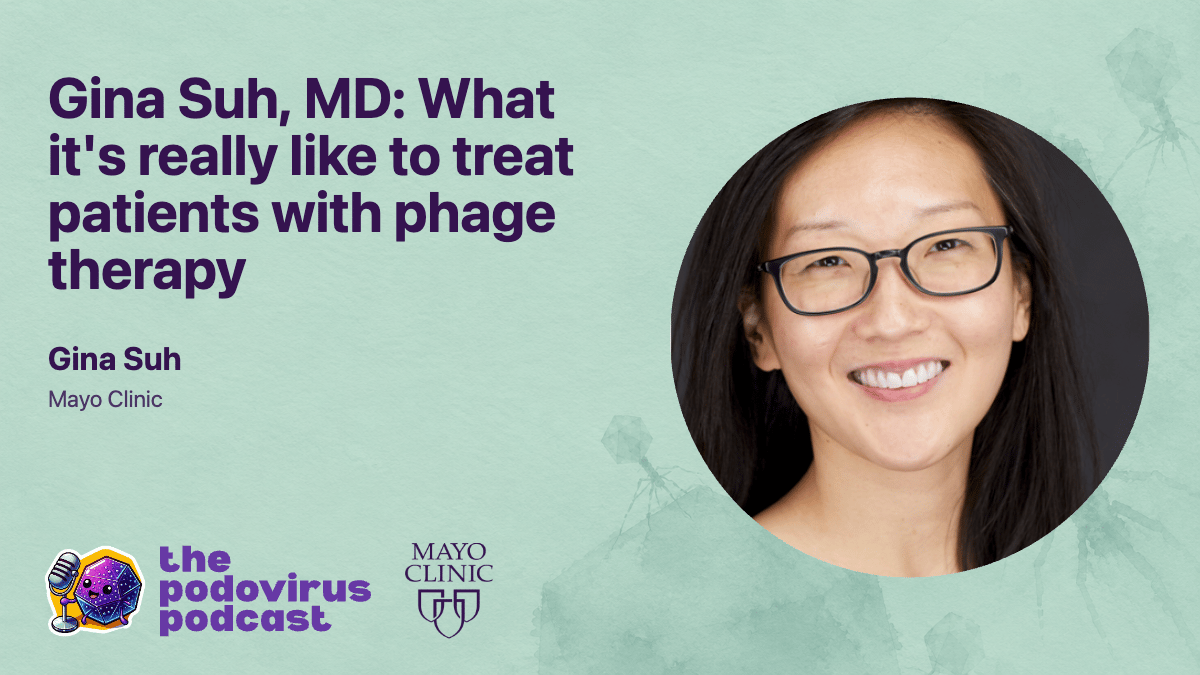
Gina Suh, MD: What it's really like to treat patients with phage therapy
The conversation
Episode notes
Gina Suh, an infectious diseases physician at Mayo Clinic, explains what treating patients with phages has taught her about choosing cases, reaching infections and judging results. Drawing on her own patients, she describes why promising laboratory activity and early symptom relief can leave clinicians uncertain about whether treatment will ultimately help.
Suh increasingly selects patients with fewer organisms and complicating factors, balancing their need for treatment against the chance of helping them and learning something interpretable from each case.
Several patients improved initially before relapsing, and Suh estimated roughly half of completed treatment courses succeeded, while emphasizing that the figure depended on how strictly success was defined.
Banking serum preserved an opportunity to study neutralizing antibodies, but Suh explained that testing still required access to the treatment phages and a separate assay for each phage.
Episode timeline
- 0:00 Introduction to Gina Suh and the phage therapy series
- 6:31 Choosing patients and defining treatment success
- 17:46 Pharmacokinetics, antibody testing and clinical infrastructure
- 32:12 Early improvement, relapse and possible reasons for treatment failure
- 44:33 Future protocols, phage access and centralized banks
- 1:02:28 Funding infection treatment across medical specialties
Transcript
AI-transcribed and edited for readability. May contain errors or omissions; check the recording for exact wording.
Select a word or timestamp to listen. Use arrow keys to move between words.
- Jessica Sacher
Hello, welcome everyone back to Podovirus. This is our fourth episode. So I'm Jessica and I'm here with Joe Campbell and Gina Suh today. So this is a special episode. And I'm gonna pass it over to Joe to kind of introduce a new phage therapy series that we have plotted to do. And so take it away, Joe.
- Joe Campbell
Yeah, my name is Joe Campbell. For a long time, I was a program officer at NIAID and I was running the bacteriophage interest group. And Jessica and I got to know each other while I was doing that. And Jessica and I have been interested in exploring the potential of phage therapy with people who are intimately involved in it and trying to figure out what's potentially keeping us from getting to that potential.
And so we wanted to talk, have a bunch of conversations with people who are experts in phage therapy. And our first guest is Gina, and I'll just let Gina briefly introduce herself, and then we'll start with a few questions.
- Jessica Sacher
Yeah, go ahead, Gina.
- Gina Suh
Right, I'm really excited to be here and invited by two of my most favorite phage people, Jessica and Joe. My name is Gina Suh. I am an infectious diseases physician at the Mayo Clinic. And I have been lucky enough to be able to treat patients with phage therapy, 17 treatment courses so far.
- Jessica Sacher
Wow, 17 already.
- Gina Suh
it's, 15 patients, 17 treatment courses.
- Jessica Sacher
Okay, wow.
- Joe Campbell
I guess we'll start out. We have a first question for you, which is when and how did you start getting involved in phage therapy?
- Gina Suh
Well, I have been a clinician, so I see patients every day, all daysince. Well, I guess, I don't know for the past 15 years or so. And my subspecialty is orthopedic infectious diseases. And so that means that I treat patients with musculoskeletal infections, such as osteomyelitis, so bone and joint infections, osteomyelitis, prosthetic joint infections. And while treating those patients was incredibly, you know, gratifying, and we really made a lot of good progress and cured a lot of people.
There was a subset of people that we just couldn't help, because their infections kept coming back over and over and over again, no matter what we did. And it was really heartbreaking a lot of times, and we saw people's lives get ruined because they had an infection and they ended up not being able to walk or with an amputation. And, so that really inspired me to kind of think about things that were different than what we were already doing.
And that was at Stanford University, where I worked previously. And at this very same time, I just happened to start working with somebody there named Paul Bollyky, who does a lot of basic science and translational. Not necessarily phage therapy at the time, but basic temperate phage work. And he wanted me to collect a bunch of wound samples, for some experiments that he was doing.
And so because I took care of wound infection patients, I did that. And then slowly I started to learn a little bit about these things called phages, and I was intrigued and started to kind of think about phage therapy. So this now would have been about 2016, 2017, and 2018. And then after that, I was recruited to Mayo, for my ortho ID interests.
And while I was there in the first six months, we had a patient who eventually became our first phage therapy patient. But he had a recalcitrant, intractable infection of his prosthetic knee, and he approached us about phage therapy, not really even knowing that I was interested. And then one of our colleagues referred him to me, and I looked at the case and I thought, you know, this patient has, you know, 10 to 12 years of infection.
They've been recurrent. There are about three or four or five bugs. He's allergic to everything on the face of the earth in terms of therapeutics or antimicrobials. There's no way this is gonna work. is what I thought. But instead of kind of saying, you know, no. I talked to my colleagues and particularly my boss at the time, Dr.
Berbari, who is our division chair. Dr. Berbari said, just go for it, you know, at the very least, we'll have learned something. So I did that. and that patient is Mr. John Haverty, who has been, who we all know, his name is, you know, public and published. And so John became our first phage patient. And then after that, it was just like a no brainer.
It was just like, you know, it worked so well for him that after that it was. It became my purpose, or calling, if you could say that, to keep going with this, because it changed his life.
- Jessica Sacher
So yeah, that story is incredible. And I remember following John Haverty's case. and I feel like I've met him, but I think I probably haven't. It's probably just been on webinars and seeing him speak online. With you, or, yeah, no, we did a webinar together with you too. Yeah Yes, that's what it's from. And so what have been the biggest changes in how you approach phage therapy now compared to in John's case?
- Gina Suh
I am much more careful about patient selection, so I select patients now with fewer variables and confounders. I look at things like how long have they had their infection? How many organisms are involved? How many isolates or sub isolates are involved? If they have, you know, seven, eight, nine, 14 different sub isolates of pseudomonas, that's probably not a great candidate. And you know, in retrospect, I think maybe if John had come along now, I don't know that we would necessarily have even treated him.
And he was evaluated by other phage centers and not, and his case was not accepted. And so initially, and that's how he came, you know, to knocking on our door is after he had been to other places. And so I'm more careful about patient selection. I try to select patients who are both, you know, in dire need, of course, but not patients who I think are highly likely to fail.
Because we want to learn, of course, but we also want to help patients. And you know, with each, it's not easy. You know, doing one of these courses, it takes a lot of time and we have to select, you know, three or four that we do in a year, so we have to be pretty selective. I also have come to respect pharmacokinetics a lot more.
I know that, the PK is something that we don't know all that much about with phage. And I am way more deliberate, I guess, in choosing a route of administration. And really trying to think through that and also trying as best as I can to make decisions based on evidence, or based on at least some kind of group consensus or something.
Because the stakes are high, I think, for not just the patient, but the field. You know, I want the field to move forward, and you know it, I want to be able to contribute, with lessons learned, or with successful cases, or both.
- Jessica Sacher
I just have a quick follow up, just wondering, like, when you say you wouldn't have potentially chosen to treat John if he came along now? Like, what would be the main reason? Just because it is more difficult to find phages against that many isolates, or were there other reasons?
- Gina Suh
Primarily because he has a polymicrobial infection, so he had streptococcus, he had coagulase negative staph, he had enterococcus and klebsiella, and maybe even more than that. I just can't remember off the top of my head, but yeah, the polymicrobial nature of John's infection maybe would have deterred us, and I don't know to what degree that impacts… I mean, for John's case.
Initially, it didn't impact our success because we were able to treat the klebsiella and he had a very dramatic improvement in his symptoms. But three or three years later, he did come back with a with an enterococcus infection, so the enterococcus that had been in the joint from years ago reappeared, despite the fact that he was on chronic suppression. And when we re tapped the knee to evaluate the enterococcus, we never saw the klebsiella again, so that really cemented our success with the klebsiella.
But when we went back to treat the enterococcus with a second round of phage directed at the enterococcus, it didn't work. Why didn't it work the next time? I don't know. It's something to work on. It's a gap.
What are all the things that contribute to clinical failure when you can show on the plate that there is susceptibility and lytic activity?
- Joe Campbell
Following up, when John's case is presented, as you said at the beginning, it was in many ways a huge success, in spite of the polymicrobial nature and the later problem with the enterococcus. So I guess what I'm curious about is, why was the overall result successful in spite of those issues?
Does that give you pause in terms of turning down other people that maybe you could help them if you had more resources?
- Gina Suh
So I think to answer your first question, John had a lot of symptomatic relief from specifically targeting the Klebsiella, because the Klebsiella, for him, happened to be the latest infection. So he had had all of these other infections that we managed to successfully suppress. He was on at least two oral antibiotics, I believe, and those other bugs were suppressed.
And then he acquired yet another infection with Klebsiella. So when we were seeing him, that Klebsiella infection was somewhat more acute, even though it happened in the setting of a chronic, very chronic infection, that bug was actually somewhat more acute. And I think that's one of the reasons why we saw more success in that case, because subsequent cases that I had that I started to treat were much more chronic.
But and sure, it does give me a little bit of pause to turn down. Let's say, patients with polymicrobial infections. But I am learning that trying to reduce the number of confounders is important. Just because we, at the end of the day, there's too many factors and there's fewer conclusions that we can come to because of the different confounders.
So, you know, in the same way that I can't really tell you how much the polymicrobial nature of John's infection contributed to the overall success or failure. It's because he had all these different factors that complicates things. So I am trying to, you know, make the cases, or select cases that are a little bit simpler.
- Jessica Sacher
Okay, that's interesting, like, so would you say that? I was first thinking, you know, the choice of patient, you're thinking about success rate and you want it to be successful. But I was thinking, maybe there's some pressure on you as a physician to have successful cases. Like, will they stop letting you do this if you don't keep having successes? But it also sounds like there's a maximization of learning that you're trying to get.
And that's like your actual core motivator, maybe in choosing a patient, would you say, or how do you balance those?
- Gina Suh
Yeah, no, it's both, and I want to, but I think the biggest motivator is I want this to happen for the patient, you know, because they are taking a lot of time out from their lives. A lot of them have completely stopped their lives to move to Rochester and not go to work and not see their family and live out of a hotel sometimes to do this. It's costly in terms of time.
They also have their hopes super high. And so more than anything, I really want this to work for that person. And is there pressure on me, or on phage in general, to be successful? Yeah, I think so, I think there's definitely that. However, I think that we have to be very careful not to sort of bias things so that we're successful.
In other words, I think we have to be careful on what we call a success and what we call a failure, and really be fair in terms of how failure and success are defined. So if, for example, you have a patient who didn't clear their infection after phage, but then had three more surgeries and then had the entire implant removed, you know, infected prosthesis or whatever it was.
Is that really a success that we can attribute to phage therapy, you know? I think we do have to be as judicious and as fair as possible about what we call a success and failure. But yeah, maximizing learning, too. Because I don't have ready access to a phage lab,
Unfortunately, I am somewhat limited in the fact that I am unable to, sort of, you know, test the phage against the bacteria, you know, multiple times during a patient's course. I don't have a lab. And so, kind of being a little bit alone on a little bit of an island, it has limited my ability to kind of look at those different factors.
That's why I'm always sort of trying to build relationships with other, you know, phage labs and trying to, you know, create a partnership or a kind of multi-pronged approach.
- Joe Campbell
So, our next question is related to PK, which you mentioned, but broadly, what sort of research do you think the community could do? Either in animal models or other routes, to give you more information that would allow you to be more successful in treating patients? You already mentioned PK, but…
- Gina Suh
Well, that's one. PK, pharmacokinetics,, I think, is one of the keys. I think that rigorous kind of systematic animal models, but also very intentionally designed human trials are necessary, and perhaps human trials in healthy patients. So understanding where phages go in a healthy, uninfected individual. If you give it intravenously, if you give it by mouth, if you give it, you know, into the bladder, intrarectally, what have you?
Where does the phage go? How long do they stay there? What compartments do they go to? That's key. And then what happens in an infected individual? How are they different? What is the impact of the frequency of doses? What's the impact of multiple doses? And then what's the impact of the dose? You know, the actual dose? Ten to the ten, ten to the nine, ten to the eleven.
These are questions that I think we as a field have a feeling or gestalt about, but we don't have. Maybe there's not as much rigorous data around that. And I would love to be able to, you know, look at where phages go, if there are ways to label a phage and then use advanced imaging to see where they go. That would be like a fairy tale, like a wish for me.
Wouldn't it be wonderful if I could treat a patient with compassionate use, give them the phage and then scan them, see where the phage went, and adjust the course according to that? That would be hard, because with compassionate use cases the way they are now, you're required to give the plan a priori. Switching and being like, ‘I'm gonna
just adjust the dose based on what we see on the scan,’ I don't know if that's gonna fly. Because we have to request a change to the FDA, they have to review it and then the IRB, the local IRB, and all of these changes take time. Those real-time adjustments are hard to make.
- Joe Campbell
So you mentioned animal models? And I wonder if, you know, you have comparable infections that have been treated in animal models and evidence of different dosing? Have you had conversations with the FDA about that?
- Gina Suh
Well, I haven't had conversations with the FDA about that, but I know that there are good people working on it. Dr. Robin Patel, at Mayo, did a great rabbit model looking at the administration of intravenous and intraarticular phage into rabbits. I believe it was phage K, and found that if you give phage intravenously, it gets cleared quickly.
And there is a little bit of uptake in the synovial fluid as well, and vice versa, if you give phage into the rabbit knee, then you see a lot in the knee. And I think I can't remember if there's systemic absorption, but I mean, these are things that are not that surprising.
But I believe it was just one dose. I don't think there were multiple doses that were checked, and I don't think that these were infected. Yeah, in fact, I think I know that they were not infected rabbits.
- Joe Campbell
You know, there was one case, and there's probably more than this, where the Hatfull group published a study where they observed neutralizing antibodies that seemed to impact the effectiveness of the phages that they were using. And I wonder if you worry about that, and if you've ever, in the 17 or so cases that you've been involved with, have you seen evidence of that?
And just your thoughts on that as a potential problem?
- Gina Suh
I guess I do worry about that. My hunch, and I'm sorry to use such an unscientific word, is that they don't matter as much. They don't seem to be a consistent factor. Graham Hatfull also looked at another case where neutralizing antibodies were seen.
It didn't seem to correlate clinically with the clinical outcome. I would love to be able to look at that, and in anticipation of studying this, I have prospectively collected serum samples from my 17 patients in a bank, and so those are banked. I just haven't had the opportunity to. If you want to look at neutralizing antibodies,
you have to create an assay for each individual phage. When phages are being used via compassionate use, it's by nature a clinical endeavor, not a research endeavor. So it's been difficult to keep the phage. You know, I'm asking other institutions to share phages with me, and so I haven't had the opportunity to collect the leftover phages, create an assay to look for neutralizing antibodies and then test them.
But I know that collecting the serum prospectively will be absolutely essential to studying that question. So they are sitting in a big bank here in Minnesota, waiting to be looked at some point.
- Jessica Sacher
That really aligns with my experience in Australia. Our minus 80 was filling with serum samples and we were supposed to be, you know, watching the phage levels and the bacterial levels in real time. And that was just so practically difficult, even though we had lab people, but they were me and Stephanie, who needed to be making the phages for the next one. And so, I guess, yeah, I totally feel you on
this data sitting in the freezer and it's kind of an infrastructure problem to even do the learning. You don't just learn from these cases. There's a lot of work.
- Gina Suh
Well, thank you, Jessica, for validating that, because I do feel like, you know, there must be a way. There's a wealth of information sitting there. That's why we've been trying to get funding and we've been trying to work toward, you know, being able to do that eventually.
- Jessica Sacher
That makes me think about everything you're saying at the infrastructure level. Like, say, you had a magic wand to kind of have the infrastructure to continue to do compassionate use cases. Like, let's assume there's no phage products on the market for the next five to ten years, so compassionate use is what you have. What's your order of priorities?
Is it like having phage susceptibility testing that you can do? Or like somebody to take all your serum samples and give you real time data? Or the labeling that you said, like, your phage is actually scannable through the body with a PET scan like tag, or whatever, what comes to mind?
- Gina Suh
Yeah, I would love to have all of those under one roof. I mean, starting with a phage clinic, right? Oh, that would be great if phage referrals can come see me in clinic. And then we have the capacity to see patients, and then evaluate whether they'd be a good candidate, and then be able to test the phage and acquire the phage under the same roof, right?
So all within one institution. I mean, this is a magic wand we're talking, right? If I had everything I wanted, it would be to get the patient in clinic, evaluate them, take a sample, you know, isolate the bacteria, test it against a phage library under the same roof, and then biomanufacture it, and then have control over that, and prioritize
the cases that we think need prioritization, like the patients who are not doing well clinically. And then really hone in on the efficiencies of that. At the same time, we can be doing the regulatory steps, and I have a team for that, so that's been great. And then be able to see how they're doing on the phage therapy, right?
So being able to test in real time, you know, do therapeutic drug monitoring, being able to scan them and being able to see, you know, where the phages are going. And be. And then having the flexibility of using judgment to change the course if needed, just like we would with any therapeutic course in the hospital. If the patient's not doing well, then maybe we need to increase the dose or increase the frequency, or change or do something else.
But being locked into a certain protocol, that you have to state, beforehand, that you can change, but it takes a while. It's not very fluid or flexible. It would be amazing. And so that, and then having partner, having phage scientists as partners. Nearby, where I can walk the sample down to the lab and not have to worry about freezing it and mailing it, to someplace that would be my wish.
- Joe Campbell
Yeah, just a couple of questions. I mean, you mentioned Robin, who's also at the Mayo, and Robin has done, in my mind, a lot of really nice work. On trying to develop in vitro assays and seeing how well, you know, you can get people in different labs to get the same answer with the same in vitro assay. And I wonder, sort of broadly, how much you know?
When you're trying to learn from other people. And maybe your lab did a one in vitro assay and another lab did another in vitro assay. And you know, how much is that a problem in terms of learning from other people's experiences when you're not sure they used the same in vitro assay?
- Gina Suh
I'm not sure that I understand the question fully.
- Joe Campbell
Well, I mean, I guess, ideally, you know, like with antibiotics, you have the you know, you get an MIC that's done by the CLSI guidelines. You can kind of assume that the answer in Minnesota is just the same as the answer in San Diego. Just picking two random locations. Maybe not completely random, but, you know, but you know, maybe that isn't quite as much the case with in vitro phage susceptibility.
And when you're trying to learn from the experiences of phage people treating P patients in San Diego and say, well, they saw this and I'm seeing this, and you know, but are you sure you're measuring apples and orange? I mean, not measuring apples and oranges?
- Gina Suh
Yeah, oh yeah, th. So you're asking about the kind of lack of standardization of basic assays like susceptibility testing, and you know, we're t. We take susceptibility T testing for granted for antibiotics, but with phage, that's correct. There is not a standard. And you know, there's diff, there's liquid assays, there's plaque assays, there's all sorts of different, there's user variability, you know, there's a whole lot of variables.
And what we consider to be susceptible, what has lytic activity and what doesn't, that in and of itself is problematic. Definitely so, if we can't even say for sure whether or not something is susceptible, then we really don't have a lot of data to begin with, even at the start of a case. Yeah, that's definitely something I think about.
- Jessica Sacher
I would say, to follow on that, when you look at your 15 patients, and all the courses of treatment, how often is it that? It does seem like in vitro and in vivo are not lining up. Like, is that overblown that people say it doesn't line up, or is it usually the case that you see some response?
- Gina Suh
Yeah, I feel that there it. Most of my patients, have seem to respond at first, even the ones that end up failing in the end. I. There's some kind of objective evidence. Either their CRP takes a big dip down and then goes back up, or there's something subjective like they their symptoms are actually better. That's subjective, so that's less reliable. And but the CRP, really, the inflammatory markers seem to improve in the first week or two.
That's happened in several of my patients where that, you know, th they've, gone down. Everybody's really hopeful. And then after a couple more weeks, it goes back up, and then so too do the correlating symptoms. and so I've seen that now several times. So of the 17 cases, about two or so are ongoing, and of the rest that are completed, we've had about probably a fifty-fifty success rate.
The numerator of successes really depends on how strict you want to be with the definition of success. But yeah, it's been around 50 percent.
- Jessica Sacher
For the 50 percent that didn't go well, what would you guess are the main reasons for failure? First of all, do you think it's the same reason for everyone, or a completely different reason for each person? Or like somewhere in the middle, like, how many different factors do you think are actually important, and like, which factors are they?
Is it the immune system? Is it, you know, the phage stability? What do you think?
- Gina Suh
I think that a major factor is biofilm. So the patients who have failed, kind of the hardest, if you will, are patients who have had real mature biofilms. So, for example, a patient who's had a prosthetic joint in place for eight, ten years, and they've had a recurring infection with Staph aureus, or actually Staph epi, staphylococcus. So organisms that can be quite indolent, but really are prone to forming biofilms.
And I don't think that the phage are getting in there, they're able to penetrate the biofilm to the degree that we want. And in that way, it's it. To me, it's a problem of delivery. Because if you think about a prosthetic joint, you know, let's talk about, let's say a hip, and you have, or the knee, and you have the prosthesis. That, goes down into the intramedullary canal of a bone.
So if a, if you picture a bone as a cylinder and the prosthesis going into it, that interface between the prosthesis and the bone, like that interface. I don't know how phages would be getting in there, you know, and so even if you, even if you are able to get phages into the joint, the joint space, that is still different than the interface between the bone and the metal.
And so I think it's a problem of delivery. So those, I would say, that would be the major reason for me, for my pro prosthetic joint infection patients who have failed therapy. Other patients, like I've, I have one patient who has a mastoid infection, and that is with Mycobacterium abscessus. And so we've been, we've been, so. We tried to get to the issue of delivery by putting the phage right into the mastoid during surgery.
And then keeping, putting a catheter into her ear and keeping it there for as long as possible, and delivering phages right to the mastoid. And that was unsuccessful for the first several months. And now we have pivoted a little bit and now we're really tr. So we took her back to surgery, my colleague, the ENT surgeon, took her back to surgery.
It was great because I was able to be in the OR with her and watch this whole thing, which was incredible. And I haven't been in the OR in that capacity since I was a medical student. So that was cool, but we. I was able to see them kind of open everything up. There were parts of her ear that were totally blocked off because of granulation tissue from the infection.
So I watched them really open up that space and access the middle ear. So that, we could, get another catheter in there. And now she's able to administer phages more directly into that space. So I think for her, we have addressed the problem of delivery as best as we can. And so we'll see. She's about a month into her the second course of therapy, so we'll see how that goes.
I also feel that third, like a, or maybe second issue is the inherent lytic activity of a phage. So Jean-Paul Pirnay will talk about phage training. You know, you've got a phage with lytic activity, and then it's trained, so to speak, to kind of enhance its killing effect. And, you know, I think that there's a factor that is inherent to the phage.
So not all phages are made equal, right? You know, some phages work better than others, and it may not be quantifiable necessarily on the susceptibility tests that we have. So those are the reasons that I that come to mind. First.
- Joe Campbell
So just following up on something you said, the first sort of class that you mentioned. Where there are these biofilms that are embedded with the prosthetic joint, are those cases where you see initial evidence of success and then a failure? Because I guess my naive thought would be that, you know, all along the biofilms haven't been being attacked, so are the biofilms somehow later causing? How are the biofilms not causing the problem?
Initially after the initial treatment and then causing this bounce back effect? Cause that would sort of presume that they were there the whole time and [unclear] being refractory. So
- Gina Suh
I think that the initial improvement may have been planktonic bacteria that were not in the biofilm, or the free floating bacteria that were just in the synovial fluid. In other words, I think, the fact that these patients initially did seem like they were responding and then didn't even supports the biofilm idea more. Because there's a component of a planktonic, non biofilm infection, and then maybe the rec, really recalcitrant part is the biofilm infection.
- Joe Campbell
Right? But I guess sort of what I'm getting at, and I'll drop it in a second. But I mean, it seems like from what you're saying, the biofilm is just sort of being unaffected, but is causing a problem in a later time after you treat. But if the biofilm was there when you were seeing the improvement, why is it not causing a problem at that time and only later causing a problem?
- Gina Suh
Even if it's causing a problem the whole time, it's just that the improvement is felt. Initially. Because the parts that are treated able to be treated that are not in the biofilm are treated first,
- Jessica Sacher
That's super interesting.
- Gina Suh
I don't know that for sure, though, Joe. I mean, if I think about, you know, if I think about the patients who in whom there seemed to be an initial response. Some of them are respiratory, you know, two patients. I had one patient who has non cf bronchiectasis with staph aureus, and she in the first seven to ten days said she felt better.
And then, like a week after that, she relapsed pretty quickly, and that was a that was a that was a respiratory infection. And then I had another patient who had non cf bronchiectasis and his CRP and numbers, you know, came down significantly initially in the first week. And actually, with that patient, we, were able to clear the sputum. He had many, so this is a polymicrobial infection patient.
We went ahead and we did, and we treated this patient for Pseudomonas, Klebsiella, Staph aureus, and Stenotrophomonas. And he received phages for three out of those four organisms and CRP went down. For the first time, pretty much ever, the sputum cultures had cleared, but that was very temporary and that wasn't our goal.
That's an unachievable goal to sterilize, the sputum of somebody who has non cf bronchiectasis. But that initial like signal of activity, of treatment, of efficacy was there, and then I don't know why, but he relapsed, fairly quickly.
- Joe Campbell
Have you ever seen evidence that the bugs are becoming resistant to the phages?
- Gina Suh
In the few cases where we've checked for that, there was one case where, when we tested the phage and the bacteria again, the bacteria was no longer susceptible to that phage. It's unclear whether it was because of resistance or a sub-isolate, but that was the only case we checked where it was no longer efficacious.
The other times that we've checked, there was there, it was still active,
- Jessica Sacher
so that's not like I noticed that wasn't really on your list of failure modes or failure reasons like resistance.
- Gina Suh
Correct.
- Jessica Sacher
Interesting. Well, do you wanna take this to our kind of future looking couple of questions that we wanted to ask?
- Gina Suh
Sure.
- Jessica Sacher
So first, where do you hope to be in five years in terms of your ability to treat patients with phages?
- Gina Suh
If you had asked me this five years ago, I would have had a maybe a more optimistic answer. But I am more aware of the realities of all of this. In five years, what I hope to have are some established protocols, so some consensus in the phage world, in the world of phage clinicians, about how to treat patients and different patients.
Like we have among infectious disease physicians, with other conditions, with antibiotics, I hope to have that, I hope to have more insight on PK, more, maybe clinical trials. And then, with the advancement of things like labeling and advanced imaging, hopefully that will play a part in that. I also would love if there was a clinical trial out there that did, you know, more definitively show efficacy.
Or if it doesn't, then maybe some illuminating reasons as to why things weren't efficacious. Those are the things that I hope to have in five years.
- Joe Campbell
And I guess when, at least when I was writing that question, or we were talking about the questions about where, you know, our next question is, where are you going to be in 15 years? But one of the things that was sort of, I mean, those were great answers, but I guess I was also. We were considering, you know, where you might be in terms of, you know, your ability to quickly find phages that match the isolate or isolates of the patient.
And sort of, where do you think that's going? And you know, yeah, where do you think that's going? And what? What, you know, are your ideas of that?
- Gina Suh
I mean, I for that to happen, for me to be able to, or a person like me to be able to quickly get a phage. That requires a system, some sort of infrastructure, you know, some sort of coordination. And I can do that fairly quickly because that's pretty much all I do, right? I mean, this is a major part of my life.
But another physician who's just who has, who just is interested in treating their patient? It's a minefield out there that's very hard to navigate. You know, I get a question from a physician, maybe every week or every other week about, you know, where do I even start? and I feel bad because I send them a long email with the steps that are needed, but I know that it's very hard to do that.
So, in order for a physician to, you know, be able to send a phage somewhere and get a phage back, at least get an answer back and then a biomanufactured phage back. I don't think that's gonna happen in five years, at least not in the US, because there are no steps towards that right now. I mean, Jessica, Phage Directory was maybe the most coordinated effort toward that, and a very valiant one.
And that's helped a lot of people. But what we probably do need is a more coordinated and centralized process, which we don't have. And so that would be like banking, or at least, or some sort of centralized database, or at least, you know, one place where you send and you can test the isolates against other isolates. Either on the plate, or some, you know, or virtually like, you know, what's the word?
Not virtually? If we can use genomics, we're not there yet, but in the future we might be. So, yeah, I don't think that's gonna happen.
- Joe Campbell
But just a question like, you sort of made it sound like because you do this more often, that you're in a better position than the physicians who reach out to you. So your process when you have a patient who you think might be a candidate is—I mean, do you have phages in house, or do you just have relationships with some companies and university labs?
And you reach out to them and you have established relationships. And that allows you to do it more efficiently than someone who reaches out to you, or…
- Gina Suh
I think I just have done it, so I kind of know what to do, and I also have. I'm lucky in that. I have, a team of people who, well, the team is much smaller now than it was. But I have some help, and so the process is easier for me because I just know what to do. But I don't think it's easier per se in that.
I don't ha. I'm not at the top of anybody's priority list, I don't think necessarily. I know that our friends at Baylor have really, you know, helped us a lot. And but and I appreciate that so much. But I think it's the same onerous process, but it's probably easier for me simply because I know what to expect and I've done it now several times.
But the process is still long and arduous. You know, it's still, I have, you know, so I get the isolate, send it to a lab. I have relationships with university labs, my commercial relationships have with phage companies that do that, are no longer, you know, in existence. So it's really academic centers like Pittsburgh, Daria Van Tyne, Graham Hatfull, Anthony Maresso, Austen Terwilliger, Keiko Salazar at Baylor, and.
And then and then. David Pride and I have also been talking, David Pride at UC San Diego. And so those are the main folks that I reach out to when there's a patient in need. But if you notice, I have treated, you know, 15 patients, 17 treatment courses in five years. You know, that's not a lot.
- Joe Campbell
Right.
- Gina Suh
And so part of the reason why it's taken so long is that it is, it's a slow process, and you know, it's just it's a lot of work.
- Joe Campbell
Yeah, and you know, I think, you know, one of the things when Jessica and I were kicking around various things, you know, a former colleague of me at mine at NIAID. Once I when I used to talk about some of these issues, you know, I guess this is a little bit off the wall. But there's this repository of anti venom that's stored, that's run by the Florida, I forget wildlife, that, you know, because people get bitten by poisonous snakes in Florida.
And either the county government or the state government keeps this stock of them. And you know, I mean, so, I mean, I guess, sort of in. You can imagine a situation where the government might get involved in this. And I know there is some interest, I think, as I mentioned to you at some point in doing this from some people at the NIH Clinical Center.
And you know, I wonder if you how you think that would look
- Gina Suh
Yeah, I think, so I love that idea, Joe, because with that program, that anti venom collection is prioritizing patient lives, right? So this collection of anti venom was put together for one purpose only, and that was to save the patient who gets bitten by a snake. Because snake bites are everybody's problem, right?
- Joe Campbell
Right?
- Gina Suh
And so the notion that antimicrobial resistance is everybody's problem, it is, should also be, that's also everybody's problem. And so if there were a similar collective response. Where, you know, the phage that had the most lytic activity and the broadest host ranges were sitting in a repository in some central location, that would be amazing, right? That would be that would, but it.
But it's not quite working out that way. Because, you know, these are, and you know, these are. These are people's phages. They're carefully curated and collected phages that can sometimes represent a person's lifetime of work. And so, you know, it's hard to give those up into a repository. So there's a lot of conflicting, you know, priorities, and a, and I would love it if we treated antimicrobial resistance.
and, you know, difficult to treat infections like we treat climate change, for example, you know it's a problem for everybody and we need to centralize efforts to find a solution. And a big payoff profit may not come with that. Maybe we ought to think about that.
- Joe Campbell
Yeah, I mean, it is. I always think there is a big similarity between AMR and climate change in the fact that, you know, as opposed to something which was obviously hor horrible, like Covid, where a bunch of people are dying in a big group. You know, AMR is just sort of, unfortunately, slowly killing people at a steady but appreciable rate. But it's not quite as dramatic as Covid.
That gets everyone activated in a way that maybe is commensurate with the degree to which it's a problem. And climate change has similar aspects. So, you mentioned being at Stanford. And I happened to be in the Bay Area after one of the big fires, and it looked like Mars or something. You know, this, the pollution, this was 90 mi away. And you know, so, I mean, it's obviously having huge effects, that we can't even really determine the overall effect.
- Gina Suh
I mean, I do. I do think that having centralized biobank or phage bank, or at least access to, or centralized process would be very helpful. In kind of personalized medicine, the magistral system for regulation of personalized cocktails, like they have in Belgium, is something that we could maybe learn from. But I do think I am hopeful, just to be hopeful here too, and optimistic.
I truly am hopeful that we will have at least one. We will start to have some fixed cocktail products coming onto the market. And you mentioned that, you know, you were gonna ask the 15 year question. I think in 15 years we will have that, probably a fixed cocktail will, you know, be available. First, I'm gonna guess that it's going to be a UTi type of indication, and that's going to be very helpful.
And that doesn't mean that there's no room for personalized approach, we don't have to pick one or the other. It will be both fixed cocktails and personalized, approaches that will be needed. And then things adjacent to phage therapy, too, like lysins and endolysins. Just in the same way that overcoming climate change will take solar and wind and geothermal and other things.
We will need all of those different modalities to tackle, to address, to solve this antimicrobial problem, resistance problem.
- Joe Campbell
Here, here, I thought phages were gonna solve everything.
- Jessica Sacher
Yeah.
- Joe Campbell
No, sorry,
- Jessica Sacher
Yeah, oh, I love that. And that's a really nice way to kind of close out with a little bit of hope. And I guess I also am glad that you touched on the cocktail side, because that was gonna be kind of. My other question is like, cause I completely agree that we're gonna need both prongs and both of them. They have separate roles and they're both great for certain sides.
And I don't see a future where we don't have both, on the cocktail side. Like, one of my burning curiosities that I hope we can find out the answer to in this series, like, we can't finish it until we have some satisfying answer. Is like, why have all the clinical trials been failing for cocktails? Is it because of phages, because of cocktails? I don't really think it is, or is it?
Could it really be that? Just it's people problems every single time? Or like, do you think it's more about what you're talking about with the like, the delivery and the PK? Like, we have so little window into the in vivo reality that the design has just been too hard for people. Like, what is the best answer that you have for these like these failing clinical trials, and is it the phage's fault?
- Gina Suh
Ugh, yeah, I know for a long time, I chalked it up to the lack of personalization. And I still think that may be a large part of the problem. Because the trials that are taking place now, that use fixed cocktails, they're not, they're not performing. Not all of them are performing susceptibility testing prospectively, right? So that's, I think, that's a big pro, that's the big thing, and then and then, and then kind of the PK and the other things.
But I think the cocktails seem to be quite good, but are they right for all the patients that they are being tested against? And the and the numbers of patients are still quite small, you know? So, n of eight, n of twelve. Is that enough information to say this fixed cocktail [unclear] didn't work in these eight patients, or didn't work in the majority of these eight patients?
I don't know that that's enough information. So I still chalk most of it up to the lack of personalization. But then that calls into question, you know, the whole premise of fixed cocktails. Would that even be feasible and marketable and successful in the marketplace? So, yeah, it remains to be seen. I wish I had a better answer.
- Joe Campbell
no, I think it's good to. I mean, I like the fact that you are quite willing to say, I'm not sure when you're not sure, cause that's almost. I sometimes don't trust people who know the claim to know the answer to everything. Cause then I feel like they might not be, they might have misplaced confidence.
- Gina Suh
Well, nothing will humble you like phage therapy or phage.
- Jessica Sacher
Yeah.
- Joe Campbell
We had a last question. Are there scientific, clinical or regulatory, or economic challenges that you see preventing? Where you'd like to be in five and 15 years that we haven't touched on? Cause I think we touched on many of those challenges during the course of your thoughtful answers. But is there something that you can think of now that we you didn't touch on that you'd like to highlight?
- Gina Suh
I would maybe just emphasize that I am sometimes, amazed at the trouble people in this field are having with getting funding, right? And it seems to me that all of the other sophisticated medical breakthroughs that also suppress the immune system, like CAR T therapy, for example, and all of the sophisticated and lifesaving cancer therapies. All cause or can cause infection as a side effect.
I wish there was more of an acknowledgement that infection is not just its own thing. It's integrated, it's everywhere, it. Not only it impacts cancer patients, it impacts, you know, every field. and with every M new technology or development, a new thing that gets put in the body, you know, another device. That's another problem that where infections are the problem, that's another potential for infection to be the problem.
And so I don't know. H if I'm articulating this well, but I just wish that the people who make policy decisions and decisions about where the money goes realize that CAR T is not gonna be helpful if your patients all die of infection.
- Joe Campbell
Yeah, I mean, that's an issue that, you know, I used to go. When it was in Washington, I would go to the World AMR Conference every year and people would discuss this issue. And how, you know, there's a couple factors that I think we're sort of all a little bit aware of that, you know, people when they get infections, they tend to either get treated and recover, or sometimes, horribly, die fairly quickly.
And so there isn't this chance, like with cancer patients, where there are these people who are suffering, unfortunately with cancer for like, five or ten years and build up support groups and lobby together. I mean, I guess it isn't as great a, you know, a venue for getting like support groups for people with AMR. I mean, you know, you have CF patients who have lobbying for AMR.
And but you know, you've sort of highlighted a strong reason for doing it. But it, you know, you have a diverse group of people who are being treated for a diverse group of things. And AMR is in common with all of them. But they're not like banded together in the way that, you know, cancer patients band together. Cause they all have, I mean, they have different kinds of cancer, but they all have cancer.
Or, you know, people who need implants have common issues, but then they have AMR. But the cancer patients and the implant community and the CF community don't all get together as an AMR community. And I don't know how to other than banging the drum, how to get that done. In terms of funding, you know, I think I've mentioned to you that one of my former colleagues at NIAID has a call coming out soon for center grants in phages.
And there's also, you know, centers to treat AMR. And I guess Jessica and I were talking about this a little bit when she actually interviewed me. But, you know, do you? Th Do you think that the ability to apply to NIAID and other institutes that there, that? The prejudice against phage in study sections is getting less of a problem, or do you still find that phage modalities of AMR treatment are still maybe getting not as good a chance to?
- Gina Suh
Well, until you actually said prejudice against phage, I didn't actually think that was happening, but maybe it is. To be honest, I feel like it's worse in the lab. I don't know. I mean, that RFA for the phage centers is a bright shining light in all of this. And I'm so glad that's there and I'm really hopeful that, you know, there could be.
That's the start of something big for the field. But in my personal world of phage people, no one I know is getting any funding. And so that's just my perception. I'm sure, you know, I don't know the real numbers, but I feel like it's gotten worse over the past couple of years.
- Joe Campbell
It'll be interesting to see. I mean, I guess, you know, there's NIAID is also putting out sort of a general call for AMR approaches around the same time as they're putting out the phage specific call. And you know, I mean, I guess it will be interesting to see if people put in phage applications to that, if they, you know, there's still a prejudice in study sections that aren't set up to review phage grants.
To.
- Gina Suh
Yeah, well, the fact that it's phage specific is—
- Joe Campbell
Yeah, well, you know, one of them is, and one of them isn't. So, yeah.
- Gina Suh
Yeah, that's amazing. What a great thing.
- Joe Campbell
no, I mean, there's people who are thinking about it a lot, obviously, but it's hard. But I don't know. Jessica, do you have more questions? Or should we thank Gina for her time and very thoughtful responses?
- Jessica Sacher
Yeah, I love this. Thank you so much, Gina. And Joe, thanks for making this happen. And just, it's so much nicer to have two interviewers, cause I can, like, think and have like, way more time to think of my questions. But yeah, this was so fun. And it sets the tone for the whole series. And it's gonna be so interesting to see if we kind of ask similar set of questions to a bunch of people, are we gonna get the same answers?
And yeah, I know that all these things have been flying around and people have put them in review papers. And we're Gina and I are writing a review together right now, which is coming to your inbox soon. With the final edits I worked on last night.
- Gina Suh
Oh God.
- Jessica Sacher
I mean, it's like these, I feel like it's been a swirl of these concepts. And so I'm trying to pluck out something new, or some new synthesis, or at least some like 2024 synthesis of where we're at. And I do think it's shifted a lot. And to be honest, I never really read any of the reviews anymore, cause I'm like, there's another one like, and I should.
But it just becomes this whirlwind swirl of all the same keywords. And I just, I don't know. I think that's why we're talking to people, because you just need to ask the questions point blank, like, why is everything happening this way? Or are we making progress? And I think you got both sides really, really well illuminated. So thank you so much, Joe. Do you have any parting words?
- Joe Campbell
Well, you know, I mean, I think Gina was very kind to the two of us and said that we were some of her favorite people. And I think it's probably an obvious reflection of how we feel about you, that we picked you first. Because you are, you know, a well, I mean, I think it was evidenced by what you said here, that you're someone who obviously cares deeply about your patients.
And you know, obviously, I imagine there's nights when you're the last thing you're thinking about before you close your eyes is what you should have done or could have done. And the first thing that you're probably thinking about when you wake up in the morning is what you should have and could have done. And, so thank you for doing that and thank you for just—I think, you know—you.
And I mean, there's a few other obvious people, who just are just, you know, making the phage field an open and wonderful field to be a part of. So I think Jessica and I both feel lucky to be part of it in some way.
- Gina Suh
Thank you. That's so kind of both of you. Thank you so much. It was an absolute pleasure to talk with you, and let's talk some more, whether or not there's a mic and a recording device.
- Jessica Sacher
I have so many ideas.
- Gina Suh
Yay!
Thank you. Bye, guys. I'll see you soon.
- Joe Campbell
Thank you so much. Bye-bye.