


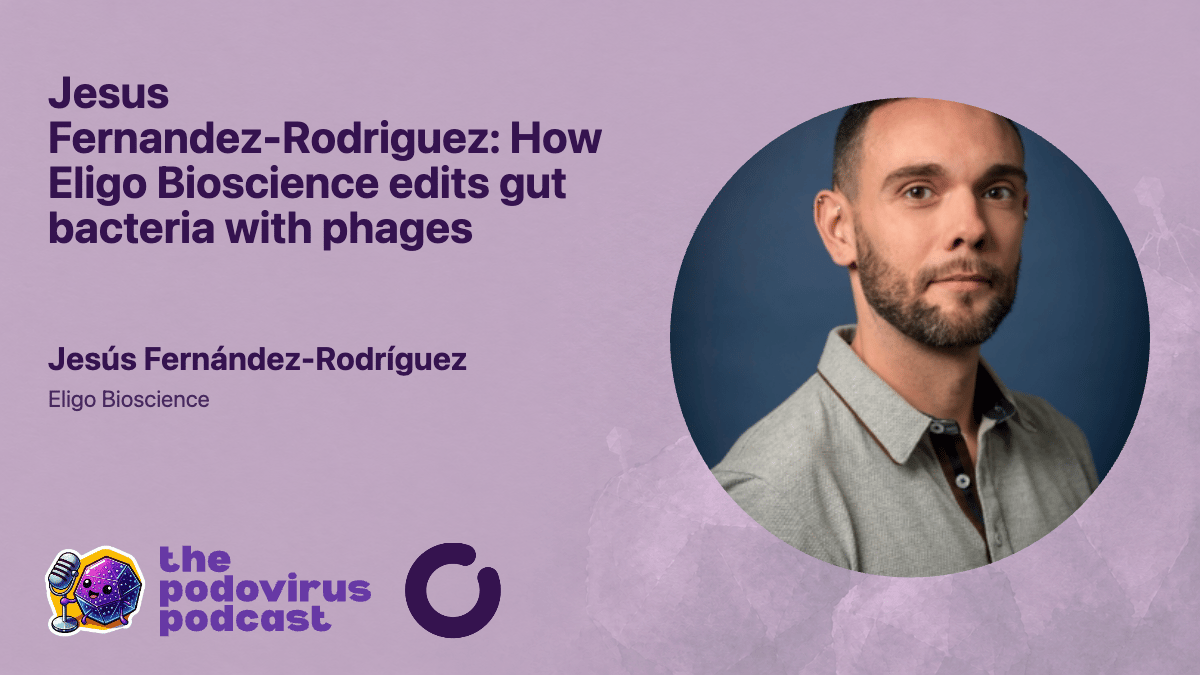
Jesus Fernandez-Rodriguez: How Eligo Bioscience edits gut bacteria with phages
The conversation
Episode notes
Synthetic biologist Jesús Fernández-Rodríguez joins Jessica Sacher to explain how Eligo Bioscience uses engineered phage particles to change bacterial genes inside the gut. Drawing on mouse experiments, he explains what makes delivery work and how editing bacteria in their natural environment could help researchers test which genes contribute to disease.
Fernández-Rodríguez explains that cutting bacterial DNA with Cas9 usually kills the cell, while base editors can change individual DNA letters without killing the bacterium.
He discusses why the team cares about how long the editing material remains present after delivery, and what the mouse experiments can tell us.
Identifying disease causing bacterial genes remains difficult, and Fernández-Rodríguez proposes editing suspected genes in place to test their effects while keeping the bacteria alive.
Episode timeline
- 0:00 Introduction to Eligo and gut bacterial gene editing
- 5:56 Finding bacterial genes worth targeting
- 11:24 Base editing and the challenges of delivery
- 27:09 Acne trial plans and the limits of microbiome disease links
- 36:13 How long editing material persists
- 46:19 Brain disease uncertainty, multiple targets and bacterial growth
Learn more
Studies
Guests and background
Transcript
AI-transcribed and edited for readability. May contain errors or omissions; check the recording for exact wording.
Select a word or timestamp to listen. Use arrow keys to move between words.
- Jessica Sacher
Welcome back to the Podovirus Podcast. This is Jessica. This is the third episode. I’m really excited that you're back listening. This interview that I'm gonna share with you today is with Jesús Fernández of Eligo Bioscience. They're a biotech company in Paris, France. I've been following them for several years now. They've been working on using modified phages to target bacteria, especially with the microbiome in mind.
And they've just published a new paper in Nature on in situ targeted base editing of bacteria in the mouse gut. So this came out July 10th of this year. And so what they show in this paper is that they can actually modify E. coli and Klebsiella in the mouse gut. And they do base editing, which is different from CRISPR, so with base editing, you are just modifying one nucleotide at a time without cutting the DNA, you're just editing it out.
And so, as we'll find out, that's crucial for microbiome editing, because with CRISPR you're gonna kill the bacteria, when you try to edit. And so we talk about the history of Eligo, what they're up to, what they think their technology could be used for now that they've gotten it working so well, and things like cancer and Alzheimer's.
It's kind of a shift in thinking from phage therapy, which I think about a lot, to actually using phage-based technologies to fix other diseases. So things that aren’t necessarily infectious and aren’t considered infectious diseases. But they involve a bacterium or a bacterial gene that is made in the body that has some impact, and that can lead to some disease.
So it was really great to talk to Jesus and just probe him with all my questions about where we're at with the microbiome, with editing genes, the different technologies. Like it's not just CRISPR anymore, and all the ways that we could be sort of using what we know about phages to have impacts on a lot of different diseases. With that, here is the conversation with Jesus.
All right, so hi, welcome. I feel like Eligo has been just a company that I've been having my eye on ever since we started Phage Directory in 2017. I don't remember when exactly it started, but it was in the early days of me getting into this space. And Xavier was always kind of at the phage conferences. And I've just always been rooting for you guys and meeting your scientists.
And it seemed like you had a really cool mission. And a all of us in the phage space, I feel, are hoping for successes so the whole field can be lifted. And definitely looking at using phages to edit the microbiome, I don't know, I guess I wanna know if that was always your focus, or was it more antimicrobial? But also like, how it led to where you are now.
- Jesus Fernandez-Rodriguez
Yeah, no, so you're very right. So, Eligo, so I started Eligo almost eight years ago, oh, more than eight years ago now. We started Eligo started as an antimicrobial company. So it was, you know, David Picard, one of the co founders of Eligo, you know, worked with Xavier. And then he got this paper out where he could, like, use CRISPR, delivered through a phage that would, kill bacteria through a sequence specific killing, right?
So that was the start of Eligo. So, we had a lot of success doing that, actually had Eligo using, modified phages to deliver a payload that contains CRISPR. So it's actually, it's important to know that what we do at Eligo is not a phage, it's not really directly a phage, it's not, so it's based on the classical cosmid technology 2.0, let's say.
So we apply all these synthetic biology techniques that we know today to build particles that are really good at, delivering. And with circuits that have been engineered to do exactly what we want to do. So we started using CRISPR, sequence specific, antimicrobials, we had several programs, on that. And then we realized, you know, with all the CRISPR technology booming in the last years, we realized that actually our technology was great.
It was a way of modifying the microbiome with specific killing in mind, without disturbing the rest of the bacteria that live in, for example, the gut or the skin. But also to make them express things. We can modify the phagemids and the Eligobiotics to contain payloads that are going to be expressed by the target bacteria, or, as we show in the paper, to modify genes in situ without making really large disruptions in the microbiome.
Like no antibiotic treatment, no replacement, so directly in the complex environment of the natural microbiome. And so that was a little bit the history of Eligo, how we moved to one thing to the other, you know? And we have several programs that really touch upon these three aspects of the technology, which is base editing or something in situ.
Killing bacteria, sequence, sequence specific killing of bacteria in their native environments, and modifying the bacteria so they express something also in their in their native environment.
- Jessica Sacher
Okay, awesome, so you edit and then you kill, or you modify.
- Jesus Fernandez-Rodriguez
Yeah,
- Jessica Sacher
if you could think of it like that, okay, I guess what I wanna dive into. And I've always wondered this about anything to do with microbiome therapeutics, if you call them that, is to what extent is it known? For? For all the things that ail us diseases across the board, how much is it a bottleneck? Deciding what to target versus targeting it.
- Jesus Fernandez-Rodriguez
Yeah, so that that's a really good question. So, you know, and that's actually the difference between. So, whenever I talk about what we do at Eligo, people, CRISPR killing or editing base editing, you know, people really have human, genes in mind, so there's, oh, there's a human gene. People know. We know a lot about these mutations that cause diseases in humans, and the thing is that this is kind of a paradigm shift.
It's not just having a human with a patient with a mutation in a gene that you can edit. We have realized, like the last years, that also the micro, the genes that exist in the microbiome are very, very important for human diseases. Is exactly what Elio is trying to do bring this technology to patients, by touching upon the genes that exist in the mic in the microbiome.
So there's not a lot of specific targets known yet for bacterial genes. So, we know bacteria cause, diseases could be degenerative diseases, it could be cancer. They could affect, for example, a treatment a patient is following, like an anticancer treatment. Bacteria can modify that molecule and make it inactive, they can sequester it. So they can really do, a lot of things that affect the health of patients.
But it's hard to pinpoint exactly which bacteria, are doing that, and what's a gene that is causing that? And I think, so there's a lot of people working on this right now. And I think the technology that we show in the paper, provides a really, really great way of interrogating specific gene functions in a natural environment. So, for example, you say, okay, I think, or we have, some idea, or somebody, you know, we're collaborating with somebody.
And we think this bacteria might have a gene that does Xyz, or has an impact in the patient. So we can really go there, modify that gene, inactivate it without killing the bug, and see if it that has an effect, in the disease, for example, you know? So I think it's a really great way of interrogating, having this kind of correlation between a gene and an impact in disease.
So I think, there's gonna be a shift in the way we do things, and I think that's what exactly that's exactly what we need. Finding these specific targets,
- Jessica Sacher
Yeah, that's so interesting, cause, yeah, it just seems like, I mean, I'm wondering, has it been not known? Like, do we not know targets? Because there haven't been the technologies to probe them and to interrogate them? That's maybe what you guys are saying,
- Jesus Fernandez-Rodriguez
Exactly, that's one of the reasons. You know, you can do things in vitro and you can say, oh, you know, I could. I put this bacterium together with these, cells, you know, and something happens. That's never gonna be a real disease setup, for example, in an animal model, when you have a disease model. Some bacteria cannot be cultivated in vitro, so you might not be able to really do that directly because they need to be part of a consortium.
Or, you know, it's really just not possible to cultivate them. So, at the end, having this technology that allows it to do something in the natural environment, to me, is the key to really find, specific targets that we can go after.
- Jessica Sacher
Yeah, and like touching on what you said about uncultured organisms. And just like all the bugs that we barely know anything about. Because they don't play well in the lab or in animal models. How, yeah, like, can you use your technology equivalently on those kind of targets, or is it gonna be the same problem? How do you think about that?
- Jesus Fernandez-Rodriguez
Yeah, so that's a good question. So actually, we talk about that, in the paper, and while we focus on enterobacteria here, I think one of the most import important aspects of what we do is that. You don't need to have a specific vehicle, specific elite biotic is how we call it particle, so you can program to target just E. coli. We show, yeah, we can jump the species barrier as long as they are relatively close.
For example, we jump from E. coli to Klebsiella, we can edit Klebsiella using a lambda based particle. You know, by changing some, some of the receptor binding terminants. So, yes, different targets will need, will most probably need, different vehicles to be developed, different, you know, an understanding of what we need to bind to make them deliver well to what, what we need.
And that's part of the process, you know? But I think the what we show here is the first step in that race. And that will let us really will lead us to really bring this technology to the clinic. Which I think, is is, it would be great to have somebody, treated with this kind of technology and cure a disease, right?
This is what we are after. So,
- Jessica Sacher
Yeah, it's ex exactly, I wanna talk about, like, how do you distinguish? For someone who's not in the CRISPR space, gene editing space is more of a phage biologist. You know, base editing versus CRISPR, like, how do we think about the different technologies and the types of ways you're gonna edit something?
- Jesus Fernandez-Rodriguez
Yeah, so that's a good question. And I go back to what I said before about, the image that people have, about CRISPR on eukaryotic cells, so human cells and bacteria. So I think the main difference here is when you express CRISPR in a human cell, CRISPR will Cas9 nuclease, you know, will cleave the genome. And the repair mechanism of the cells, the human cells in this case, will repair that, and the cell would not die, will stay alive and will have a modification.
Well, the vast majority of bacteria don't have this kind of repair mechanism. So if you cleave the genome of a bacterium, it will start degrading its own genome and die. That's the basic, basic difference, okay? So that's why people use CRISPR, Cas9 as an editing tool for human cells, while you don't really edit bacteria this way. You can, but the efficiency is very low because most of them will die.
So that's why, some specific mutations, for example, you can only do really, really specifically. You want to change this a to a g. You know, this is what we show in the paper. They needed more specific tools, and that's exactly what we are applying bacteria. Just because a nuclease will kill them, while a base editor will modify the gene without killing them.
- Jessica Sacher
That's, so fascinating. I never realized that distinction. So do people just as a side question, do people use base editing in human editing projects, or do they need to if they have the repair mechanism?
- Jesus Fernandez-Rodriguez
Yeah, you can use, it depends on what your target is and what you need to do. You know, for some specific, targets diseases, you know, or, you know, modifications that you need in the lab. Just work with something. You might just want to have a one base pair mutation or something more or less complex insertions for these kind of more complicated things, or more specific things.
If you really, really want to have something specifically inserted or changed, then you go for these base editing tools. That I'm, that we use in the paper, like site specific base editors, adenine base editors, prime editors, transposon based, you know, technologies. Because that allow allows you to have a deeper control, on what you want to do and exactly what kind of modifications you want to insert.
- Jessica Sacher
So can you use something? How do you do things like add a whole gene or delete a whole gene? Like with base editing in bacteria, you just kind of mutate the stop codon or something, or do you have more leeway there?
- Jesus Fernandez-Rodriguez
Yeah, so again, th these really depends on the mutations. So, for example, in the paper we introduce, so we break the start codon of a gene, but we don't really insert anything there, we just change the a tg to a to a. I forgot now, is, I think it'sag, you know? So I think we made this modification, so there's no start codon, so there's no protein being made.
But that only requires one, the change of one base, one one base, so that's really not any insertion going on there to do, something, like, like you were saying, inserting a gene. And that's where I'm going, like to more, complex, or, let's say, fancier base editing, sorry, or gene editing. Then you rely on new technologies, or, you know, technologies that are different to the base editors that we use here, like a prime editor, a prime editor will let you insert, short fragments of DNA into the target, site of the genome.
For example, you, put them together with a deca decas9 or a ncas9. And it will go to the specific genome region and insert. I think there, yeah, transposon based methods to, they allow you to insert stuff into the genome, you know? So this technology exists. It's new, people are developing that now, and I have no doubts that, they will become this.
This kind of tools will become really, really important for therapy, in the coming years.
- Jessica Sacher
Okay, so there's a bunch of tools. Some of them play well with bacteria, where they're not gonna cleave the DNA and cause the whole cell to die. Some of them don't. But and you guys have been focusing on this base editing to make pinpoint changes and to make it is. Is the reason that cause? I noticed in your paper that it's very high effectiveness, like Hun, close to 100 effective on the population.
Is that mostly, do you think, attributable to the lack of the death of the cells because of the base editing, or more than that?
- Jesus Fernandez-Rodriguez
Yeah, so there's more than that there, and I think, we also talk about this in the paper. I think, to me, one of the key aspects of what we do at Eligo. Let's say that there are two ways of doing this. Whenever you want to target a bacterium, you know, you have a new bug. And then then, so, okay, I'm gonna use a phage to deliver.
SOM I'm gonna develop. In this case, it's a Cosmid, it's a Cosmid based, so it's an elite biotic. It's like a Cosmid. Let's let's talk in this is just sandwich for sake of clarity. And you can go for really fancy phages that do a lot of things, you know, but you don't really understand, or you can go for a phage that you know a lot about.
In this case was lambda, which is really a tame phage, you can really. You cannot really infect a lot of wild type E. coli strains with lambda, it will just not do much. But the good thing about this is that you really understand what lambda does. Because there's so much literature on this phage, there's been so many things done with this phage that really understand what you need to touch.
The first things, the first thing we saw is like, okay, people use lambda. It works fine with wild type strains, sorry, with lab E coli strains. But, it uses a receptor that is down regulated or mutated in gut. So the first thing we did is okay. Let's try to find a receptor, let's try to make lambda bind something that the cells cannot lose in the gut.
In this case, we modified that to recognize OmpC, for example, and also the famous tail fibers, or the or the tail spikes that people talk about in phages. Lambda also has them, the wild type lambda list, so we modify them to be very, very strong binders to the target strain. And by changing these two receptor binding domains in the phage capsid, we could really have binding curves that were really, really accurate.
We could select variants of this, of this oligobiotics that would really bind strongly to one thing and not to the other. We could make lambda degrade. Capsules of Klebsiella of other, pathogenic E. coli, just by changing and understanding what you want to target. So, going back to your question, I think I started talking a lot about it. I think it's really, really important to understand what you have in your hands.
So you can engineer this to make it a really good binder. So for me, reaching that hundred percent was really a lot about engineering the phage particle to make a really good oligobiotic. That would really recognize a strain with high affinity, even in the crowded or complex conditions. That, that in this case, they got, that the mouse got.
- Jessica Sacher
Got it? Yeah, and does lambda? Is that sufficient? Is it sufficient to only have the right receptor binding protein? And then the rest of the injection of the DNA is gonna happen, and you don't have any more host range determinants.
- Jesus Fernandez-Rodriguez
So that's a good question. We have only investigated these two, variants, from what I've shown in the paper and also other projects. You know, this is necessary and sufficient to achieve high transaction, efficiencies, which is exactly what you need if you're gonna have a therapy. You know, something that is really good at what it does. I'm not saying there's something else out there.
Right now there's a lot of anti phage mechanisms coming up. You know, people are really taking a deep look, to that. But you really have to go back to what an oligobiotic is. It's not a phage, and most like a lot of the anti phage mechanisms that you can find out there in bacteria. Will somehow attack the replication of the phage, or, you know, the way it assembles the you know, once the new variants have been made, or the, you know, arrest after something starts getting transcribed.
But in our case, the capsid is a syringe, so it's the payload that is designed, and with the payload we can do a lot of things, you know, so you can really modify to bypass all these mechanisms. There are things that exist out there, there are phages that block receptor binding, proteins, you know, like they block them, so the phage doesn't see them.
But since this is an engineered particle, you can go back to them and bypass this. This injection, and this in this injection blockers, too, like they block the tail tube that goes through the periplasm, for example. There's phages like HK97 and some others that do have more genes that do that injection. Again, you can modify these things. So I think, it's all about going back to what I said at the beginning, and I'm repeating this.
Really. Understanding what you have in your hands so that you can really modify it to be good or to do the best at what it does, you know, I think for me, that's really the key aspect of what we do at Elio.
- Jessica Sacher
Yeah, yeah, what? Back to the paper when you guys were, you know, trying to get it published, was what was the hardest part about that process? Like, was there something that reviewers made you take an extra year to do, or what was the like, the final nail in it that you guys had to do?
- Jesus Fernandez-Rodriguez
Yeah, I think, you know, required, obviously, like, you know, it's a. It's a big paper, there's a lot of data in there, so gathering all this data, you know, having, all the controls, everything that we needed to show, you know, it's. It was hard, I'm not gonna lie, it was an effort, but we really, really wanted to have this, this, you know, out.
Show people what we do, show people that this is possible, show people that this, is a therapy. There is really, you know, it's something that looks like a really promising therapy, and we should really push towards that. So there was nothing specifically hard about publishing process, it was the whole thing, you know, putting it all together, you know, having in mind that we also, you know, we are, we're a company, so we develop drugs, you know, so we need to also find time to sit down, get all the team members that, you know, working on different things and say, okay, let's sit down.
We need you to put this graph together, we need to dig into this experiment, can you put this data together? And we realized, maybe, you know, oh, we're missing this control, so we have to redo it, you know? So it was more about finding all that, time to put it together. But, we were really passionate about doing this, and actually, we were really pushing hard to have this together.
So, I think at the end it paid out and it paid off, and, it was really, really great.
- Jessica Sacher
Yeah, how do you? Oh good, yeah. How do you think about, as a company, the value of publishing? Like, what's the goal that you hope to achieve with publishing it? It as a paper? Is it to attract scientists to your team, or to kind of let people know how exciting the technology is at?
- Jesus Fernandez-Rodriguez
Sure, I think you really touched the two most important points. So I think the first one is really to make people aware that these exist again. You know, when you talk about gene editing, people think about human genes. I think it's important that we realize that there's a paradigm shift happening right now. It's not just the human genes, it's the genes of the other things that live with you, in this case, it's a bacterium.
That are really important for human health, and I think it's, it's. It's important that people really understand that. That it's also possible to modify or to touch, do things to these genes, inactivate them, add things to the bacteria that, you know, cause a disease. In the complex environment, I think that was one of the big questions, when we were developing our drugs, it's like, yeah, but you guys have to use, you know, an antibiotic, mouse models, mice that don't have any, any bacteria in their gut.
It's like, no, we really use, you know, mice. We have to treat them with some antibiotic before so that we can put the bacterium in, but then, you know. We run a 16S analysis and it's full of other species in there, so it's really not an easy environment. So I think that was the first thing really make people aware that this is possible and we should all push to get there.
And the second thing, as you say, like, you know, when somebody shows excellence, about what they do, may it can be in a company, can be a lab, can be a university. I think that also really attracts talent, and that's really important, also for us. Obviously, we want to work with the best, you know, out there, and I think it was a good way of making ourselves, you know, like, Hey guys, we're here, look at what we're doing, and this is our vision, and this is what we need.
Want to bring forward to the clinic. And if anybody's interested, please write to us. Yeah,
- Jessica Sacher
Yeah, yeah, that's awesome. I hope that you get, an onslaught of people, to come hang out with you in Paris. That's where you still are, right? Are you kind of close to the Institute Pasteur, or do you still work really closely with them?
- Jesus Fernandez-Rodriguez
Yes, actually, our co founder, David Picard, it's, he's PI at Institut Pasteur. So, you know, we still work closely with him. He has a lot of experience in phage, biology, obviously, still working with phages, you know, he was developing the first, you know, CRISPR based antimicrobials, encapsulating phage, to kill, to s, to make, to have sequence specific killing of bacteria.
So we still work together, we collaborate with David, and physically, we're not in the same space. We started there, when, you know, eight years ago, when I joined, we had a little lab there at Pasteur, and then we moved to. I mean, you can see it's a very fancy office here in Paris, it's really, really cool, it's in Paris center, it's a great place to work.
I recommend everybody come visit us.
- Jessica Sacher
We visited a few years back. I forget which year, but we met with Dr. Bikard and talked about what you guys were up to. It would've been probably 2018 or something, so everything has happened since.
- Jesus Fernandez-Rodriguez
We've moved a long way from there. We became really good at what we do, and it makes me proud to say this. I just can't wait to bring this forward even more and have therapy out there.
- Jessica Sacher
Let's talk about the clinic and what the timelines would look like. Like, do you guys have plans to start doing clinical trials with this, or do you have a target in mind? What's the timeline for that?
- Jesus Fernandez-Rodriguez
Yeah, so we do have, a program that is gonna move to the clinic soon. It's actually, this is actually a CRISPR killing, it's not a base editing. This is for treating, acne vulgaris. It's actually a program to target specifically, Cutibacterium acnes strains that are involved in the inflammation, so the what you call acne, while leaving the nonpathogenic C. acnes strains intact.
So I think that's really, really important, because the therapies today, are the same as when you take an antibiotic, it basically kill everything, and that causes dysbiosis, and it's really not good. In the case of acne, it's really no, no different. So we are really excited and we really hope that this therapy would help a lot of people that have, this inflammatory disease.
We do have some other, projects, I cannot disclose here about, but it with they really involve, base editing in this case, to inactivate some genes. There are several targets that we're thinking about, you know, that really have human, relevance in terms of human diseases. So these are really a lot of exciting things that we're thinking about, cancer, too, you know?
So there's a lot of programs that we can apply, our technology to, and we go back to what I was saying before. It really highlights the importance of bacterial genes in human disease. And I think, again, that's for me, that's a take home message. Is these bugs have genes that do things to you that we might have not have been aware of before. So I think that's that, that's the new way of thinking.
Let's say, yeah,
- Jessica Sacher
Yeah, I wanna talk about that and like, how we. I feel like there's been microbiome hype, and there's probably we're pro in some stage of the hype cycle. That's not the highest point anymore, but probably it's, you know, still moving forward. And like, very solid. But we don't hear as much about, you know, oh, the microbiome, as much as I feel like we used to.
But I also think there's more talk about the gut brain access. And maybe all these diseases that aren't just infectious diseases or gut diseases are related to the gut microbiota. But I just haven't heard anything recently. So I guess, where are we at in terms of that? And like, what's known? Like, are the cancer people saying this bug is, if only we could get rid of this one, we would, our cancer drugs would work.
And are the Alzheimer's people saying the same? Or are you guys kind of connecting with those communities when you pick your targets?
- Jesus Fernandez-Rodriguez
exactly, no, that's a good question. I go back to what I was talking about before. It's. There's a lot of things happening now, there's a lot of people working on this. It's very hard to pinpoint exactly what bug is doing what. So you say, yeah, there's a gut brain axis, for example, you know, or there's, immune disease, you know, like, we know it must be something in the gut or in the skin, or in whatever other microbiome you can think about.
But it's very, very hard to really figure out what you, what is causing that, you see. So to me, that causation, like, really, that's right, that correlation, and say like, correlation, causation, say like, this is the gene that I need to touch, and that's gonna have this effect. That is what we're still trying to understand now. And most of the studies that are happening right now, really go for this kind of microbiome 16S analysis.
And say, you know, this is the family that seems to be upregulated in these patients versus in these others, you know, so, but we still cannot really attack or modify or change that these biases, if we want to talk about this in these terms. So I think we need to really change the, you know, it's not just a microbiome therapy, so what we're trying to do at Eligo is a microbiome gene therapy, which it's really different, you see, so the microbiome is still there.
A lot of people, I'm sure you're gonna be hearing a lot about this, soon, because it's really something that is, it's becoming really, really important. So, yeah,
- Jessica Sacher
Okay, so the hype is not burst, there's still microbiome hype.
- Jesus Fernandez-Rodriguez
There's still microbiome, and I think there's gonna be microbiome for a while. Yeah,
- Jessica Sacher
Yeah, that’s what got me into microbiology. I think it was in an undergrad class that I learned that you could transplant the microbiome from obese mice into a thin mouse and make that mouse obese. That hooked me on microbes for life, basically.
That was 2008, maybe.
- Jesus Fernandez-Rodriguez
There are a lot of these fecal matter transplants, and it's true, you know, it's therapy. People are doing that, you know, like, you can really do that. The thing is, we may not necessarily understand exactly how that works. We know this composition of this microbiome composition does this, and we just apply it, but we don't really know why.
So it might be okay for some cases, but for most of the cases, you can't really know what other genes in this fecal matter transplant, for example, you're putting into the patient. That in the future may have an effect that you don't really understand, you see, so I think it's, that's the difference.
- Jessica Sacher
So are you guys thinking of as a company? Like, how much of the company's focus will be on kind of pushing this technology toward? Like using it to interrogate versus using it to treat, like fifty, fifty, or how do you think about that?
- Jesus Fernandez-Rodriguez
So, for sure, we want to bring this to the clinic. You know, like this is again, I think this is our vision, I think, so Eligo really wants to bring this technology forward and treat a person, a human, a patient that has a health issue and hopefully cure this health issue. So that's their number one goal. Now we, as we develop our technology, this is exactly what we talk about in the paper.
We know we can apply this technology for something else. That is not just applying it to a target, but to find that target. And for this, you know, we have collaboration, with some people, you know, trying to figure out how we could exactly apply this technology to pinpoint what I was talking about. Exactly what bugs, that, what bug does what, or what gene within this bug does what?
You see, so I cannot give you a percentage, what? But the most important thing is really bringing this technology to the clinic and then apply to something else so we can keep on bringing things to the clinic. I think that's the that's it, that, that's the bottom line. Yeah,
- Jessica Sacher
Yeah, one is upstream of the other.
- Jesus Fernandez-Rodriguez
Exactly,
- Jessica Sacher
So do you have a target in mind for what you'll go for on the base editing side? Next, or are you allowed to say?
- Jesus Fernandez-Rodriguez
Yeah, so we do have one target. It's a really exciting target. I can really talk about that. I'm sorry, so I cannot really disclose. We're working hard on that, we are applying this technology to this, we're having a success. So, you know, I think it's great. It's good to see that we move for some from something that, you know, in the paper.
It's not really. It's a proof of concept. It touches some really important genes, for example, we modify coli bacterial, genes, you know, that are causing, that are known to be involved in colorectal, cancer. So, you know, it's not that we're just touching, you know, toy genes. We, I really don't like this kind of term, you know, but it's not, only that we also do this with pathogenic, bacteria.
So we do have some exciting target, for base editing going on. And, I hope you will hear from us very soon, and, we will let you know that, you know, we're really successful in applying this technology. There.
- Jessica Sacher
Yeah, oh yes, well, we'll be keeping tabs. I have some more questions on the science. I think our AU audience is probably gonna be the phage directory audience for the time being, and they're mostly phage scientists. But
- Jesus Fernandez-Rodriguez
Just just dis disclaimer here. I'm not a phage scientist, okay, so I'm not a phage scientist. I'm a synthetic—well, I'm a biochemist, structural biologist, and then synthetic biologist, and then I move to applying all these things to phages. Okay, so I'll do my best.
- Jessica Sacher
Perfect, I guess I... One thing that just stood out in the paper is the use of the PICI, or, however you pronounce that, the okay, and I know we have some picky phage scientists in the audience. And how did you come to use? Like, I think there's like two different plasmids that you have to work with, and one is take has is inducible by some agent, and then whatever product of that plasmid is inducing the next.
How? Why do you need to use this complex two plasmid system, and how did you come to use PICI?
- Jesus Fernandez-Rodriguez
Yeah, so this I can answer, so that's great because it's, really an a, an engineering, question. So I'm really happy answering that. So, you know, one of the I'm gonna start from the end, okay, so the end is you're gonna treat somebody with this case, it's a gene therapy, you know? Like something that's gonna modify bacteria, in the mouse, well, in somebody's mouse, you know, but it's gonna modify the genes in the mouse gut.
And what happens after? You know, it's a plasmid that replicates, stays there, you know, it can be shed, you know. So that is something that, in a clinical, setup, may not be that desirable. So something that you might want to stay away from. I'm not saying it's a no go, but you know, it's something that if you want to, you would, if you cannot, can kind of avoid it, like you would do that.
Okay, so that was the initial question, why, we developed this then, so we needed to find a system that allowed you to have something that replicates in the pronox in the strain that makes the oligobiotics, but not in the strain that receives the oligobiotics. Okay, so I think, for me, the choice of PICI, the specific, this specific PICI, was because it was shown to work with lambdaid phages.
Okay, so the SaPIs, the PICIs, the satellite phages, you know, things that really kind of hijack the machinery of other phages. And when I saw that this specific PICI was working with lambdaid, you know, in this case, as a, that's great because I know the way this PICI replicates. Lambda is gonna like it, because, you know, it's kind of the natural pair, and I think for me, that was the really, really important thing.
Now, PICI has two basic elements for replication. It's a primase protein, and then it has an origin of replication that is short DNA fragment right after it. So we said, Okay, can we make a split system? Normally, the PICI? What it does is it excises like a prophage, and then replicates, and you have the you have the primase and the origin of replication right after this.
So it's a system in cis, so it will replicate itself. So we decided to try it in trans and see if that works. And, so, we have one plasmid that contains an inducible primase and a second plasmid that contains a payload that's gonna be packaged into the lambda particles. That contains the primase, origin, the PICI origin of replication, the short fragment.
And that worked, beautifully. So we could see that, you know, the strains that contain both plasmids replicate nicely. There was no problem, lambda packaged that and create titers really compatible with lambda, so that was great. And whenever you injected that thing into a target strain, you will get a peak of expression, like a normal plasmid. I think it's about 2 h, what was shown in the paper, and then it will be lost.
With cell division really fast, because there's no way it's not able to replicate. And importantly, these 2 h of expression, in the target strain, really let, the CRISPR system, in this case, the base editor, to be expressed and do its job. So for me, it was like a really jackpot for everything, you know? So that, you could find a PICI that was compatible with this phage, that you could make it work in trans, and you could make it work even in the absence of replication in the target strain.
- Jessica Sacher
Okay, yeah, I love it. So could any sort of like two plasmid system with an inducible sort of, I don't know, waterfall effect, could any sort of setup have worked, or is the PICI particularly useful in some way?
- Jesus Fernandez-Rodriguez
I think, you know, that's a good question, and I can't really give you like a hundred answer because I don't have more examples about this PICI biology. So, and that's what I was telling you, it was, you know, like we saw that, and then we said it looks really, really interesting. And I think we should really go for this, for this kind of PICI that, is compatible with lambdaids.
We have a lambda based oligobiotic particle. So, you know, let's go for that, and it works. So I cannot really tell you if using some other PICIs would have worked or not. I suspect, you know, some different phages package stuff in different ways, or they, you know, they can package in different ways. They can have like a cos, a pack, you know, or a long terminal repeats, for example.
So I think that may affect, the way the replication of that plasmid may, that may affect the way the conformation that enters in the capsid. So, you know, this is more a hypothesis. So I cannot really give you an answer, but I suspect, you know, not everything will work everywhere.
- Jessica Sacher
Yeah, and just for the audience, what is a PICI in nature? It's a phage induced chromosomal island that I that I know, but what does it do, or what do we know about those?
- Jesus Fernandez-Rodriguez
Yeah, so PICIs, you know, like talking about PICIs, that's what I said before. So there's PICIs, there's tapies in some other bacteria, there's phage satellites, you know, that like, like two tapies. So what these guys do is to they sense that a prophage phage, you know, is being induced in the bacterium, so, for example, the prophage is resident, they sense that it's being induced, and then they induce themselves.
So they excise themselves. They really behave like phages. There are different ways of mechanisms of action of this, of these things. But the one we use, for example, what it does is to re recognize, or, you know, know, that the phage has been induced. And then hijack, block the terminase of the phage, and then modify it in a way that now the whole phage particle will package the PICI instead of the phage.
You know, so it really hijacks the phage machinery to, you know, to package themselves. And then what you have, it's a natural cosmid, let's say, you see, because it contains a cos site, you know? So they package themselves into something that looks like the prophage, the, you know, the phage capsid. What is the right word? You know that that was excised from the bacteria, but inside it contains a PICI genome.
So they can jump to other bacteria by doing that, you see, so they really hijack the prophage.
- Jessica Sacher
Okay, so when you make your eligo, what are they called oligobiotics?
- Jesus Fernandez-Rodriguez
oligobiotic, Yes, it's an oligobiotic. Yeah,
- Jessica Sacher
Okay, is it right to think of it? Like, when you actually make them, you have to have a lambda phage first and a bacterial strain that has these two plasmids. And then,
- Jesus Fernandez-Rodriguez
Exactly, so, yeah, so what? What you have is, it's a strain. That's such a good point, because it's also a question that I normally get, I always forget about, explaining this. So we work with prophages, okay, so we don't work with infection. Working with prophages from the engineering point of view is much better because they're stable. You can carry them in the bacteria, you have them in, you can induce them, you can modify them easily.
100, you know, so it's really, really nice to work with prophages from my engineering perspective. Now, I'm sure people in the audience will say, Ah, yeah, but you know, but from the engineering perspective, and from what I'm working on, I think that's, is the best system. So what we start with is in this case, it's an E. coli strain that contains lambda prophage modified or not with the receptor binding proteins, and then two plasmids.
One contains the primase that allows replication of the payload, whatever is going to be inserted into the lambda capsid, you see, so it's a three, it's like a three, three element system, you see, so, but there's no PICI in there, there's just the primase and the origin of replication of the PICI.
- Jessica Sacher
Okay, so the PICI doesn't have to in the production, in your production, it doesn't have to actually sense a phage. That aspect of it is not part of the system.
- Jesus Fernandez-Rodriguez
There's absolutely no PICI in the strain, it's just the primase and the origin of replication. They are now in trans, so we separated them physically. See,
- Jessica Sacher
Yeah, oh so clever. Is that what genome engine or synthetic biology feels like? Is just a bunch of rigging?
- Jesus Fernandez-Rodriguez
isn't that cool? Yeah, that's why I went to synthetic biology. Yeah, that's great. Like, I really, we do a lot of these things. And sometimes you see, like, when you go to a synthetic biology conference, it's crazy. You see these names that people, build, so they're really, really cool. So
- Jessica Sacher
Yeah, no, sometimes my research has, like, started overlapping with that kind of stuff, and it's like, Oh, this is like, feels like being a kid
- Jesus Fernandez-Rodriguez
Yeah, it's literally like Le Lego building, you see, sometimes it's really cool.
- Jessica Sacher
And you have nature to pull from. And
- Jesus Fernandez-Rodriguez
Yeah, exactly,
- Jessica Sacher
Just sometimes it works.
- Jesus Fernandez-Rodriguez
Yeah,
- Jessica Sacher
Yeah, okay, I'm just looking through my question list, cause I know we're getting to the end. But I kind of did some crowdsourcing of questions from some of my phage microbiome friends. But I wanna make sure we hit on some of those questions to wrap up. So, one of them. So we kinda talked about the brain gut and the diseases that aren't infectious, and I got, I got your.
I got a sense that it's definitely of interest, and that's like, definitely the future is like getting to these other diseases. So maybe we talked about that. Is it like, are I know you can't talk about the targets themselves, but like, are there targets that are? Just? People are just waiting to be have the technology to actually drug? Like in the s, in the, you know, on the brain side, like, is there something, some bug that we know that is impacting the brain?
And we know which gene is the problem? And it's just like, the next step is your technology.
- Jesus Fernandez-Rodriguez
Yeah. So exactly for the brain, I cannot really tell you. I mean, there's some kind of, you know, peoples and some papers say, yeah, there's, you know, degenerative diseases. And that's why when, if I, curly eat the paper, you know. But again, this is more like a yeah, we know maybe something is going on, but we're not entirely sure. There's, we know that they, some bugs, modify and produce serotonin precursors, and they do things to your brain, in the gut, you know, and we're just starting to understand that.
But I can't. I don't really. I don't really think we know if exactly, you know, this bug makes this and that's a driver of this disease in the brain, you know, so that I can think of, so maybe I'm wrong and there's something out there, and you know, but yeah,
- Jessica Sacher
Someone can email us and say, Hey, target this.
- Jesus Fernandez-Rodriguez
Sure, I mean, you know, I think, yeah,
- Jessica Sacher
Oh, what was I gonna say? I think, I just is there an atlas somewhere, or what's like, a good? Is there a good data set that is kind of starting to catalog? You know, all the different microbes that we know live in our body, their genes, and like, matching those to disease or health states, like, is anyone kind of curating that kind of information?
- Jesus Fernandez-Rodriguez
Wow, that's a huge mission. It's like, you know, it's like, imagine, like, you know, you're. It's the same as for humans, you know, like, you know, sometimes, you know, you have a disease and it's okay, go go, figure out what gene is doing what you see. And in this case, you know, the microbiome, different people living in different places, eating different food, having different, you know, cultural, I don't know, like, it's the climate, it's really, really crazy.
So the pan genome of the microbiome, the human microbiome, is massive, is huge, you know? So I don't think that's gonna be easy. I think we'll get there, but we need to have technologies like what Eligo is doing. To try to start interrogating this and say, okay, now I do have a target. I know what I need to touch. But because otherwise it's really a lot of, a lot of things.
And you might have, you know again, like families, or maybe species that tells you, yeah, maybe this bug is, you know, this family is related to this. We've seen patients that have more of that, you know, by going down to the gene, especially for a bacteria, that sometimes, like, sometimes, not always. It's not just one species, you have species and then strains. Because if you talk about E.
coli, yeah, it's E. coli, but then you have the lab strains, all the enteropathogenic strains. Like, you know, you have a really different strains of e. coli, they're behave really differently, have different genomes. So, you know, it's not that straightforward.
- Jessica Sacher
No, and there's, and you know, yeah, we don't even know which bug is responsible, let alone which gene, let alone which, you know. Even to engineer, you have to be able to target. You have to know something about the receptor binding protein that would be the key to that microbe. Yeah,
- Jesus Fernandez-Rodriguez
I think that that second aspect, it's it. I would say it's easier to understand what a phage binds to in. You know, I'm talking very in with in very general terms, okay, than trying to figure out what, what, the gene, you know, what bacterial gene is causing a disease. You know, if you start, if you know that it's a bacterium causing something, or really, you know, you're really sure, finding out this gene is not that straightforward.
And that's because the technology again, I go back to that. We do have a lot of assays that have been developed for phages, we know how to work with them, they've been there for a long time with us, you see. So you can have more or less complex phages, but you know, you can kind of adapt the techniques that exist to something new. But really, pinpointing this gene for me in a bacterium, you know, again, in a pan genome of billions of bacteria, it's, probably not that, straightforward,
- Jessica Sacher
Yeah, yeah, and on. Another question that came up is related to, and this is kind of my question too, is like, can we, can you multiplex this technology? And cause, I'd imagine it's probably not gonna be one gene that's the cause. I feel like that's a minority of human diseases that have been found that are like one gene is completely responsible. How can we?
Can you imagine that you would be your? Your product would actually be, you know, something that is gonna go target like seven different genes and just release it at once? And kind of, would it work? Just the same?
- Jesus Fernandez-Rodriguez
Exactly. So that we're really dependent on what you need to do. But, you know, for example, in this case, we're using, nuclease based base editors, you can mul multiplex those, it's relatively, it depends on what nuclease you use, you know? So we go, you know, really devilish in the details, but you can really multiplex that. So there would be no problem in targeting different things.
Now reaching different bacteria, you need to work around with engineering, you know, trying to make, vehicles that deliver into this bacteria, but not in that one, or deliver into these two at the same time, you know? So this is exactly it's one of the things that we do at Eligo. So, you know, it's like modifying the delivery vehicles so that we have an oligobiotic that can really target different things.
Or with a multiplexing payload that, you know, can modify or target or kill, a different DNA sequences. So, you know, we do all that here. Yeah,
- Jessica Sacher
And what about, like, slow growing bugs versus fast growing ones? Like, how is there a difference that you see with how effective, your tech is on targeting those?
- Jesus Fernandez-Rodriguez
Yeah, so in principle, you know, when you target something, and you deliver very well, the differences in maybe the bug divides slow, slower, like, you know, it says it takes, you know. I think some mic mycobacteria take like two weeks to divide. Something is like a crazy, you know, crazy numbers. But, you know, once you a DNA payload enters in a cell and goes to the motor, you know, does something, you know, that response is fast.
So, you know, bacteria. If a bug takes 14 days to divide, it doesn't mean it takes a week to transcribe a gene, it makes no sense, you know? So if you're a gene based, if your payload contains a gene, will be transcribed. In this case, no place it will be expressed within. I don't know, let's say an hour. You have a decent level of protein that will, like, cleave the genome, and the bug will die.
So, you know, in that sense, I don't really see, prob, an issue, a problem or a difference. It will be more about, you know, their residence time, or their payload is what we talk about in the paper. So, you know, it will. If you deliver something into something that doesn't divide, if there's not no mechanism actively degrading that DNA that entered, it will stay.
And then when the cell divides, it will be fifty, and then when the cell divides again, it will be 25, you know, so that that we talk about the residence, time. And that's, you know, one of the things that we're trying to work, that we, you know, kind of fixed in the paper by using the PICI. So we do have these things in mind. And again, to me, there are engineer engineering, challenges that, can be bypassed.
And sometimes you can find really elegant solutions, like this one, you know? So I think it's a matter of really understanding your the what you have in your hands, your problem, what you need to solve, and then finding a solution.
- Jessica Sacher
Yeah, yeah, no, it's so exciting. Thanks so much for talking to me and just diving into, like, nitty gritty science, and also like, tell me which target in the brain we're gonna be hitting.
- Jesus Fernandez-Rodriguez
Yeah, I wish I had an answer for you. No, thank you so much for letting me talk to you about this. It's really exciting. I'm really, really happy that I've been working at Eligo and we keep on developing these things. I think, you know, it's great.
- Jessica Sacher
Yeah, so what do you need? What do you guys need from the phage community? Do you need people to go apply for your job openings?
- Jesus Fernandez-Rodriguez
Yeah, sure, we do have, job openings, so please apply, talk to us, shoot us an email. If you have some target that you think, you know some bacterium that, you know. Oh yeah, I think this gene is important, or, you know, I do have a phage that infects this thing and this thing has been involved in X. Please reach out to us. And you know, we can start talking and maybe collaborating and find same kind of therapeutic out of that, that'd be great.
- Jessica Sacher
Oh, I love that. Yes, okay, think of your gene that you say in all your grant proposals matters to whatever disease. And reach out to Jesus and see if he wants to know what it is.
- Jesus Fernandez-Rodriguez
Please do.
- Jessica Sacher
Awesome. And I'll also definitely point to the paper that we've been discussing, which I didn't really introduce very well, but I'll add a little bit to that. This Nature paper on in vivo, base editing of the microbiome, using phage-based particles, Eligobiotics. They're not phages.
- Jesus Fernandez-Rodriguez
They're not phages. It's very important, you know, it's one of the first things I really need to explain when I go to conferences. It is not a phage, it does not replicate, it's a plasmid based system, you see, so yeah,
- Jessica Sacher
Okay, well, thanks. So great to chat. We'll be in touch soon.
- Jesus Fernandez-Rodriguez
Yeah, thank you. Great, nice to see you. Bye-bye.