


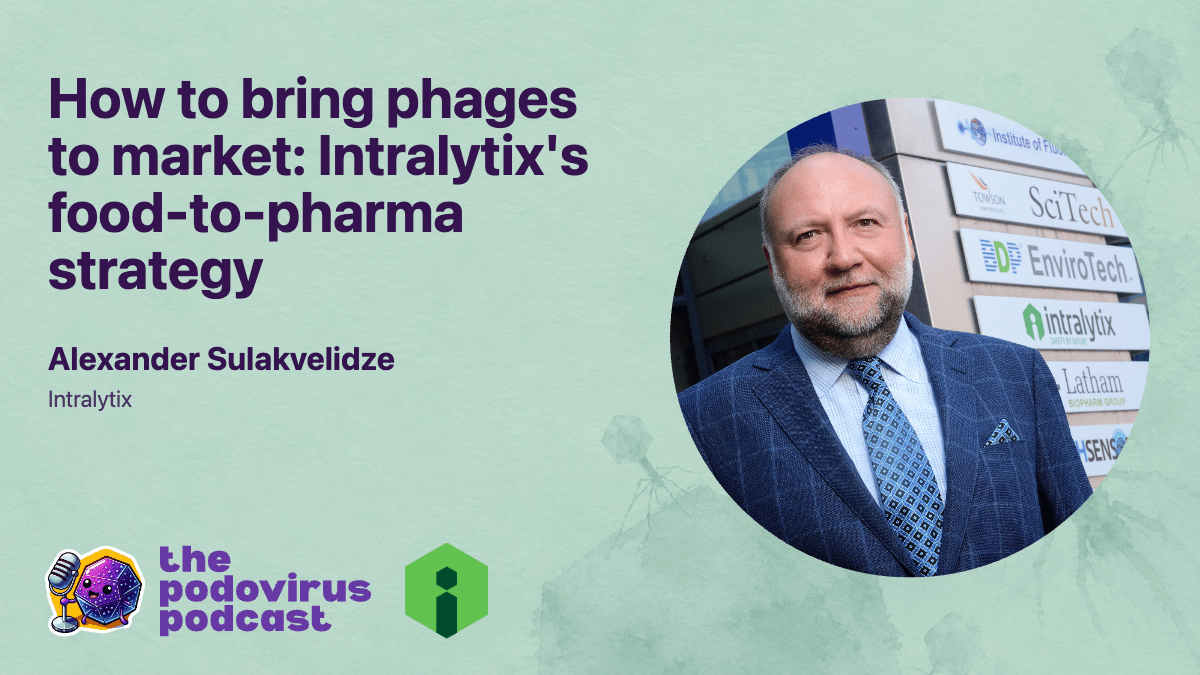
How to bring phages to market: Intralytix's food-to-pharma strategy
The conversation
Episode notes
Alexander Sulakvelidze, co-founder of Intralytix, explains how a company founded to pursue phage therapy survived by moving into food safety. Listeners learn what that experience taught his team about manufacturing and regulation, and why he sees convincing clinical efficacy results as essential to wider medical use.
Sulakvelidze estimated that 75–80 percent of the manufacturing and quality documentation overlapped between food safety and clinical applications, although human trials required additional, more rigorous information.
He described having regulatory flexibility to update food safety cocktails as bacterial strains changed, and argued for similar flexibility in human applications under defined production and purity criteria.
Personalized treatment would require hospitals to test bacterial susceptibility to phages and prepare selected mixtures, making trained staff and testing equipment essential alongside a suitable phage library.
Episode timeline
- 0:00 Introduction: From Georgia to founding Intralytix
- 5:29 The food safety pivot, clinical evidence and regulatory hurdles
- 23:09 Personalized treatment and updating phage cocktails
- 34:47 Scaling production and building hospital testing
- 42:44 What food safety experience contributed to human trials
- 47:05 The outlook for efficacy, access and reimbursement
Learn more
Transcript
AI-transcribed and edited for readability. May contain errors or omissions; check the recording for exact wording.
Select a word or timestamp to listen. Use arrow keys to move between words.
- Jessica Sacher
Okay, welcome back to Podovirus. So today we are graced with the presence of Dr. Alexander Sulakvelidze. I probably got it wrong. We'll let him correct me.
- Alexander Sulakvelidze
The best version I've heard in many years. I can tell you, Jessica,
- Jessica Sacher
Great, because we didn't check this before. Also, you go by Sandro to our phage friends, I think in the field. But it's been amazing to follow what you've been doing with Intralytix ever since I became aware of anything phage. It's kind of been just one of the exemplar companies that's actually pushing forward in the space. So Joe and I are really excited to have you on our phage therapy series and I think there's a million ways we can take this.
But first, I think it would be great to just hear kind of back to how you got into the phage field. And I know that you are from Georgia, not the state, but the country, the birthplace of kind of phage therapy. So maybe you could take us back to that part of your life and then how you kind of found phages.
- Alexander Sulakvelidze
Great, and thank you, Jessica, for the nice introduction and I'm very excited to be here. Indeed, me coming from Georgia, country of Georgia, played a significant role in forming Intralytix, but essentially shaping my entire life for the last twenty-five years or so. That's what I've been doing. And it all started kind of by accident, if you will. So I was born and grew up in Tbilisi.
That's where the famous Eliava Institute is located. At that time, director of Eliava was my PhD advisor, so I had close relationship with the institute. I still have many friends there, but I never thought about phage therapy much. You know, just like you don't think much about antibiotics. I assumed it was used everywhere, so you need it, you use it. I've taken phages, you know, when I was living in Georgia.
A lot of people I knew have taken them one time or another, so I didn't really think much about it. Then, in nineteen ninety-three, US National Academy gave me a fellowship and I came to University of Maryland Medical School to work in Doctor Glenn Morris's lab, in Baltimore. And over the years, Glenn and I became very good friends and he was a fantastic mentor. And this relationship played a pivotal role in forming Intralytix.
And so I've told this story many times, but it's an interesting story in a sense, so I'll repeat it here. Sometime, I either ninety-six, ninety-seven, somewhere in those years. I noticed Glenn was walking around in a very sad mood and I asked him, You know what was going on? And apparently, and Glenn, of course, in addition to being a phenomenal scientist, is also a practicing physician.
And so he was treating a patient at the, I think it was at the VA center in Baltimore. The patient underwent a very sophisticated surgical procedure. I, from what I recall, I think it was organ transplantation, and it went well. But then he got infected from vancomycin resistant enterococcus from his own intestine. And Glenn and his colleagues were trying to treat him with tried all kinds of antibiotics.
Nothing worked and the patient passed away. So, and me, without thinking much, I ask Glenn a question saying that, you know, how come that, you know, bacteriophages didn't take care of the infection? Because I knew that, you know, phages can kill bacteria that cannot be killed by antibiotics, they're just—the mechanisms are different, and so drug resistance doesn't mean phage resistance, so it's a phenomenal supplement or complement, if you will, to antibiotics.
And so Glenn looked at me kind of with a very puzzled expression on his face. You know, what are you talking about? So thi this was really one of those moments in life when, you know, it hit me that somebody's, you know, father, friend, husband, just passed away, died in the most developed country in the world, ah, after undergoing one of the most sophisticated surgical procedures or medical procedures from a simple infection, that probably could have been treated in Georgia, and so it just made no sense, and that made no sense feeling led to multiple conversations between Glenn and I.
Some friends in Baltimore. And eventually we formed Intralytix back in nineteen ninety-eight to develop phage therapy to for managing vancomycin resistant enterococcus, and then the subsequent events is a different story, and I can tell you, but I don't want to deviate too much from your questions. So that's how the company was formed based on my background coming from Georgia and being, you know, exposed to phage therapy all my life and realization that in this most developed country, and in fact, in most Western world, people don't know about it.
And so that didn't make sense.
- Jessica Sacher
Got it. Joe, you wanna take the next one, or I can keep going.
- Joe Campbell
Yeah, I mean, I guess so. So the next question, I think, is where, have you seen the field changed the most since you started, and how is that affected your approach to treating people?
- Alexander Sulakvelidze
And boy, did it change. Now, you know, as I mentioned, we were formed back in nineteen ninety-eight. You know, nobody knew about phages, and there were so many unknowns. FDA has never approved anything like this, and, you know, there were lots of experts that would tell me repeatedly that FDA will never approve anything like that. There was no obvious way for IP protection, because, you know, phages are natural, and so it would be difficult to patent them.
And in general, there was no acceptance of this concept. It seemed like a Soviet medicine, it's too old school. We are developing now, so such sophisticated things and modalities that let's not worry about this. And retrospectively, it's been more than twenty-five years now when I think about this. There were so many true experts, so to speak in quotation mark, and some of them really brilliant people.
That were just so skeptical, that I'm shocked that we continued. There were so many reasons just to stop and not do anything else. And then, and because of all those unknowns, there was almost impossible to raise money. And so that was very, very difficult. They we tried, raising money unsuccessfully. We tried applying for various grants unsuccessfully. I mean, back then it was a no no, and so, but we pursue we continued pushing it.
And one dramatic change that we made is that we realized that because of all those unknowns and difficulties, we cannot survive if we continue pushing pharmaceutical route. And so that Virette treatment that was the original idea for forming interlectics just wouldn't go anywhere. And so the company shifted towards food safety applications. We thought that it would get us easier to regulatory approvals and help us get things going.
Now, and I'll, I'd love to talk a little bit about regulatory approvals later, but getting back to Joe's question, how is it? How does it compare to today? And as you know, the picture today is completely different. There is a very high interest in phages and phage therapy. There are, you know, dozens, if not hundreds of publications from various groups. You attend various phage meetings.
When I started this twenty-five years or more ago, the main meeting was Betty Kutter's meeting at Evergreen. And we would go there, it would be, I don't know, fifty people, hundred people, everybody knew everybody. Now you go to a recent meeting, you have five hundred, six hundred, seven hundred people, and more willing to come. They can't accept more people, so the interest has clearly grown.
Now, what also changed is that now we have numerous regulatory approvals. Incidentally, Intralytix was the first company in the world to obtain FDA approval for phages for food safety applications. That was a, I think that was a historic moment in a sense that, we finally broke that barrier. And now we have five FDA approved products on the market for food safety applications, so that barrier has been broken.
And to all those naysayers that FDA will never approve anything like that, we proved them wrong, and so we have those approvals. Additionally, there are multiple clinical trials ongoing. Many of them are compassionate basis type. But there are several that are full blown, you know, placebo controlled, double blinded, including three trials that Intralytix is sponsoring. So we're running three full-blown IND trials currently in the United States.
And so there are numerous patents again against all those naysayers, there are patents being issued for phages and many more, patent applications. Large companies are beginning to be engaged, larger companies, which is critical because most of smaller companies like Intralytix and others that are currently active in the field have limited resources. They can push this up to certain point, but when it gets into, you know, phase three clinical trials, product registration and final marketing, that requires some some significant efforts and funding, and so in involvement of large companies, I think it's critical there.
And there is a better access to capital. There are, you know, companies, including us, that have raised tens of millions of dollars to advance this technology forward. So day and night difference. The only sad part of that is that it took twenty-five years for us to get to this point.
- Joe Campbell
So if I could just follow up on one thing I'm most curious about and like to see, hear your perspective. I mean, I think you mentioned that this was used in Georgia and I think Poland was using it a lot and Russia, I think also. I guess, you know, maybe not playing Devil's advocate, but, you know, I mean, I think in the Western world, and partly had to do with technologies, you know, DNA sequencing has gotten so much better, so it's much easier to define, make a defined product.
And, you know, a lot of the things that the FDA asked for now probably weren't possible forty years ago, you know, sequencing and all that kind of stuff. So I think from my perspective, I think a lot of the West skepticism about the phages, phage work, the phage therapy work that was being done in Eastern Europe was a thought that it may be because of technologies, or maybe because of something else, couldn't be as rigorous as the work that was done on traditional antibiotics.
And there was this prejudice against this, which, of course, has been overcome by a variety of factors, some of which I might argue is the overwhelming need in the Western world for something other than antibiotics. But what's your perspective? Do you think that the sort of the criticisms or the skepticism of the West about phages? Do you see there was some justification for it, or do you think it was completely trivial?
Or somewhere in between?
- Alexander Sulakvelidze
Someone in between, you know, there is no doubt in my mind that this the phage therapy works, right? Uh, there is just too numerous, uh, semi-anecdotal evidence for this. Most of that being published in Russian and Georgian literature, and I've actually translated many of those published, some mini reviews and book chapters to help English speaking people to get better, uh, access to those. But, and on the other hand, we still don't have a rigorous proof in FDA's, uh, approved clinical trials, double blinded clinical trials in this country.
So I think the one of the biggest thing that is still missing for this technology to really take over is a proof that this thing really works. Not just based on numerous publications, hundreds, if not more publications, come that say that it does work, not based on individual patients being successfully treated. And there are some, you know, the media picks up any single patient being saved as far as and make a big story out of this.
It's wonderful for popularizing this, but it doesn't help us cross that barrier, establishing a really rigorous, solid proof of concept, or proof that this is this is. So, as I mentioned earlier, there are multiple clinical trials, several clinical trials currently ongoing, so hopefully we will start generating that proof. At the same time, you know, the rigorousness regular of regulatory approvals in this country to a degree has played a negative role too.
And I will preface saying that FDA's been very reasonable to work with. I know people like to blame FDA for all the delays and everything else. That has not been my experience. My experience with FDA, both CifSun and Ciber, has been very positive. At the same time, you know, we are now in the twenty-first century. They're looking for some more state-of-the-art approaches and methodologies to look things.
And some of the things that they are overly concerned about, quite frankly, make no sense to me, but complicate things. One approach not to deviate too much, but I it kind of hits me every time. Everybody seems to be overly concerned about transducing phages, and a and the rationale, of course, being that, you know, they can potentially transfer horizontally genes, and that could create some super pathogenic bacteria.
And cholera is frequently used as an example by phage transferring cholera toxin. Diphtheria would be another example. So it has happened, in a history of microorganisms. And so now there is this concern that, you know, oh, you should only use transducing, the lytic phages, and there is too much emphasis going into how to ensure that you're not using transducing phages. And I put some numbers, and then you can cut this out if that's too long or too too too complicated, but it's funny to me.
So there are, it's based on facts and I have the numbers, so I'm gonna read this because I can't go. Lytic phage, and that's a fact. Mispackages DNA, and transduced DNA at a frequency that is equal point and then five zeros of one percent. The FDA has approved use of phages at up to certain level. So for food safety, it's ten to the eight PFU per gram of food.
OK, so that's established. Now, if you assume that the average person in the US, it's, three thousand grams of food per day, which is typ kind of a typical diet. And let's say US population is three hundred twenty-seven million, more or less, but roughly also scientific fact, everyone of any any human, healthy human, carries about ten to the fifteen phages in his or her GI tract, ten to the fifteen scientifically proved.
Now, let's assume, and I'll make some conservative assumptions. So let's say we're using a cocktail of phages that has six phages that each phage of those six transduces at about equal frequency. We are using all foods at the maximum allowable level of ten to the eight PFU per gram. And that fifty percent of phages in a GI tract are lytic. In fact, they're probably more, transducing phages in the GI tract than there are lytic, but let's assume this to be a conservative side.
So what would happen in this scenario? If you use a transducing phage, it will the. If you use the phage pi control for those levels, the transducing frequency of the phage that I've used to treat those foods versus what's happening naturally in a GI tract is zero, oh, oh, oh, oh, four, zero, six of a percent of what's happening there naturally. OK, so just it's such a minuscule number that do we really need to worry about this that much?
Yes, you exercise prudence, but it shouldn't be a stop show stoppers for you. And just to give you a final twist for that to happen, for that zero, oh, oh, oh, oh, six percent to occur. We need to be selling products at five hundred thirty-seven billion with a B a year. Let I can assure you that none of the phage companies is remotely close to that number and probably will never get to that number.
So thi this was a funny exercise using some assumptions and some biological scientific facts that tells you, yes, you don't overdo things, so you don't wanna become a, you don't wanna become some of those things to stop the progress. So I can tell you in reality, this has been a delaying factor in many product development. But again, we're working with the FDA to see if we can, what are the scientifically reasonable approaches to address this point and not be not make it as a show stopper.
Quite frankly, as you all know, temperate phages are not as good killers as lytic phages, and so people were probably not gonna be using them anyway. But I'm not saying you shouldn't be looking at this. Yes, preference should be given to lytic phages. It's just an example, maybe exaggerating a little bit, but showing that don't let too much of that cautionary and prudence is stop your progress.
OK, again, this was a very long exercise; you can cut it if it's too long.
- Jessica Sacher
No, ok, I wanna keep it. Just what was at the very beginning, the first number that was the percent of phages that are transducing.
- Alexander Sulakvelidze
Lytic that was a lytic phage is mispackaged DNA and DNA may be tran transduced at zero, zero point and five zeros of one percent.
- Jessica Sacher
Okay, so that's for if we are saying only lytic phages are allowed, what if we expanded to all phages? Do you think that number goes really high? Like,
- Alexander Sulakvelidze
I mean, transducing phages, in reality, when I say it's a fifty percent lytic in a GI tract, it's probably much less. Most of the phages in the GI tract are transducing, so that process goes on. So the whole message that I was trying to convey with this, mathematics, if you will, is that whatever we do is so negligible compared to what's already going on in nature and who controls what's going on in nature.
So, yes, exercise some reasonable caution, but don't let this become a showstopper for otherwise very promising technology.
- Jessica Sacher
Yeah, that kind of, oh, sorry, go ahead, Joe.
- Joe Campbell
It's my impression that the FDA's concerned for transduction reduces substantially if you remove all genes that look like they might cause problems from the strain you're growing the phage on, which to me seems like a reasonable approach. Because I certainly I think what you said is reasonable, although I'd have to go back and look at all the numbers. You,
- Jessica Sacher
No,
- Joe Campbell
but,
- Jessica Sacher
no,
- Joe Campbell
But I mean, I think my impression from talking to the FDA and being a part of some of these things is that their big showstopper. And I actually think this is reasonable. I'll see if you agree—is that you don't have like a toxin gene on the strain you're growing the phage to make it for production, which
- Alexander Sulakvelidze
Yes,
- Joe Campbell
to me
- Alexander Sulakvelidze
I agree.
- Joe Campbell
seems like a reasonable.
- Alexander Sulakvelidze
I agree with some clarification, and so there are two, two issues there, right? The phage itself could have a toxin gene, and in that case, and then the host range could have a toxin gene or prophage. And there are some issues about prophage, and I will challenge you to say that it will be very hard to find natural host range that is free completely of, you know, some undesirable genes.
To make it even more interesting, you know, there are numerous publications. People publish something when they think, you know, this gene could be responsible for virulence in some way. Not proven, you know, but it ends up listed as a potential virulence gene. In reality, it may not be, probably is not, and so it helps them, it makes the science more exciting, and it gets helps them get funding, maybe easier for whatever reasons.
And in some cases, they truly believe it could be responsible for virulence, and so whatever the reason, there are many putative genes, or some genes that are called virulent and they're not. And if you're studying, if you start ruling everything out, it will make it very difficult to identify host range. So I agree with the point that the phage should not carry toxin gene, yes, and I agree with the point that the host range should not carry well established genes.
In fact, FDA has a list of table of undesirable genes, and definitely you could be. You should be checking against that list. And I also agree, and FDA agrees to this also, I think, which which is very, which is a good sign of agency being flexible. So, for example, if the host range has some toxin gene and you can't get rid of it, right? They prefer you not to use it, but if you have to use it, you can't find anything else, then you can prove that the.
The protein or the toxin, the actual toxin, is not present in your product. So there is a fallback approach that if you, if not everything else fails, you cannot find the clean host strain, and it carries some gene that is, say, toxin. You can still use it by ensuring that the product is free of that toxin.
- Jessica Sacher
Yeah. This is really interesting getting into the nitty gritty of what it's actually like to submit something to the FDA. And what kind of are the most annoying things for you as a phage producer? Like, if you had kind of a magic wand to get rid of one requirement, setting aside the transducing, maybe cuz that will say that one's one, what would you say? Just this one's deleted, what would it be?
- Alexander Sulakvelidze
Since we are in a Christmas spirit, not, my ultimately what I, you know, and that's maybe too optimistic. It's just I'd like to all lytic phages to be considered safe to be used. And so, as long as they meet certain criteria that they don't carry those toxin genes, they are produced in a toxin-free or you know, host range that meet the criteria we just talked about a few minutes ago, they are produced and they meet certain purity criteria.
At the end, I think there should be a freedom to use them. And that kind of a ties into concept of phage therapy, what is the most optimal way to use phage therapy? So, you know, there are two main avenues, right? There's one, I call it mainstream. When you develop a phage cocktail as effective against as many strains as you can and have, and kind of a universal, and you know, push it through clinical trials and go.
And the other approach is kind of like a customized phage therapy or personalized medicine type. When you actually see what is infecting a given patient, test it against your library of phages and pick the most effective phages, one or ideally a few of them, and then use that specific cocktail for that specific patient. That has been done, it's done in the United States. In fact, it's a common approach that was used in Georgia and former Soviet Union.
There are even papers published in which people would compare a mainstream cocktail versus customized cocktail, and the customized cocktail always worked better. And so, and I agree that the customized med or personalized medicine using those types of customized cocktails is a better way to go for phages, too. It has its own challenges, the business model and the reimbursement and things like that, but scientifically and technically it has a better chance of working.
Now, in that concept, having the ability to access a very wide library of lytic phages without having to approve each phage in advance can make a big difference. And so that's why my Christmas wish, if you will, was that under certain reasonable conditions and certain criteria, purity, you know, toxin free, those types of things, which we have a list, and every company and every scientist has its own list that matches in many regard.
There may be few outliers, but overall it all matches. That would go a long way towards bringing this technology to real life.
- Joe Campbell
So just to put a finer point on this, I assume that you're definitely talking about compassionate use situations. But I guess sort of one of the things that gets maybe a little bit more complicated is, let's say, someone like you is doing a clinical trial for Shigella, and I believe you have four phages in your cocktail for that.
- Alexander Sulakvelidze
Fine, fine,
- Joe Campbell
OK, fine, and let's say, you know it works and you have great results, and then you know there's a Shigella outbreak somewhere, and it turns out that that cocktail doesn't hit it. But there's clinical trial evidence that those phage, those five phages worked. Are you saying that if you find another phage that's lytic against the new Shigella isolate that that should be considered to have clinical trial evidence, or just have the ability to use it under emergency conditions? You see,
- Alexander Sulakvelidze
No, I'd like to, and the concept that I outlined is not solely focused on emergency use. I think it could be a standard use moving forward. So there are again, two main approaches, right? The mainstream was a five phage cocktail and then and customized medicine for a mainstream approach. The scenario that you described would have a would have an approach when, let's say we have the five phages.
We've proven it works beautifully. But then we go to some other country in which different strain population circulates, or it is just a new clone emerged, and this cocktail is not as effective. So the approach there would be to update this five mainstream cocktail with new phages that will make it more effective against that strain. Now we've actually done this for salmonella. We published a paper in which we specifically, you know, had a cocktail, had a susceptible strain, had a resistance strain.
Obviously, it worked against susceptible, didn't work against resistant. Then we changed the cocktail formulation, it worked beautifully against what used to be a resistance strain. So this concept biologically works, and I'm pleased to say that at least CifSan, which deals with the food safety, has allowed us to change and update cocktails in this manner. So we, let's say we approved the original cocktail. We're using it, we're selling it today, it's on the market.
But eventually, if we see a new strain emerging, we have the freedom and flexibility granted by CifSan to update this cocktail without going back to them with whole new application. This has not yet happened for human trials. I think ultimately this needs to happen for it to. So that's one of the mainstream approach for personalized medicine, of course, it's a different story. You have multiple phages that all meet certain criteria, they're pure, clean, they're produced under GMP.
If you like, and then, I kind of will call it a pharmacist approach if you want. So the hospital pharmacist can look at the susceptibility data, just like they look for antibiotic susceptibility today, and tell the doctor, OK, I need to pick Phage X, Y and Z for this particular patient. Here it is, I'll make, I make a mix, use it. So those are two, two approaches,
- Joe Campbell
right? I mean, I guess, and I'm probably getting too much into the weeds, but one thing that strikes me as different is that, you know, all of those antibiotics, that things at least in the great majority of cases have been shown to be efficacious for something in a rigorous clinical trial.
- Alexander Sulakvelidze
Yes,
- Joe Campbell
And what you're doing is picking among them. In the case where you where, you know there's a new Shigella isolate that doesn't respond to your five-phage cocktail. And you find that will have no clinical trial evidence that it works.
- Alexander Sulakvelidze
correct,
- Joe Campbell
And so, I guess it's sort of a question. I mean, it's a little bit like, maybe CAR T-cell therapy for cancer, where the exact, you know, it's an approach rather than a... The approach is to find a phage that kills it and give it, rather than, and the approach has been proven rather than sort of each individual case. Cause if, unfortunately, any of us were to need CAR T-cell therapy, as I understand it, it would be a therapy that was given to us that had never exactly been given to someone else.
It was just sort of the same method.
So, I mean, I guess that's something that I view the FDA must be struggling.
- Alexander Sulakvelidze
some extrapolation, which I don't think it's unreasonable, but needs to come into play. So you establish the concept is working, right? And so all you're doing is, repl, and you establish that these new phages are effective against new strain in vitro, and you have this standard operating procedures methodology that is well established to show that at least in vitro it's effective. And then you extrapolate that.
Hey, you know, the concept worked, and those phages that were effective in vitro were effective in vivo treating that patient. Now I have phages that are effective in vitro. I assume and extrapolate that they will also be effective in vivo, and I'm gonna start using it. The bottom line is that it will do no harm, for sure. And I think it's a very high likelihood that if it's effective in vitro, it will also translate into in vivo efficacy.
- Joe Campbell
I completely agree with you, but, you know, I guess it's I don't know, I don't. I understand sometimes why people get a little bit frustrated with the regulators, but I also think they do a tremendous job.
- Alexander Sulakvelidze
I agree.
- Joe Campbell
I think it's a lot easier for someone else to say, Hey, why don't you let this stuff go through? When, you know, those they're the ones that, you know, when I was at at niad, which I was at the beginning of this year and I end left at the end of January. You know, we used to talk about the Washington Post, story that you always, you know, in the government, you're always a little bit worried, you know, like if something goes bad, what's the Washington Post story on this?
Gonna say, and, you know, I mean, I think you don't wanna be doing everything with fear, but there is a, you know, especially in the charged partisan environment, there we are. Someone is gonna wanna if someone, something goes wrong, someone's gonna want someone to get blamed. And you know, you, you know, you don't wanna be the one who
- Alexander Sulakvelidze
As I mentioned earlier, my experience with both CifSan and Ciber has been very good. And so I keep hearing all the horror stories. That has not been my experience. The people that we've dealt with have been reasonable to the point that it's a funny story that some years ago, we were approving some phage for food safety application. And one of the phages in the cocktail was isolated in Georgia.
And then some, you know, the there are lots of people sitting around the table, right? FDA, and food safety is also approved by the USDA. So two agencies. So imagine how many people look at this. And so it's one person was raising concerns that, hey, this is a Georgian phage, you know what would happen if it comes into the United States? And I'm thinking, you know, this can't be right.
It's not gonna take over US Phage population, but you have to argue and justify why this is not right. So there are occasionally questions and issues like this, but by and large, it has been a very reasonable experience with both agents.
- Joe Campbell
Not to mention that every time you take a trip home and come back, you're probably carrying in your body several phages from Georgia.
- Alexander Sulakvelidze
Every every in your GI tract, you
- Joe Campbell
Yeah, yeah, no, that's what I meant
- Alexander Sulakvelidze
from eating all the Hachapurris in yeah,
- Joe Campbell
So I guess we should move along to the next question. Are there specific areas of research that you think need to be done to make phage therapy even more effective? People talk about PK and things like that.
- Alexander Sulakvelidze
And obviously, yes, and even, you know, fifty years from now, if it's a mainstream, there's always be a need for additional research, as you all know, right? I kind of see it's a, you know, I can loosely group it in the four categories. You know, the one is obviously a basic research that is lacking that includes pharmacokinetics, which, as you mentioned, Joe, is it includes optimal delivery mechanisms, optimal even dosing and treatment duration, things like that.
For now, it's all been semi, random, and based on the previous literature and so forth. There are some applied issues also that complicate things, and that range from, you know, formulation optimization to scale up manufacturing. And, you are familiar that, you know, NIH has played a pivotal role in advancing some of the scale up applications. Intellectics has received some funding from NIADNIH to use artificial intelligence to optimize the methodology for quick scale up of phages, and that has been a tremendous.
Not to spend too much time on this again, Jessica, you can cut it out if it's too detailed. Imagine, let's say you have the phage and you have a host strain, and imagine scenario when you have many of those, right? In the ideal scenario, when you really have a big library, now you wanna scale it up, you wanna scale it up so that, you know, you generate high quality, high titer phage cocktails.
The variables that you have to examine are mind boggling. You know, this phage, does it work better on this host strain or the other, or the third, or the hundreds? What is the best moI? What's the best harvest stopping timer? What's the, what's the aeration requirement? I mean, if you think think of all this, the variables could be in thousands, and people traditionally been approaching them by using, you know, trying few in flasks and then identifying.
“Ah, this seems to be working best,” and going with that. Now, what NIH has helped us to do is to summarize all the production data we had generated over twenty-five years. And that ranged from, you know, small flasks to ten liter fermenters, wave hundred liter fermenters, now thousand liter fermenters. Normalize it and then apply artificial intelligence to learn what has created the best condition to grow this or the other phage.
And that is currently running. We have that system; it's phenomenal. So you bring a new phage and tell the system, you know, I wanna grow this in a thousand liter fermenter, tell me what I should do, and it quickly tells you. And then we go in the fermenter and try it, and so far we have had a hundred percent match. So whatever the program predicts, we get that in a real life, and you can imagine how much time it saves. And how applicable, uniquely applicable, this would be when the phage therapy becomes more mainstream than it is today. Then there are many, many more phages and the need to quickly scale them up, including under conditions that's suitable for C GMP manufacturing. So that's the kind of an applied science challenges. There are logistical issues, which I think are very important, and we kind of alluded to them earlier today.
So there is no infrastructure for phages currently in medical community, so there is a fabulous infrastructure for antibiotics. Every major hospital has ability and trained personnel and equipment to quickly determine susceptibility of a given bacteria against antibiotics. So they can quickly tell a treat, a physician, which antibiotics to use. There is no such thing for phage. And for the types of approaches that we talked earlier, when the pharmacy approach, somebody needs to determine what works the best.
You have to have that infrastructure, you have to have that ins, instruments, you have to have trained personnel, and that's all in addition, assuming that you already have lytic phages. I assume you have lytic phages, but the infrastructure comes all after that. And so that's, I think, will be a big challenge, possibly one of the biggest challenges in this. And then there is a regulatory part we've kind of talked about this, and, I mentioned that CifSan has shown flexibility and ability to update the cocktails.
I don't think it has come with to that point with CB, ciber yet, but I think it will be important that the ciber also allows similar flexibility with obviously some caveats. So some reasonable, you know, purity criteria, phage criteria, the host range criteria, but under certain criteria, I think we'd like to have that ability, and finally, the green light to compound those medicines on site.
Again, getting back to the pharmacy approach, so it's a complex issue, almost scary. So many things need to happen for this to become more widely used, but those things need to happen, and it takes time. That's why it's moving so slowly.
- Joe Campbell
So, I guess if I could follow up on a couple salient points that you made, one is my impression from talking to people like Gina, Sah and Saima, Aslam and some other people who are doing a lot of compassionate use cases. That the FDA is, they can get approvals very fast.
- Alexander Sulakvelidze
I agree,
- Joe Campbell
I mean, because the FDA, and so I guess the more in interesting and challenging things for the FDA will come with sort of, you know, when, hopefully, people like you have successful clinical trials. And then some of the scenarios that we talked about earlier happened. And I guess that's a more, a slightly more complicated issue. And I guess the other thing which will be more of a question is, you know, for traditional antibiotics, there's the CLSI guidelines of how to measure MICs minimum in inhibitory concentrations.
What do you think it's a realistic goal to get people together to have the equivalent of the CLSI guidelines for in vitro phage assays, which is sort of something you alluded to, I guess, in the pharmacy approach?
- Alexander Sulakvelidze
I think it is, but I think it will also require infrastructure in improvement, so it's not like somebody just develops a method, it needs to be ideally automated. It needs to be easy to be used, and you need to have a trained personnel able to do it. And that could be a very challenging process getting there. And so, for one, you know, the phage companies are mostly focused on developing phages.
They're not focused on developing, you know, high throughput, testing systems for phages. And the business is not big enough yet and not proven enough yet for other companies that specialize in those things to get involved in this. So it's kind of a catch twenty-two, right? You need to have a business showing strong promise before other things come together, so that's what makes it so, so challenging.
At the same time, so exciting to push forward.
- Joe Campbell
Yeah,
- Jessica Sacher
I've—I thought, just when I think about, you know, the whole food, like all the cocktails you've made for food, and now you're going toward the human health clinical trials. How much of one feeds into the other? Like, are there any shared phages that are just as useful in your human cocktails that you've already had in your food cocktails? And like, also, to what extent? Or I'm sure there are ways that, you know, you can just like you're kind of accelerated in your quest toward human trials based on what you've done in food.
Does regulatory see that too? Do they go, “Oh,” like, do they look at kind of a package of data that you got from a food trial? And could that be supportive of, you know, your human cocktail or how much?
- Alexander Sulakvelidze
It is. It is somewhat supportive, but getting back to the first question, how do we use the same phages for food safety and human trials? And not really. There may be one or two, and that's has to do with just the biology of it. For example, we are it's a different bacteria that are important from a food safety standpoint versus what are commonly even treated, even with antibiotics.
So it takes salmonella infection. I mean, it's a huge problem for the food industry. But unless you really have a very strong salmonellosis case, you're not even being treated with antibiotics. So you're probably not gonna be treated with phages, so the phages that we have for salmonella for food safety are probably not gonna be used for therapeutic use. And as far as I know, nobody is developing salmonella, or, you know, or listeria cocktail for human therapeutic application, so yeah, there is a little bit overlap, but by and large, they're separate.
Now, in terms of the data sets, then, yes, you know, we started with CifSun, we remember, we've never done it before. FDA has never done it before, so there was a lot of learning. As going back and forth with CifSan and understanding what they want and explaining what the phages are and so forth. And then that portfolio, I think we was used to go to Ciber.
Interestingly enough, we were the first company in many things, phage related, but in this, in the clinical trial, we were the first to establish master drug file with FDA that included how phages are manufactured for clinical trials and what quality control and quality assurance methods are in place for it to move forward. And we used a lot of things that we've developed for food safety applications in that package, and so in many regards, packages overlap.
I'll have to say that for Ciber, there may, there are some additional, more rigorous, requirements, but I don't know, seventy-five percent, eighty percent is probably the same.
- Jessica Sacher
So would you recommend, other companies go this route that you've gone, taking out the competing with you side of things? But was it? Are you happy that you chose to do it this way?
- Alexander Sulakvelidze
We are, I think, the decision that we made from many, many years ago to go the food safety route first was absolutely correct decision. We would not be here today if we hadn't done it. And a good example is that there were two or three other companies back then, and they're all out of business. And so we are on the other hand, what? Have? So we survived, we're growing, and we are one of the very few phage companies today that actually has sales revenues.
So we are bringing money in this year, we will, we'll make some profit, even, and so this is something that I'm very proud of. Took us very long time, but if you ignore the very long time. And I wanna focus on the fact that we are the only probably phage company that has some profit from this business. That's something I think that's something.
So for us, it has been absolutely correct decision because we were formed way ahead of time. But today, if the with all the excitement around the phage business, I don't think the companies need to go food safety route if their focus is the clinical, so whatever their focus is, I think they can go straight to that.
- Jessica Sacher
Got it, yeah, do you wanna take this now to the future questions we have, Joe? So we have two kind of first in five years, kind of, where do you hope and expect to be in what you're doing? And then the next one, spoiler alert, is the fifteen year version of that question.
- Alexander Sulakvelidze
not as optimistic as you might imagine, but I'm realist. And so in five years, I think it will still be mostly limited to personalized type of medicine, you know, treating individual patients here and there. Maybe have one or two mainstream products, especially if those are the on the market, especially if those products are regulated under, you know, maybe orphan drug or under LPAD limited population pathway, kind of a route that accelerates things. And may even remove the need for phase three trials.
Because if you, if you're getting into phase three trials, it even that one or two mainstream products may or may not be there. But if it's orphan drug or LPAD, then maybe I would also imagine there will be a lot more nutraceutical phage products for human applications. They're essentially very similar to pharmaceutical products. And there are several that are already on the market, including ours, and they do the job, except that because they're nutraceutical and not drugs, you cannot make any clinical claims.
So you can't say they prevent or treat the disease, even though they may well do it, but because they're not drugs, you can't do that. So that's where I think we will be in about five years. So there will be a little bit of better infrastructure, but not too many products on the market, as drugs. In fifteen years, I would imagine it would sign, change significantly, and that's based on one major caveat that we will have in the next few years.
Rigorous proof of efficacy. There are multiple clinical trials ongoing, and so the hopes are high that they'll show efficacy. But there's a concern. There were several clinical trials that were conducted and showed no efficacy. And so that's, it's a, so that's an absolute overreaching assumption that it needs to be approved, that it works. If it works, then I imagine in that we'll have several mainstream products on the market in fifteen years or so from now.
We'll have, increased availability of customized options and perhaps even personalized medicine, the pharmacy approach available. My hope is that we'll see enhanced infrastructure, maybe some reference centers that will have ability to quickly identify the most optimal cocktail and prescribe it and use it. And I would also see more microbiome-modulating products. I think it could be nutraceuticals, could be drugs, and when I say microbiome modulating, so far.
And historically, phage therapy has been going after, you know, disease causing bacteria, infectious disease causing bacteria, you know, you have, shigella, you treat it with phage, you have, I don't know, staphylococcus infection, you treat it with phage. But what is happening now with microbiome field is that people are beginning to correlate microbiome composition with various non-infectious diseases that traditionally have not been considered for phage therapy, you know, things like obesity, cancer, the certain forms of cancer, perhaps even Alzheimer.
Those all kinds of things. Some of those links may never pan out, some of them will, and then if that happens, I imagine there will be an increased interest in developing phage-based nutraceuticals or drugs to modulate microbiome, because phages are so specific, right? Once you have this link, you can go in and specifically target that disease-causing bacterium, whether it's infectious or non-infectious. And so I think that would be a very exciting kind of avenue to watch out, perhaps even more exciting than treating infectious diseases, right?
So that's that's, I think, really something interesting. And finally, I'd like to see in fifteen years or so, or sooner, some business side of how all this thing can be reimbursed. Will insurance just start paying for this? Will Medicare pick this up? Those are critical components for this to become a viable business.
- Jessica Sacher
Sorry, Joe, I'll let you go in a sec, but our next podcast episode is about drug pricing for phage therapy.
- Alexander Sulakvelidze
And who pays for it? And
- Joe Campbell
yeah, yeah, and related specifically to that, I don't know. I mean, I know one of the trials you're doing is this Shigella trial, and I keep talking about because that's the one I'm most familiar with. But assuming, have you started having conversations with insurance companies and with the people who could determine Medicare funding about whether or not, ha, how they'll will they give you? You know, will they reimburse if you have a successful clinical trial?
- Alexander Sulakvelidze
and the answer quick answer is no, not with insurance companies. We've talked to some large pharmaceutical companies. We had some discussions with the Gates Foundation. There seems to be an interest, including from the Gates Foundation, to pick this up and push it for the bigger goods. But everybody is kind of a wait-and-see mode and see if we have a proof of efficacy. So we really need to have a proof of efficacy before this can actually get some more traction.
- Jessica Sacher
Do you think like one proof of efficacy of one cocktail, one clinical indication will be enough to move the needle for the whole field, or how? How transferable could that really be? Cuz I've always kind of felt
- Alexander Sulakvelidze
It will move the needle a little bit. It will help everybody, but it will not be transformational. I think several other products also need to be proven to be working for it to really break this barrier, but it will help for sure. It will. It will be a significant
- Jessica Sacher
okay, yeah, so we only have one last question, at least planned question, and I think we're getting close to our time. We're actually beyond. What are the biggest scientific and clinical, regulatory, economic challenges that could prevent where you hope to get to in the next five to fifteen years? And we've talked about a bunch of them, but if something's gonna foil all of your plans, like, what are?
What are you kind of scared of, or what do you see?
- Alexander Sulakvelidze
What I'm scared of that we won't be able to establish proof of efficacy in a reasonable way. In deep in my heart, there is no doubt this works. There's just too many successful stories that I'm absolutely convinced that it works. The potential issue is that will it work in this particular clinical trial design setting that is somewhat limited of what you can do, how many patients you treat, you know, how you treat and so forth.
So just to give you a good example, the Bangladesh trial that failed, it has numerous things that they were designed by very smart people. But then there were some limitations that the regulatory agency was done outside the United States, but whatever the regulatory, they prevented them from doing scientifically correct things. And, for example, they would not let them neutralize gastric acidity by giving phage orally. They would, I think, also significantly reduce the viable phages doses, and so there were some severe limitations that led to the failure.
And so there are some limitations, maybe not as severe, but still for currently ongoing clinical trials, so there's always this the fear and concern that while this concept works in general, no doubt about this, will it work in this particular clinical trial? And so we really need to see some good efficacy coming out of those trials for this to take off. So I think that's the major, major issue that we really need to have.
Everything else will come after the infrastructure development, the high throughput testing, logistics, that will all come once you are over this hump. And, of course, you need to then figure out what's the proper pricing model is that the companies involved in this can make some money, but also make it, the point that is accessible to a large population that needs to use it.
- Jessica Sacher
Joe, do you have anything else? Feel like I could?
- Joe Campbell
Yeah, no, I mean, I think we've covered so much. And I think, you know, by the time we got to that last question, and I think that was our experience in some of our earlier pods, that when we get to that last question, usually most of the things have been hit during the course of the discussion. But yeah, no, I think this has been great. And Sandro, thanks for your time and for your thoughtful answers, and think this has been wonderful.
- Alexander Sulakvelidze
My pleasure. Thank you for having me. And Jessica, I'm going to see you in Colombia soon.
- Jessica Sacher
Yes, we'll be there.
I heard you're going scuba diving there.
- Alexander Sulakvelidze
I am already making some inquiries.
- Joe Campbell
Awesome,
- Alexander Sulakvelidze
Are you in it? Do you do that too?
- Jessica Sacher
No, I'm too scared, but I'm curious. In terms of time frame, just to leave people with something to look forward to, when do you think your clinical trials will show some kind of answers? What year, what month?
- Alexander Sulakvelidze
For Shigella, we should know something by maybe the middle of next year, if not a little sooner.
- Jessica Sacher
Yeah, cool.
- Alexander Sulakvelidze
And incidentally, that's something that is funded by NaiDnih, so they really helped push this concept, forward with the Shigella trial.
- Jessica Sacher
And what clinical indication is it?
- Alexander Sulakvelidze
That's a shigellosis, basically, so it's an interesting design, and Joe is familiar, I think, with it. It's a—you actually give a mildly virulent strain of shigella to volunteers, so you trigger shigellosis and then you treat them, so, the—and it's an FDA approved model, and it's been done at the University of Maryland. I think Army has this, Johns Hopkins uses it. What it helps you is that you don't have to go and look for many naturally infected patients.
And Shigella is not a big issue in this country, so you really have to go then to some developing countries. And so, by, but by having this model, you can create your patient population, and that's what makes it, relatively straightforward and quick for this trial to go forward.
- Jessica Sacher
Yeah, no, see, I opened up the doors again and we're trying to close it down. So thank you. There's so much cool stuff to dig into and we will all be keeping track and keeping tabs on how Intralytix keeps going. I just
- Joe Campbell
Yeah, well, let me, you know, as you know, I run this phage seminar series and I'm already trying to get you and Jennifer Schwartz to talk about this study in my series.
- Alexander Sulakvelidze
We'd love to do it, especially once we have some results.
- Joe Campbell
Yeah, well, results help.
- Alexander Sulakvelidze
As you know, we just published phase one results for Shigella, and that's a fairly sophisticated analysis, very complex, very positive. Obviously, there were no significant side effects, but it was expected. So the real thing that everybody is looking for is the phase 2a results, which speak about efficacy.
- Joe Campbell
Right.
- Alexander Sulakvelidze
So hopefully by middle of next year or so,
- Jessica Sacher
Exciting! Have you back on to tell us all the deets or we put you on Joe's series, cuz then that's we can see the data. Awesome. Well, thanks so much, Sandro, and I'll see you in Columbia very soon.
- Alexander Sulakvelidze
My pleasure. Very good talking to you both.
- Jessica Sacher
Okay, awesome, well, we'll be in touch.
- Alexander Sulakvelidze
All right.
- Joe Campbell
Bye-bye.
- Jessica Sacher
Bye.