


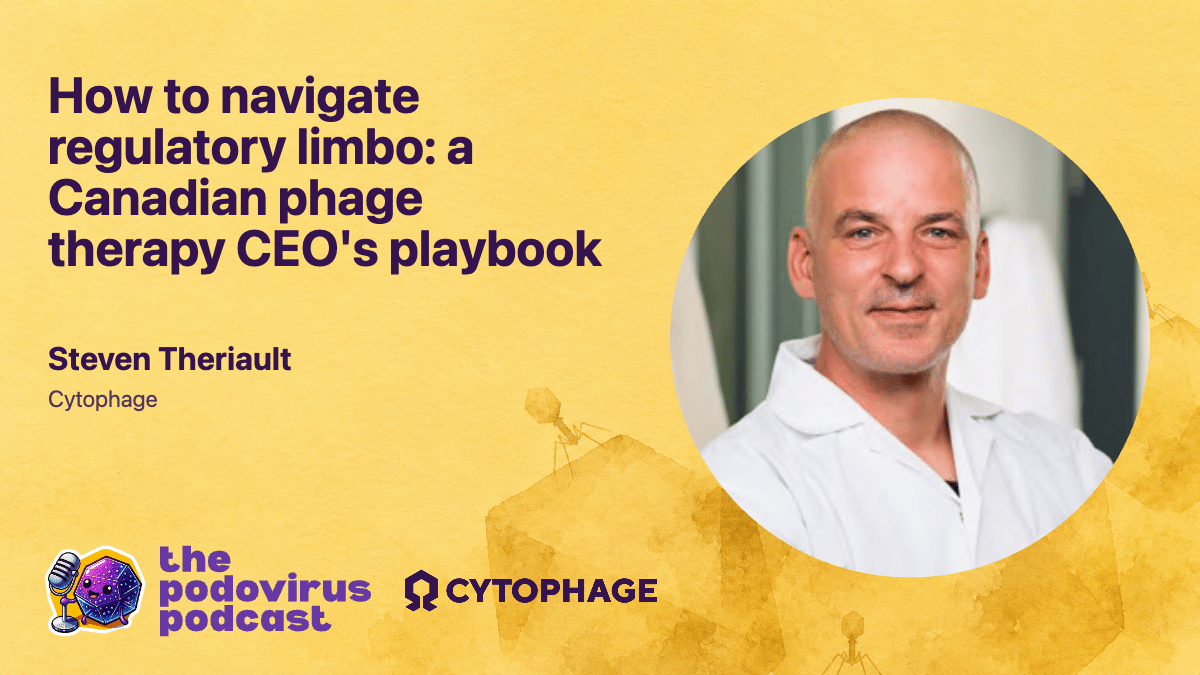
How to navigate regulatory limbo: a Canadian phage therapy CEO's playbook
The conversation
Episode notes
Steven Theriault of Cytophage explains how he navigated the costs, approval delays and unexpected requirements of developing phage products in Canada. Listen for his account of why promising laboratory results did not create a straightforward business, and how those obstacles shaped his approach to funding human treatments.
Theriault initially pursued hospital disinfectants to fund human research, then turned toward poultry after a hospital purchasing contract blocked access and a neighboring farmer described needing antibiotic alternatives.
Cytophage’s stated plan was to collect data from individual patient trials, then seek federal support for a Canadian clinical trial of its proposed prosthetic joint infection cocktail.
Theriault said dosing drew on historical data and acknowledged uncertainty, while estimating that dosage studies would cost his company half a million dollars and calling for funded foundational research.
Episode timeline
- 0:00 Introduction to Steven Theriault and Cytophage
- 5:02 Why hospital disinfectants led to poultry products
- 13:15 Building a coordinated path for patient requests
- 20:03 Unexpected regulatory hurdles and manufacturing requirements
- 30:06 Dosing uncertainty and who funds the missing evidence
- 44:33 An unexpected review requirement and ambitions for Canadian care
Learn more
Guests and background
Further reading
Transcript
AI-transcribed and edited for readability. May contain errors or omissions; check the recording for exact wording.
Select a word or timestamp to listen. Use arrow keys to move between words.
- Jessica Sacher
Hello everyone, welcome to Podovirus. Joe and I are here with Steven Theriault from Cytophage, so Cytophage is a company you may have heard of. It's a Canadian phage company. And I'm Canadian, so I like to promote Canadian groups especially. But even without that, I think Cytophage is one of the companies that's really pushed the field forward a lot. They've been around for I'm gonna get it wrong the number of years, so I'll just let Steven fill that in.
But several years now. And they started out looking at phages for chickens and chicken feed to control, bacteria in that setting. And then now they've also started moving toward human, phage therapy cases, and they've been providing phages for a couple of patients now, I think, or they just did the first one recently, and I think maybe the second is in the works. So we'll again, let Stephen fact check me, but it's really exciting.
To have you here. And we, as like we've been doing with this series, we really just are trying to understand, like, why don't we have phage therapy yet? What are the bottlenecks? What's going on behind the scenes? But for everybody who's doing work to build in this space, so maybe I'll pass it to you, Stephen, and give us a little background on you.
- Steven Theriault
Absolutely, thank you again for the invitation. And before I get started, I do want to say thank you guys for doing this. Putting out a podcast on phage research and phage science in general is not only needed, but, it's something that we again can build on. And once we build on it, more people can actually, understand what we're doing. So again, thank you for that.
For myself, again, I—I've kind of been a scientist my entire life, as we all say, as scientists, I started at a young age, where again, I became a paramedic. So I loved health for humans, realized I didn't wanna be a doctor, I wanted to be a scientist as opposed to a doctor. The reason for that is because, in my mind, as a scientist, you can help a vast amount of people; as a doctor, you can help a few people.
So I really wanted to do things that could be impactful on the human population, and that's something that sort of drove me as a scientist. So for me, again, I started off, a as as a government scientist. I worked at the National Microbiology Laboratory. I did my PhD developing vaccines for organisms like Ebola and other exotic organisms. And I fell in love with bacteriophages, not at the government, but the idea of using a virus, which was non-toxic, to actually help us deal with bacterial problems, which they do phages, that is, they do on their own in nature.
So as I was becoming, you know, more in tuned in infectious disease control, I really, really, really looked at phages as something that we could use as a population to actually help us get over a hump. And that hump is using chemicals to treat populations as opposed to natural organisms. Sorry, a little long winded there.
- Jessica Sacher
Awesome, yeah, great, and so yeah, that kind of covers, like, our usual first question is just like the origin story and how you got involved. And you kind of just were, yeah, like, figuring that out from your post at the government. At that point, was that kinda how it went?
- Steven Theriault
Yeah, so one of the challenges that I had at the government was to actually deal with nosocomial infections in hospitals. So bleach doesn't work. All of the chemicals that we were using weren't working. Why?
'Cause we still have AMR issues or antimicrobial issues in our hospitals. So as I was working towards that, realized very quickly that phages could be a solution here. And you know, I worked in the government for probably 15 years. I realized that the government's not necessarily the best place for, you know, out-of-the-box thinking. So for myself, I stepped out of the government, again.
Very secure job. Worked there for about 15 years, had a great, great career. Stepped out because I really saw a need as well as something that we could do with phages to actually use them to actually treat patients. And I don't think I could have gotten, a company started, or even the program started in the government, as I did when I jumped out of the government and started it as a private-sector, endeavor.
So yeah, that's kind of my story of how I jumped into it. I jumped out of the government and then jumped into phage research. But for me, it was strictly because I really saw that there could be something done here. And, you know, with the right people supporting what we're doing, as well as the right science, this could be earth-shattering. And that's what I was going after.
- Joe Campbell
Just gonna jump in and ask—well, sort of related to Jessica's question—but it's my impression that you started out with the chickens and doing agricultural approaches. And do you wanna sort of walk us through why you decided to do that? As opposed to jump straight into human health?
- Steven Theriault
Human health so, ironically, it was a little bit the other way. I actually started in human health and I developed, disinfectants using phage-based, technologies to actually create the disinfectants. And the reason I did that was because nosocomial infections generally are residing in our areas, of our tables and our and our clothes and whatnot, as opposed to being transmitted from, you know, a patient to a patient.
So they're in our environment and that's why I was trying to tackle it that way. And, you know, we developed, I developed a product for C. difficile, VRE, or vancomycin-resistant enterococci, and then, of course, Staphylococcus aureus or MRSA. Was very excited, had great data, went to the hospital. And I was thinking, I was gonna get a, you know, a ball out of the park here.
And the hospital administrator basically told me, he said, Listen, I have a contract with Clorox bleach for the next ten years. I can't even look at your product for ten years, which totally changed how I was going to get our product into the marketplace. Now, let me explain why I was looking at it this way. In Canada, if I'm a private company, if I were to do a human health trial, it would cost me forty million dollars, impossible to do in Canada.
I'm gonna say that outright, it's impossible. Why? Because a small company with a new technology won't have the support and the biotech industry in Canada isn't big enough. So in saying that, I wanted to create a product that we could sell, I could make money on it, and then I could push the human aspect. And that's where the disinfectant came in. With my earth being shattered around me because disinfectants aren't needed by hospitals.
I live in the country again, I'm from Winnipeg, Manitoba, so, we all live in the country here. I live in the country. And, ironically enough, my neighbor is a chicken farmer. We were chatting one night and he said he's getting out of the business because prophylactically, they can't use antibiotics anymore due to government regulations, which, honestly, is a good thing. No, nothing wrong with that.
But he had no alternative. Because he didn't have an alternative, he thought he's gonna lose all of his chicken flocks. So right away, I said, Well, listen, I have phages that kill those bacteria that you're talking about. Let's see if we can use our phages for chicken. And lo and behold, there. This is how Cytophage started to develop, agricultural products, especially for chickens. We went a little bit further.
We were successful in a competition called the Nutreco Feed Tech Challenge, where we developed E. coli and Salmonella phages to remove these, you know, bad bacteria from the actual chickens themselves. We ended up winning that competition and then moving it forward, through a chicken trial. And this is how we, of course, have our chicken products. So, yeah, it's a little bit skewed on trying to get there, but for us, we're—
we're again trying to treat, animals, as well as trying to do disinfectants to fund our human health research is basically what we look at. Yeah,
- Jessica Sacher
so h- Where are you at in terms of on the human trajectory? Like, or at what point did you kind of say, Okay, we have like this colum? Column A is being filled, we're generating momentum over here. Like, when do you start looking at the human side?
- Steven Theriault
So for human health, we've always looked at the human side. The biggest thing for us, though, is we can only do about four patients a year, and the reason we only do four patients a year is because of cost restrictions. If this was a funded program, I could do 100 patients a year, but that's the whole thing is that, how do you fund something like this? You either get funding through a government, or you get funding through a granting agency, or you ask the patients to pay for it.
Or for me, I ask investors to, of course, support what we're doing. You can only do that for so long because they want something to come out of it, meaning: are you gonna create a product that we can actually sell that then will allow us to create new products that are phage developed? So for us, our human health is doing really well. We treated Thea, just recently, as you've seen, again, a great success story.
There's been many success stories with phage treatment around the world, and not only in Canada, but everywhere. So it's really starting to promote and roll. For us, our next patient, as you were—you were correct. We're already, developing phages, we're starting treatment in February, and we're gonna be doing three more. So instead of four, I know I said four, we're actually doing a bit more. And the reason for that is just because we fine-tuned how we can actually develop our phages, which allows us to do, you know, a little bit more.
as opposed to taking up all of the time from the lab staff, from their regular jobs. I know that sounds kind of strange, but, uh, you get the idea. Um, so for us, we're fully committed to developing a prosthetic joint phage cocktail. The idea that we wanna do is we want to, uh, again, I'm speaking generally here, but there's generally four bacterial types that cause prosthetic joint infections. Uh, we wanna tackle all of those bacterial types, and we wanna develop a prosthetic joint infection cocktail that we can actually supply throughout Canada.
That's our goal. To get there, we have to do, the OLIPs, those are the trials, we call them, clinical trials of an N-of-one, so just one patient. And those are what we can do in Canada. And in doing those OLIPs, we collect that valuable data showing our product works, showing if there's any issues with it, and then we can move forward in that sense.
So for us, we're doing all of the OLIPs. Once we have the OLIPs and we have, you know, all of the data that we need, we're going to move forward and ask the federal government if they'll support a clinical trial across Canada doing, all prosthetic joints using our cocktail. So that's the goal. How we get there is a little bit convoluted, and it's just because the Canadian system's a lot different than the US one. Yeah,
- Joe Campbell
So following up, with the patients that you, the patient you have treated and the ones you're planning to treat. Do you get introduced to them? Does a physician reach out to you and say, I have a patient who, you know, isn't responding to antibiotics? Or how do you end up?
- Steven Theriault
Yeah, it's ironically enough, and it's in every single way that you can possibly think of. I have. I've had people fly here from other parts of the world and meet me at my lab and catch me at eight o’clock in the morning as I'm walking in, and doctors calling me and saying, I have a patient that has an AMR issue, can you help? I have a lot of patients calling me as well.
Those are the hard ones because again, they're looking for help. And because of our system in Canada, you have to go through a doctor or a medical doctor. So again, it's, stuff that we have to sort of manage. But how do we get our patients generally? Right now, we get them from our physicians, so we're working with physicians in different areas of Canada.
So Calgary to, you know, Ottawa, all the way to Toronto, all the way to Vancouver for that matter. And those are the physicians that we're working with to try to implement our prosthetic joint infection treatment. I wish I could take all of the calls and treat all of the patients, but honestly, if I did that, we would have thousands. It's a great need.
- Joe Campbell
So, do you find that? The people that have reached out to you, do they reach out to you only? Or are they usually sort of like canvassing the world and going to some of the phage centers in the US and sending their isolate everywhere? Or how does that work?
- Steven Theriault
Yeah, so some people do so. I'll give you, you know, I'll tell you the story about the gentleman that came from overseas. He tried every place in Europe and every place in, you know, not Western societies that does or that did phage treatment. He tried them all, and none of them actually could treat him. So then he came to us, and just as a side, we again, did, did, an R D treatment for him.
I'm saying R&D because it wasn't, it wasn't through a physician, it was basically us creating the phages and then sending it overseas for him. And as I've been told, he's doing quite well. So again, this is quite an interesting thing that can happen now. For us, when we do get patients, you know, I'm just sort of gonna jump around a little bit.
But for us, what we're trying to do is we're trying to funnel patients through a certain point or a certain aspect of doing the treatments, as opposed to having it like the Wild West. What I'm trying to do is I'm trying to create a guidance document for phage research or phage treatment in Canada. And to do that, all of those patients then can apply, and then we could actually get them treated somehow.
Still working on it, we're still trying to figure out how to actually develop it to make sure that it's actually functional and actually, you know, beneficial to the patients. Uh, but for me, I'm gonna say that right now, phage treatment in Canada is still a bit of the Wild West, um, where, you know, patients will come, uh, one will eventually get treated. Once they get treated, everybody gets behind it and says, Oh my God, look, everybody's getting—it's working, it's working well.
And then we get inundated with a whole bunch of requests and then we can only pick one or two, which is what I wanna kinda change. Where, if we have a lot of researchers across Canada, we can actually treat more patients if we coordinate a little bit. That's, yeah, just speaking a little bit of trying to coordinate things.
- Jessica Sacher
That's awesome.
- Steven Theriault
I'm glad you guys have that as well. Yeah.
- Jessica Sacher
Yes, and just figuring out, like, what's the minimum workflow like? Do this, then that, and then that, and just kinda making that clear to people. It goes a long way, even if you're not doing it yourself. You just kinda put forth what other people have already done or what you've already done, and then the next person might pick it up.
- Steven Theriault
Yeah, you know, in Canada, we're doing well. Like, listen, we're going through a government change. I know we just all heard this, but I have a feeling when the new government comes in, we're gonna see a different approach to AMR. And there's again, I'm not talking about governments, but I'm just talking about sort of where we are. We got out of Covid, we weren't talking about AMR in Covid, but then bang, holy geez.
Look at all the AMR issues we're having now after Covid. So now all of the governments are saying, "Oh my goodness, we, you know, we took our foot off the pedal. Now we gotta put it back on the pedal. We gotta make sure we start treating these AMR issues that we have with whatever means we have." And for me, I think phages are gonna be one of those, you know, top tier, treatments for de developing against AMR. There's gonna be others, but this is gonna be one of the main ones. So, yeah, I'm waiting for that pedal to hit the ground again and we can get, we can get some more, more things moving. Yeah,
- Jessica Sacher
yeah, so
- Joe Campbell
Sorry.
- Jessica Sacher
Go ahead, Joe.
- Joe Campbell
I just wanted to back up before we got too far from it with the chicken treatment. What kind of a is there? A go? Assume there's a government agency, and I don't know. They mainly interested in making sure that putting phages, feeding chickens phages, won't make people sick when they eat the eggs or the chicken. And is it mainly you? Then, in terms of efficacy, do you mainly just ha?
mainly? just do you mainly have to convince your neighbor, the chicken farmer, that it works? And, or does the government analyze whether it's working also? Or are they just concerned with the fact that you're not gonna make anyone sick by giving?
- Steven Theriault
Yeah, so there's a two-tiered question there in that sense. So toxicity is really easy for us because, phages only infect hum or only infect bacterial cells, not human cells. So we don't have the issue with superbugs. And when people talk to me about, you know, toxic genes and stuff like that being transferred to other cells, it's very easy for me to say we don't have any toxic genes in our phages.
That's the whole point of why we do things a little bit different than other companies. I don't pick our phages out of a sewer and then treat; we actually develop our phages, meaning we develop them through environmental means, where we make them better at what they are actually doing. And sometimes we use synthetic means, where we actually modify the genes themselves. Now I will say, the world is not quite ready for GMO phages.
Scientifically, we are, but right now, we're just looking at using phages at the best that they can be using environmental modifications, so for that, toxicity is not an issue in my mind. The government, like, I'll give you an example. We gave them a thousand page document about the last hundred years of phage research, and there was not one toxic effect in that thousand page document.
So I'm as a scientist, and you guys as well, I'm sure you'll say this without even a blink in the eye. Phages are non toxic. So for me, that's, you know, really, really good. Now, for us in Canada, we do have a government agency; it's called the Canadian Food Inspection Agency, or what we call CFIA as a short form. Now CFIA does all of the analysis of what we're doing for the testing of the chickens.
I am gonna add a little caveat here, though. I don't only work in Canada, I'm working internationally as well, and we work a lot in South Asia. And the reason that we work in South Asia is because government's there. Their regulatory regime is a lot more, amenable to phage research and phage treatment. Now, what do our phages do? Well, our phages, when we actually treat chickens, and these were broiler chickens, so thirty five day chickens, we call them, these are the ones that you get from Costco, and you know, those only grow for thirty-five days.
Ironically enough, when we actually treat those chickens, we increase the protein production by about 22 percent. Now, when we increase the protein production by 22 percent in Canada, sure, it feeds a few more people. But when we do that in a country like Bangladesh, or if we do it in Malaysia, you're actually treating—or you're feeding a population. So that's the big difference that we see is when we're actually using phages,
as opposed to antibiotics. You're making the chicken more healthy because you're keeping its gut flora, you're keeping the E. coli and the salmonella down, but you're allowing that chicken to actually grow at a regular pace. And because of that, it's a 22 percent increase, the other thing, of course, is we decrease the sickness, if other viruses come through, because they're healthier chickens. And for farmers, which is a huge thing, the feed conversion ratio: how much do I have to feed that chicken in order to get it to being a weight that actually is sellable, that I'm gonna make money from?
We are at the same level as antibiotics for our feed conversion rate. So for us, you know, we're a win-win for treating chickens, moving away from antibiotics, stopping making those superbugs and cre treating them with phages, the natural, you know, bacterial killer. So, yeah, hopefully that answers your question.
- Jessica Sacher
Awesome. So, what have been some changes in how you approach this over the years, like, how did your thinking shift from the beginning to now?
- Steven Theriault
yeah, no, it's so. Listen, I came from the government. I think I had my blinders on, thinking that the government regulatory process was gonna be the easiest portion of this whole adventure. The science to me is like, we know what we're doing scientifically, we can create phages, that to me is not an issue at all. The regulatory aspect to me is the one that sort of caught me off guard.
And listen, I've worked a lot in, again, the government, where we were doing, regulatory type testing, and I know the government does it. But you can really see that they're very adverse from new technologies. So for us, I had to now educate the government first about what we're doing, and then educate on the new technology, and then ask them to move forward with a phage guidance document.
Because, as you guys well know, phages are not drugs, so when we go through the regulatory regime, we have to have a different subsection. If we don't have a subsection that's different, then you're gonna see people run and bang into a brick wall. Like, "Oh, if you're treating patients, you now have to be GMP." Now, I'm not saying that we're not GMP, but if you put us under the same GMP guidelines as a drug, we're a lot different.
Because we're a biologic, and biologics, of course, are inherently different, they'll be different each batch run. Now I'll give you an example of what I mean by that, which is, you know, something that I a little. I fight a little bit with the government, but they're starting to understand where we're coming from. If I grow up a phage cocktail and I grow it up, and let's say our treatment dose is ten to the eight, and I grow it up to ten to the ten or ten to the twelve.
That's still good, 'cause we can still do ten to the eight treatment. But under GMP guidelines, if I grow it to ten to the eight, or, sorry, ten to the ten, that's fine, but if I go to ten to the twelve, then that's outside of what they will accept. So I have to get it to grow to ten to the ten, which again is is a weird way of looking at things. Because a drug, you can do that, it's easy, right? 'Cause it's a drug, but for a biologic, it's not. So what we're trying to do is get the government to really understand that even though we are still under the GMP guidelines about making sure that, you know, we have safe products and all of the stuff that is required, that if we do have variables that occur,
and Jessica, you'll know this from your s, the work that you did in Australia. Those variables are actually not problematic; we just need to account for them, and that's it. So for me, you know, the government is really seeing that. I thought we could do it a lot faster. This company was developed in 2016. We're now in, you know, it's almost ten years, so nine years now.
I have more traction internationally, regulatory wise, than I do in my own country, and that sometimes is difficult. In fact, I have more traction in the US than I do in Canada. And that's because, again, people are starting to realize that phages are really beneficial and they're changing their regulatory regimes or structures to account for the difference in a phage. So for me, I'm really excited that it's changing.
I wish it would happen faster because, you know, we have a lot to do. Phage research, you know, we have ten or 15 years of still doing amazing work that's going to change how we look at phages multiple times as we move through this, you know, gauntlet of science. So for me, I just I. I'm excited that it's changing. But I really wish the government would have been a little bit more, I don't know, in tune with a new technology.
That's kind of a weird way of saying it, but I think it would have been beneficial.
- Joe Campbell
Having been in a government agency in the US. for a long time, there's a strong, incentive to be risk adverse. Maybe incentive isn't the right word. But you know, when I worked with the NIH, there was always, "Well, what's the Washington Post story gonna look like if we don't? I if we're not risk averse and something goes wrong?" Do you think that is going along?
the Globe and Mail or whatever, the CBC,
- Steven Theriault
Yep, I do actually, like, listen, I had my first meeting with the government in 2017. There were ten people in the room; not one person knew what a phage was. And when I told them that I was gonna use a bacteriophage, which they called a virus, to spray on desktops to disinfect, they thought I was crazy. Again, they absolutely thought I was nuts.
Today, though, those same people know what phages are, and they're calling me and asking me questions about phages all the time, so that's really good. But again, you know, I'm one of those optimistic scientists where I think you can get things done quickly. Whereas, you know, the government does move at a snail's pace, which, I think, you know, once the US moves, EU's also moving really, really quickly.
I'm not sure if you guys have heard all of the great things with magistral phages that are occurring, and all of the countries that are adopting the idea. This is a game changer for us. Why? Because as soon as we have, you know, a new government in place, we can give them all of that great information and say, "Hey, why doesn't Canada do this?" And that I think is gonna be a big game changer for us. We don't, of course, do that now with our governments because they're going through an election and nobody really cares, so we'll have to wait. But once we get after the election, I think it'll be a really good game changer.
- Jessica Sacher
What kind of research questions do you feel like the field should be paying attention to that would, like, you know, give us the biggest bang for our buck at this point?
- Steven Theriault
Yeah, so, you know, when you ask this question, I'm all over the board. Because phages are not just used to treat bacterial infections. I keep telling people this, that phages are going to be used to make vaccines in the future. They're gonna be used not only for vaccines, but for diagnostics. Like we're developing some really neat things in our laboratory where I can use phages to fluorescently detect where a bacterial infection's occurring.
Now, that might not seem, you know, that cool in the sense. But when you're looking at it and you're actually seeing a phage going and attaching to a bacteria and then lighting up, you can see the benefits of these types of technologies. So for me, phages, all around, like, just all around, are going to be more, used in doing all kinds of things, from treatments all the way to diagnostics.
But for using phages, for human treatment, what we need to happen for the research side is us to all get on the same page. And what I mean by that is phages need to be used a certain way. You might hear me say this a lot about GMP, cause you'll hear everybody say we have to use GMP. That's not necessarily what we have to do.
What we have to do is use the best way to grow our phages. So for research, for me, I think we all have to understand that phages are not drugs and we have to do the base research to make them, similar to a drug. When we do commercial sales—I know this is gonna sound strange—but that's our stopping point. Right now, I can't get into the marketplace because every time they say, "Well, did you go through? Did you do regulatory?" And I was like, "Yeah, I can do regulatory, but I'm not a drug." So there's 145 components of the regulatory requirements that I don't fit in. So how do I get past that? And governments right now say, "I don't know," so that's the thing
that research. I think if we can get the base research to actually show that we're, you know, safe, non-toxic—all of the things that government regulatory folks need—then that would be extremely beneficial. Because I'm not the one then all doing all of the research that they need; it's everybody doing research that is going to make all of the phage stuff that we're doing move forward.
I really think we need a government branch. I and I hate to say this, oh, do I ever hate to say this, a government branch that actually doesn't do phage research, but that monitors phage research and then can update the regulatory folks as well as the ministers about what phage research is doing. Now that's left to us right now. Me, you, Joe, everybody that's doing phage research, we have to promote it with our governments.
But if they hired five people and said, "Listen, you know, in three months, I want a big document about what phage research is in Canada." And then they build from that, I think that would be very helpful as well. For research itself, though. You know, let's just get funding into phage research, let's let's fund it more. I think you guys might have noticed this as well.
I have never seen this many grants for phages in my entire career. So for me, the world is flipping a little bit where we're actually seeing a lot more money coming in. So let's start using that money and promoting the phage stuff that we currently have and then building on it. Cause I think that's what we need, for sure.
- Jessica Sacher
I think that's—oh, sorry, go ahead, Joe.
- Joe Campbell
So, I'll just mention a couple of things. One is a comment that when I was at NIAID, we gave money, sort of, from one government agency to another, for the FDA folks to do phage research with mice in their own lab. Sort of not exactly what you were saying, but we did maybe disagree with you slightly. We like the idea of the FDA folks actually understanding what it's like to do a phage experiment themselves, in addition to regulating.
And I guess if you could talk about, how, in the cases that you've been involved with patients, how do you decide what route to give, what dose to give, what duration—all that sort of nitty-gritty stuff about treating them? And do you think we need research to better inform that?
- Steven Theriault
A hundred percent. Definitely. So, route of administration as well as dose were done on classical data that we found. So for prosthetic joints, you know, I think the classical treatment dose was ten to the eight, so we'd use ten to the eight. You're, you're, but Joe, you're absolutely right, we don't know. So if we were allowed to do a study where we could do dosage and actually see, then that would be beneficial.
But for me, as a company, for me to do those dosage studies, that's like half a million dollars. I don't need the dosage studies like the they're great to have, but I don't need them for what I'm currently doing. And that's what I, that's what I'm getting at is if we had science, or if we had grants that would actually do the base science of phages, we would probably get a lot of data out of it that we don't currently have.
You know, if you? I always like to tell people this, cause it's kind of funny. When you think about phage research, like when we were students in school, we learned about phages M13, S5 or whatever it is. But that's it. Then you don't hear anything else, and the reason we didn't hear anything about phage is cause there's only a few groups in the world doing phage research.
You know, back in the 80s or the 90s, maybe more than that. But then when AMR became a huge is issue, we're looking for alternatives, phages are one of those alternatives. And then it got pulled back into the science sort of mainstream, and now that it's pulled back into the mainstream, you're really seeing that we have a lot of base data, base information that isn't there yet.
We have to get that, and that's through academics, or through, you know, companies doing side studies. But for me, it's mostly academics that should be, you know, hopefully doing that base work that we can actually see. Then, the rest of the phage sort of science moving forward, that is to me is missing. So once we fill that gap in, I think we're gonna see a L like, you know, a huge change in how we do research.
- Jessica Sacher
This is another thing I wonder, like, when we think about, you know, you're submitting your regulatory package and you're saying, "Hey, here's the data to back up why we're doing intravenous instead of topical, because intravenous was shown in an animal to work with this phage over here." For example, like, are you first of all like, are you required? Or is it enough to cite somebody else's work with a completely different phage? Like, I'm sure it's more helpful than nothing, but like, is it kind of also the onus on you to show the same data with your own phages? And like, this question just makes me—I think about this a lot. Like, even if all the academic phage labs kept like, even if they all got a grant today and they all did five years of really solid work,
would that actually move the needle on the development side? Because wouldn't the companies have to, like, repeat all that anyway and do it like in their own hands? Or how does it work?
- Steven Theriault
I would hope not, and that's what we're pushing for. That's the key behind a guidance document, that's the key behind getting the government to understand what phages are. Or else we're gonna be re redoing. Like, listen, we all know toxicity is not an issue. When I put in my first application in the Canadian government, of which I have four currently, applications have been sitting there for 18 months.
They asked us to come back and show, toxicity. So I went ahead and I paid for a study. And this is like the most boringest study you'd ever read in your life. Nothing happened, as we knew nothing would happen. So for me again, like the idea of the regulatory folks holding things back, and then us having to do sort of, you know, multiple types of studies to show that phages are not toxic—
that should be off the table. However, if we're looking at phage development and we're looking at treating patients. And let's say, you know, we always have variabilities. I always like to tell people we live in a bell curve. You know, we have the strong people on one side, the weak people on the other side, and everybody else that's average in the center. We'll always have people that will have different effects when we're doing treatments, so if we're studying those treatments, as long as we're following within the average,
we shouldn't have to do multiple studies to test single phages multiple times to show the similar effect. That's what we're trying to jump away from. And again, that's the magistral phage sort of idea, where, it's the product and what you're treating with, and not how we're developing it. Not saying that we're making anything toxic, but it's the end product that we're focused on, as opposed to the entire process of making that product.
Because again, we're not a drug, so it's a lot different. And that's, you know, that's one of the biggest things I like to push with members of parliament, as well as other people that are really trying to make decisions about pushing phage forward is making them understand that. If you look at us as a drug, you're gonna get confused and you're gonna get like, just you're not gonna get anywhere.
But if you look at us as a phage and say, "Listen, these are the things that we really wanna make sure that we, evaluate to make sure that, you know, we can tell the public that they're gonna be safe, or we can tell, you know, these patients that their treatment's gonna work," then at least we can follow those evaluations. As opposed to looking at, you know, I always go back to the drug regime, because it's difficult, it's difficult to put us in the same level as a drug, cause we're not.
- Jessica Sacher
That's really good to walk through. And so you think this guidance document, like, would that effectively be the type of thing that would put phage in a different category? Like, how has this— is there a precedent in Canada or other places where, you know, some group got together and some industry interest had, like, made some kind of document like this? And now something that used to be regulated one way actually was regulated another way.
- Steven Theriault
I'm not sure if this would be correct in saying, but I think it's what you did in Australia. I think it's what you guys did there and how you guys pieced that together. Whereas the government came to you and asked questions about how you would move forward, as opposed to telling you that you have to move forward in this box, Because I'll be honest with you, I'm a company, right? So if you tell me to fit in a box, I have to look at it: how much is it gonna cost me to fit in that box?
And if I can't pay for it here, then I gotta go to a different country and do it there. And that's what we're running into, you know, in the US. They're starting to fund research, they're starting to look at phage, like phage is gonna be big in the US in the next four years. I'm pretty sure. Again, that's the feeling I get in Canada. We're still a little lackadaisy, we're still, we still have to sort of get there. So, yeah, I, yeah, I'm excited about the future, I'll be honest, it's, I haven't been this excited about phage research and the success of phages
Since I started this company. It's just this new year that sort of really showed that people are starting to flip the switch and really understand. Yeah.
- Joe Campbell
So, related to that, you know, and well, I know in the US. and I assume in other countries, fecal microbiome transplants are another, you know, biologic that, you know, has had—people have had a lot of success with C.
diff. And I wonder if you think there are parallels that can be drawn. And I mean, I don't even know what the exact guidance in the US. and other countries are for that. But it seems like a lot of the similar issues, in terms of drawing guidance.
- Steven Theriault
Yeah. The one thing the US. has, which we don't, is they have generally regarded as safe protocols. So the GRAS protocols and phages are actually under GRAS. So you'll see some companies in the US. that they're already using the designation because the FDA has already designated them as generally regarded as safe. Now, the big thing that we want to do in the US. is we want to use that GRAS document, build on it and then start to commercialize our product for large scale treatment.
Not necessarily in humans right away, but in animals. Because then from there, you can really build out and see, you know, see what's happening in sort of a global scale. Now our chickens, they grow and are harvested in about 35 days, so it's a really good testing ground, to be honest, when I look at it as a scientist, it's a good testing ground to see what's happening.
You know, do we see resistances occur? We actually don't. We've had many, many, many years of study, we don't see resistances occur, you know, within this time period, so that's actually a good thing. You know, is there something that's going to come up in the future that we have to look at? These are all good testing grounds for this. Now, when I say testing grounds, I don't want to make your audience scared that, you know, we're doing, you know, crazy testing with biologics in the environment.
Because these don't infect humans, and because they're non-toxic, and because they're very safe. I think we're at this point where we should be doing large scale testing. For me in Canada, if I were to do 150 million birds, or, sorry, 150,000 birds, it would be cost restrictive. But if I were working with a company that was doing 150,000 birds, it's now a joint collaboration where we get lots of great data.
The thing, the stopping point that we have is if we do any testing on birds in Canada, those birds have to be culled, they actually can't be sold. And that's one of the sticking points that I think we might have just jumped over with the Canadian Food Inspection Agency, which will allow us again to do these large scale testing. And not have a, you know, not basically cause financial ruin to the two companies that are actually developing it.
That's kind of, yeah, what we're looking for. I have to look for my investors.
- Jessica Sacher
Yeah. Speaking of investors, how has it been convincing investors in Canada, to get excited about this? And like, I feel like a lot of people say, like, "Oh, no one wants to invest in phage because antibiotic companies go bankrupt, so why would they invest in this?" And I feel like I say this a lot, I'm pretty convinced of it from the ones I've met, but also, how have you found it?
- Steven Theriault
No, I agree. So, listen, I have, I have, I. I'm very fortunate. I have a key group of investors that have funded my research and have helped me move this, excuse me, this company forward in Canada. Investments are hard though, right now, with us, you know, our economy's a little bit in the tank right now, in Canada, so it's a little bit hard to get investment, excuse me, investment dollars in that sense.
But I'm gonna stop there and I'm gonna say, in a country that was mainly mining, so gold mining or whatever type of mining, our biotech sector is very small. And I've raised over 24 million and have developed a great investor core that not only see phage research being the next science of the future, but seeing it as something that can actually treat a lot of different diseases.
Because of the different techniques and technologies we're using. So for me, if I was just an antibiotic company, meaning if I was just creating phages that were gonna treat one, indication, then I would probably be a little bit more nervous. But I'm not because our science is actually picking up on what we're doing. And as I was telling you earlier, you know, I spent the week or the past week developing, an H5 vaccine using phage technology.
Now, if I can take that phage technology and create a vaccine for H5, and have it, I like, and implement it, and using it for chickens, this will be a game changer for us, not only for showing phage research and what the capacity that it can actually do, but for us, it'll actually again. V make a make it make it valid in how we're actually developing and designing these phage technologies to move forward.
So, yeah, I'm really excited about that.
- Joe Campbell
So my naive thought, and I'm not, I don't know anything about business, but my naive thought is that if I was an investor, I might be much more excited about the prospects of phage for growing chickens than I am for patients in terms of the chance to make money, just cause there's you're gonna be treating all of these chickens and the price, you know, the profit per dose has to be a lot lower.
Of the money that you've been able to get, from investors, do you have any sense of what fraction of that is for the chicken stuff?
- Steven Theriault
Yeah, so that's a great question. I don't know if I could give you sort of the percentages, 'cause what we generally do is we make, technologies and techniques that will allow us to create phages, like, however, we create them. So for our chicken phages, one of the biggest things that we did that was a game changer for us was our growth. If you're growing phages, Jessica, you'll know this, Joe as well.
If you're growing them to ten to the eight, ten to the ten, it's usually good. Commercially, if we can get them up to ten to the fifteen and my treatment dose is ten to the three, we now got a home run. Why? Because my treatment dose is 0.00006 of a cent, and that is a game changer for us. Why? Because antibiotics are a penny or two pennies, a treatment dose.
So for us, that's the key. I think that we've had in our investments is that they see that our science is actually creating a technology that is commercializable. Now, all we need to do is get the regulatory folks to catch up and we'll have a product that will be a home run. And you were right, Joe. There's 4.1 trillion eggs produced yearly in the world.
And chickens, I don't even know the number. I have no idea, but all I know is chickens are the highest protein that is being consumed by our human population, and it's only gonna get bigger. The companies that reach out to us are asking us to treat, you know, two or 300 million chickens a month. So there's a lot of, yeah, there's a lot to do there.
I will say there's, you know, stumbling blocks as well. I always like this one, just as a side. We treated Thea, of course. This was the human patient that we were treating for prosthetic joints. We did again great job. She's, healing and doing wonderful. And then we get an email from the government, from an organization that basically said, I cannot send out another phage out of our company unless they approve it.
And I was like, well, what's this group now? And that's the whole point is we had a new group coming saying, well, if you're putting something out there, we need to know about it. And this is the problem that we currently have is these groups come out after, as opposed to before. And then they put stoppages on what we're doing, and that's some of the stuff that we have to deal with.
- Jessica Sacher
Wow.
- Steven Theriault
But we're kinda getting through it. I was just the reason I'm saying that is because the new substance notification, that's the organization. They require four months to actually look through the document. So if I was treating a patient, I would have to send them our phage cocktail, and then they would take four months to review. By that time, the patient would be dead.
So we are working on it, we're getting around it. But it's again some of the stumbling blocks that we're running into that just don't make any sense. Yeah.
- Jessica Sacher
This is like a new government, like, arm that just emerged because of something?
- Steven Theriault
Yep.
It was a shock to us as well. It was like, who are you guys? But again, working with them, we understand what they want now, so we're gonna give them the information. And my hope is that we only have to do it once. Because what they're worried about, and, you know, I understand their worry. They're worried that we're gonna put something in the environment that is going to not be beneficial to the environment.
But, you know, that's another thing is education. If you think about phages, like when I was speaking to the lady, I said, You know, you have a trillion of these on your body right now, right? And she's like, Really? And I said, Yes, so again, it's about getting through the stumbling blocks. But I, if you talked to me a year ago, I probably would have been a lot more negative. Now I'm a lot more positive because I really see that, the changes are occurring, like in the US. It's happening lightning fast, Canada not so fast, but you can see that it's picking up steam, so I'm excited.
- Jessica Sacher
Oh, one more thing before we should get to our future looking questions. But do you think, or is there any word on the street that Canada might do something like the PASTEUR Act, with subscription antimicrobials that the UK has recently passed a version of? Do you know if we're doing that?
- Steven Theriault
I'm gonna say that I don't have the answer for that, but I'm very hopeful.
- Jessica Sacher
Yeah, that's exciting. Okay, so yeah. So these are our kind of like standard questions that we like to do for everyone. But, like, where do you hope and expect to be in five years? With what you're working on your, specifically, your ability to treat patients with phage.
- Steven Theriault
Yeah, so for me, in five years, I would like to be treating patients across Canada. Now, I know I'm gonna say that with sort of heavy words. But if we can treat patients across Canada, and let's start with just prosthetic joints, cause that's where we are now and that's what we would like to do so in five years, I would love to have a cocktail that we have that every clinician across Canada could actually be used or using for treating prosthetic joint infections.
Now, prosthetic joints are just the first iteration that we're treating. I always like to tell people, name the disease. If you wanna cure it, let me know what it is and I'll tell you how much it's gonna cost you, especially if it's bacterial. And that's the approach that I'm trying to take for looking at new, new indications that we wanna use. So, prosthetic joints are first; UTIs might be second.
But it just depends on where the funding and where the need is. For me, the need is more than the funding, but the need, for sure. Yeah.
- Jessica Sacher
And then what about 15 years? What year would that be?
- Steven Theriault
Yeah, so when I read your note on 15 years, I said, I wanna be retired. No, I'm just kidding, but for me, like, listen, I. I've been a part of many things that have been earth changing, or, you know, changing on how we do things. From the Ebola vaccine, you know, to developing diagnostics, in 15 years. I would be ecstatic if we had phage treatment implemented in our Canadian healthcare system. Now, what do I mean by that?
Is well, right now we can lyophilize our phages so they can sit on a countertop or sit on a counter, similar to antibiotics. So if a, if a, if a physician sees that a patient needs a special type of treatment against an AMR, um, bacteria, then the physician can simply grab the phages that we have. The other thing that I think we're gonna see is that we need a multi pronged approach.
You know, when I gave my TEDx talk, I spoke about this a little bit, where if we're only using phages, we're only gonna get halfway there. We have to be able to use phages with antibiotics and with other treatments as well to cure the infectious diseases that we wanna cure. And that's the thing that I always like to point out to people is our goal is to treat patients, it's to treat patients with every tool that we currently have against AMR, because AMR, of course, is gonna be the killer of most of our patients.
Phages are gonna be a big part of that, but not the only part. So for me, again, in 15 years, I hope that we realize that and phages are being used. Give you an example in chickens, we're treating, C. difficile in chickens, but it's a spore former. Because it's a spore former, phages can't attack it. So I have to use bacitracin at subclinical doses to sporulate and then kill the phage or kill the bacteria using my phages.
So those types of combination therapies are going to be huge for us in the future. Why? Because we can get a patient to a certain point and then get rid of the bacteria with the antibiotic when we actually need it. In that sense, right? It's kind of a combination therapy, so those types of treatments in the next 15 years, I really hope, come to fruition, because then you're gonna see the great impact that phages can have on treating patients around the world.
- Joe Campbell
So I, if I could follow up, maybe on the comment you made about where you hope to be in five years, do you? I mean, I assume you hope, but let's say you're treating people all across Canada. Do you think the Canadian government—I guess I don't know that much about the Canadian healthcare system, but do you think you'll be getting paid? The Canadian government will be paying for the phages, paying your company for the phages, or the patients will?
How do you see that working?
- Steven Theriault
So, th again, another great question. So if we're running a phage therapy center, then I'm assuming our doctors and money would be coming through that route, for doing patient treatments. I'm not sure how this actually works for pharma, but we would be the same as a pharmaceutical. Meaning that the however they pay for pharmaceuticals for treatment of patients, we would be under the same, guidance.
The other part of that, though, just as a flip side, is if the government comes in and they start supporting what we're doing and make it more of a government branch. I'm not fully supportive of that, but let's say they make it more of a government branch. Then I see treatments being, more broad, meaning that the government would allow for other types of treatments to occur.
More quickly. Trying to, yeah, that's the kind of the way I see it. So for us, again, in Canada, our systems are a little bit different. Whereas in the US, I could create a private clinic and people would come and pay. Can't do that in Canada. You kind of can, but you really can't. You can do it if you have the support of the province that you're working in.
So again, that's one aspect that we can take. But the phage center being supported, I think that's where we're gonna get the best bang for our buck, if that makes sense.
- Joe Campbell
Yeah, one of the things that always strikes me, is, you know, people in the government have to justify that they're not wasting money. And what? While the three of us believe that phages work, I mean, trying to convince a government agency to pay for a treatment that hasn't been proven to work by a clinical trial.
I is something that, you know, I don't know, keeps me up at night, and probably not. But you know, when I worry about where we're getting, where we all hope to get that, kind of gives me pause.
- Steven Theriault
So that po it makes me lose sleep at night, too. I'll be honest with you, here, here's an avenue that we can approach. Again, we're looking for government regulations to be modified, because then big pharma will get involved. Big pharma's not involved right now because they don't see a government regulatory path. And they let the little guy like us kind of slug through the mud until we get there. Again, for myself, I've been contacted by numerous pharma companies that are interested, but they want us to get to a certain level. Once we hit that level, I think you're gonna see the funding change because then they're gonna put in the money that they need. Like, listen, guys, antibiotics aren't a thing anymore. I can argue with antibiotic scientists all I want, and the proof is in the pudding.
If we create antibiotics now, they're so toxic that we can't use them, or if we're creating new ones, they're just derivatives of old ones that we've had. The new techniques and technologies that we're developing using phages and other small molecules are the future. So for me, big pharma's gonna see that, or else, hell, maybe I'll be big pharma soon. You never know, right? In that sense, so for me, the biggest thing is the funding mechanisms that we use to fund this base research.
To get to that point where we're big pharma, and I'm gonna say we're three quarters of the way there, we really are. We have a lot of really good data. You know, I'm an investor in phage companies. I invest in as many as I possibly can because I see the value in it, and, I don't invest in antibiotic companies. That's, you know, that's my difference.
- Jessica Sacher
Yeah, awesome. Thank you so much, Stephen. This has been super interesting. We could go on for hours and hours, but we're at the time. Yeah,
- Steven Theriault
Guys, again, it's been great. I always like to do these types of podcasts, because as we get more information out there, it's gonna be amazing. And I do want to reiterate, you guys are doing an amazing job here. I can't say this enough. Again, I wish you guys would do more, but all I can say is that you can do as many as you can.
Just like our patients, it's the same idea. Yeah,
- Jessica Sacher
Yeah, yeah, no, that'll be, yeah, we'll keep trucking along. Let us know if there's more people you want us to interview, or if there's any government official who wants to chat, we can see what they wanna say.
- Steven Theriault
You know what? That's actually a good point. And let me ask the thousand people that send me emails every month. I wanna send them to our MPs because then they can see the need of people around the world for what we are doing and what we've created. So, yeah, I would be happy to do that too.
- Jessica Sacher
That's a good idea.
We should all be collecting those too. Like, just, you know, it would be interesting if we did a roundup of like, everybody print off all your, well, not physically print them, but, you know, gather all of your patient emails and let's put them in one big PDF. I don't know if that violates their privacy, but
- Joe Campbell
You have any?
- Steven Theriault
As long as you take the name off of it, it's fine.
And I would be happy to give you. We get again, I get hundreds, hundreds and hundreds and hundreds. So I, yeah, I would be happy to pass them all. Some of them are so sad, too. You know, you. I read them sometimes and I'm like, how did this happen in Canada? Where you're reaching out to me, because you can't have any, any solutions in your own healthcare system.
That kinda hurts a bit, I'll be honest. Yeah,
- Jessica Sacher
Joe, what were you gonna add?
- Joe Campbell
It's interesting. We, interviewed, Sandro from Intralytix, you know, he said that, you know, he started getting involved with phage therapy because he was just shocked that, in the US, no one used it.
Because he was working in a lab of an MD, and he grew up in the, you know, Republic of Georgia, not the state of Georgia. And he was just shocked that the person whose lab he was in, who was an MD, was treating patients and hadn't even thought to use phage.
- Steven Theriault
That's so. Georgia again was sort of the starting point for all of this, for treatment of patients, which is good. So again, I don't know if you guys have noticed, but I get, emails from scientists from Georgia all the time asking for jobs. Cause they see that phages now are spreading across the world.
- Jessica Sacher
Oh, so good.
Well, I hear they're the best. And that's who's powering the Belgian group—their clinic that has put forth the magistral phage. I know that some of their key hires have been from Georgia, from the Eliava Center, and they have the hundred-year history backing them.
- Steven Theriault
Yep, that's very true, very true.
Lots of history in phages. I stopped teaching this year at the university, but, I'm gonna put together a new course, and it's all gonna be about phages.
- Jessica Sacher
That's great.
- Steven Theriault
I'm excited about that.
- Jessica Sacher
Awesome.
Well, keep us posted. And yeah, send me any links you want me to include in the show notes, and we'll add that in there. Anything that you think of your TEDx talk, I didn't know you did, so I add—I made a note of that.
- Steven Theriault
Yeah, no, I'm sad. I have like seven hundred views, I guess. Again, I got a face for radio.
- Jessica Sacher
Let's get some more.
- Steven Theriault
And they say no. That's why I keep promoting it. And again, if it was something that people were more interested in the sense that if it was more personal to them, they would watch it.
And that's why I always love to tell people. I said, "You don't know who I am, and you don't wanna know who I am. Because when you know who I am, you need my help, and that's not a thing."
- Jessica Sacher
Totally.
- Steven Theriault
That's why I only have seven hundred views, which I'm sad about. But yeah.
- Jessica Sacher
Let's get you another 50, at least.
- Steven Theriault
Sounds great.
- Jessica Sacher
Okay, well, take care and have a great start to your new year. And yeah, we'll be in touch when we’re done.
- Steven Theriault
Great stuff.
Thanks, guys. Nice to meet you again, Joe and Jessica.
Thank you for everything, guys. Again, great job. Keep it going.
- Jessica Sacher
Yeah, see ya.
- Steven Theriault
Take care. Bye.