


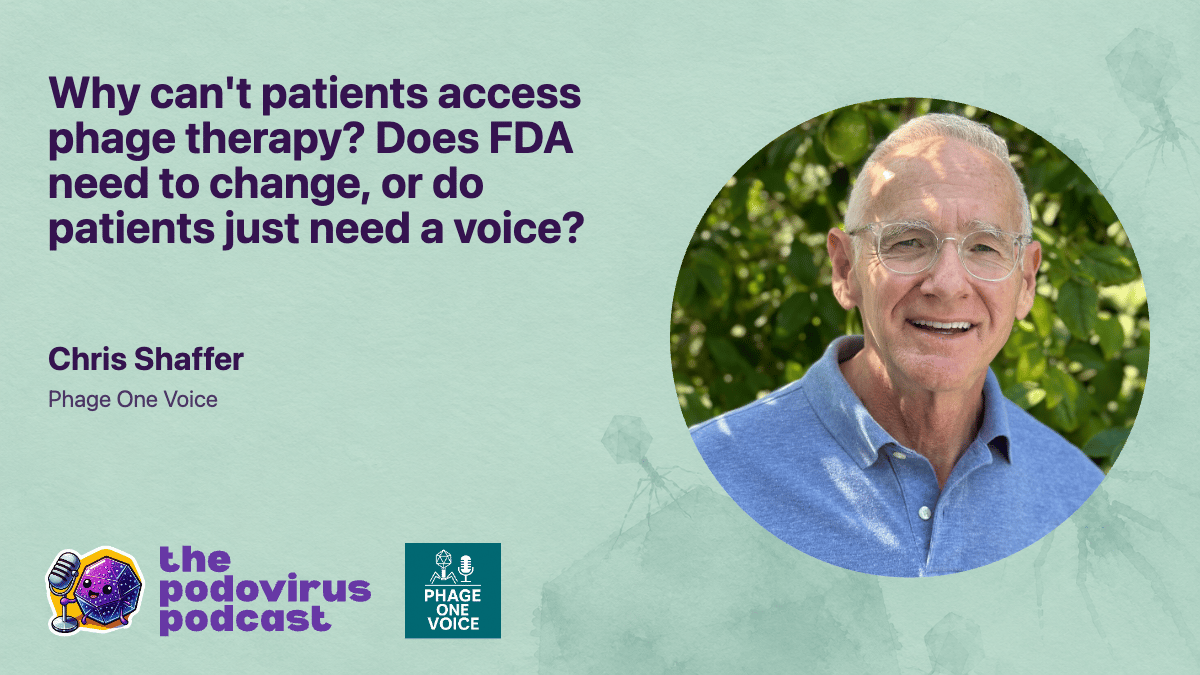
Why can't patients access phage therapy? Does FDA need to change, or do patients just need a voice?
The conversation
Episode notes
Retired teacher and high school principal Chris Shaffer describes seeking phage therapy in Tbilisi after repeated antibiotic courses failed to resolve his infection. His experience shows how unfamiliar treatments can leave patients navigating trust, specialist contacts and care while sick, and prompts a discussion about practical ways to improve access alongside clinical research.
Reading research did not settle Shaffer’s doubts about treatment abroad, but speaking with a former Eliava patient gave him enough trust to decide to pursue treatment himself.
Shaffer reports that testing found no E. coli two weeks after his final phage round, with that result persisting almost 20 months, following two years of unsuccessful antibiotic treatment.
Jessica proposes fundraising for a nonprofit compassionate use center and laboratory preparation costs, while Joe describes an HIV precedent for pursuing access and clinical trials together, leaving implementation unresolved.
Episode timeline
- 0:00 Introduction to Chris Shaffer’s search for treatment
- 7:48 Discovering phage therapy and deciding whom to trust
- 14:59 Treatment at Eliava: logistics, early results and costs
- 28:56 US access barriers, patient advocacy and Shaffer’s recovery
- 43:30 Weighing research, treatment costs and a nonprofit center
- 59:18 Communicating safety evidence and building informed patient advocacy
Learn more
Guests and background
Further reading
Transcript
AI-transcribed and edited for readability. May contain errors or omissions; check the recording for exact wording.
Select a word or timestamp to listen. Use arrow keys to move between words.
- Jessica Sacher
Hello. Welcome, everyone, to Podovirus. So today is a special day. Joe and I are here with Chris Shaffer, and he is going to tell us about what it's like on the patient side of phage therapy. So he lives in the USA, and he's gonna tell us about his story. But he tried to get phage therapy to treat an infection and was unable to do so here.
And so he traveled to the Eliava Center in Tbilisi, Georgia, and so… And I know Chris has recently even written a book about his experience, right?
- Chris Shaffer
Yes.
- Jessica Sacher
That just came out, so that's what prompted me to reach out and say, this is a perfect time, maybe to talk to you. And I met Chris, last year at the Evergreen Phage Conference—or now it's two years ago—where he shared his story. So super excited to have you here, Chris. And maybe you can kind of give your own intro. Who were you before phage therapy?
And then we can launch into your quest to find it.
- Chris Shaffer
Okay, great, yeah. Thank you so much for inviting me to be a part of this and to tell this story. Cause I do think it's really important, cause there's so many people who have these infections that they can't treat now. In fact, I just spoke to a fellow today who's from Palm Springs. He's on his fifth round of IV antibiotic treatments. He's had his prostate removed, and now he's back in the ER with sepsis.
And he hasn't tried phage yet, but I'll get to that later.
- Jessica Sacher
Okay.
- Chris Shaffer
Before this all happened to me, I was a high school principal and a teacher for 45 years and I just recently retired. And, I do miss it. I really do miss it. I do get bored sometimes, but I'm enjoying retirement too, and enjoying the phage advocacy that I'm doing. So hopefully that brings about some advancements in the accessibility of phage. So I'll tell you about how I came upon this infection.
So in 2018, I had a colon resection due to diverticulitis. And you know, fast forward about six months and a hernia develops over that scar, the incision area. And so I had to have that fixed. And we were just coming into the throes of the pandemic at that time. And so then that surgery failed and I had to have it revised.
But I didn't wanna have the same person who did it initially do it again because I wasn't real confident that it was gonna go any better than the first time. So I did a lot of research and found somebody that did the Lichtenstein procedure over at UCLA, and it's a very specific way that they repair hernias. And I did that, and what we found was that the mesh had come out. It was causing a blockage.
So in between those two surgeries, I had to go into the emergency room a couple of times and had to have an NG tube inserted so that the blockage would try to resolve without major surgery. And that's where I believe that this infection originated. You know, you can't prove these things and you can't know them for a fact. But knowing what I know now and looking back on how that NG tube was handled.
So I remember the nurses coming into the ER room where they placed it into my nose, and it was not in a sterile package. And they placed it on the sink before they put it into my nose. You know, looking back on all of that, where did it? Where was that tube before it got to my room? And, you know, the E. coli with the ESBL is a common infection that's hospital acquired, so it all kinda stands to reason. But no, there's no finger pointing at this point. I just wanted to get better.
So I'd had the surgery and was recovering in the middle of the pandemic. I thought I was gonna get through the whole thing with no Covid, because I wasn't going anywhere. You know, we were teaching online. I was here, right where I'm sitting right now, teaching my classes and thought, for sure, I'm not gonna get Covid because I don't go out.
And sure enough, here I get really, really sick. I had fever, I was coughing, chills, everything that felt like a flu, a really bad flu, body aches. I was in bed and I thought, Well, I'm just gonna run down to the airport and get my PCR test. No need to take the first one. I wanna know for sure. Well, do I have Covid or not? And I did that.
I probably shouldn't have because I was really sick. I was running a fever of 103 104 at the time, and got that test, came back, got back in bed. And the symptoms just kept getting worse and worse. The next day, I noticed my hands started going numb. I thought, this is really bad. Something is seriously wrong here. So I called my doctor, my primary care physician here in Palm Springs, and told him what my symptoms were.
And he said, You have any other symptoms? I said, Well, I haven't been able to pee very well for the past several weeks. I was gonna tell him that when I went to see him in an appointment. And I had had some routine blood work and urine tests done a few days before all this happened. Thank God, I had that done just as a routine. And he said, It sounds like you have bacterial prostatitis and you're getting septic and you need to get to the hospital now, he said. Don't wait, get there now. And I did that. And about the time I got to the emergency room, my tests were coming back, the PCR test came back and I didn't have Covid, so we knew it
was probably bacterial prostatitis based on the symptoms. And then my urine test actually came back. They did a culture test, and it came back positive for E. coli with ESBL and my colony forming units were well over 100,000. And that never changed throughout this whole event, it was always above 100,000. Anytime I had the test taken, so they pumped me full of antibiotics. I did get a little bit better.
They sent me home on fosfomycin and I took that for about five days. I was supposed to do a six week course, but it was so toxic to me, I couldn't continue taking it, so I had to stop. They put me on Bactrim then for six weeks and I did actually get better. I thought I was gonna be normal, you know, this is all over. Finally was back at the gym, back to working. Everything was normal for about a month and a half, and then I started getting all the symptoms again.
So I called the doctor. He said, Well, it looks like it's returning. Let's put you on a twelve week course and surely this time that'll do the trick, right? I didn't know any better, and I knew nothing about bacterial infections. I knew nothing about phage, I didn't really know anything about antibiotics. Other than you take them and you're supposed to be better. I was an old music teacher and high school principal, I didn't know anything about biology, so I did my twelve week course and I'm better again for about maybe four weeks this time.
So this was the beginning of this yo yo of on again, off again antibiotics. I would take them, I would get better, and then I would stop taking them. Each time I started taking them and stopped taking them, the time in between when the symptoms would return would be shorter and shorter, and so ultimately, the symptoms just never really went away. I would go off the antibiotics and a day or two, I would have fever again, and it was just constant.
I had to stop working for about six months at one point because I just couldn't do it anymore. When you have a fever of 102, 103, 104, you just can't really function. And that's what I was going through constantly. It was just back and forth. So in between that time, I started doing a lot of research about what are the alternatives to antibiotics, because I knew these aren't gonna work.
I had learned a little bit about antimicrobial resistant infections, and I ran across the word accidentally phage therapy in my research. And I thought, Wow, you know, this is insane stuff. Somebody wants me to drink or put a live virus in my body. That doesn't sound good. How could that possibly be good, you know, based on what I knew? So I thought, Well, I'll keep looking into it and I'll ask around. But, you know, that kinda leads me to the first obstacle in getting phage therapy in the United States, which is you're never gonna hear about it. It doesn't matter what doctor you're seeing in the United States, you're not going to hear the word phage therapy.
I saw a number of infectious disease specialists and a number of urologists, and you name it. I saw dozens of doctors and anybody that knew anything about antibiotics, they all said the same thing. And the infectious disease specialist. Your only option when the bacterium fails, not if it fails, but when it fails, is to go into the hospital for three weeks and take an IV antibiotic toxic cocktail.
And I would ask each one of them, You know, what's that gonna do to me? Well, they couldn't tell me. Is it gonna cure me? It might, it might not, but you'll need to be in the hospital because it's a pretty dangerous procedure and you might not survive it. And I said, that's not gonna happen because I'm not going to do it. I'm not going to take that antibiotic infusion because I know where it's gonna lead.
I had done an antibiotic fusion when I was 28 years old. I had a terrible bicycle accident and I've had lifelong side effects from all those antibiotics to keep the peritonitis from developing. So I knew where that would lead. And I was learning more and more about phage. But again, there wasn't a single person in the US. that spoke to me about phage at the time, because I didn't know any of the phage, you know, the scientists or the people who are involved in it.
Which is, you know, and I know we all know it's a very small circle right now of people. But um, obstacle number one you will not hear about phage therapy, which is probably, I won't call it the biggest obstacle. I think there's another obstacle that may be even bigger, which I'll get to in a minute. So I started really digging my heels in on phage and I started asking the doctors about phage.
What do you know about it? Every response was either I've never heard of it or it's experimental, don't try it. So most people who hear that are gonna stop right there because we trust our doctors. And I'm not bashing doctors at all because they don't know about phage either. They've never heard of it. It's not taught in our medical schools. In fact, at one of my appointments, much later on, after I was taking the phage therapy, I spoke to an intern who came from a very prestigious medical training institute in the United States.
He was shadowing one of my doctors, one of my infectious disease specialists, and that was his area. And I asked him what he knew about phage, and he just came out of school. He had never heard the word, or at least he didn't remember it. So there certainly wasn't much, much coursework on it. And I told him all about phage. And I said, you're gonna be using it in the near future, I don't know how soon, but you're gonna be using it.
And I think he was just looking at me with crossed eyes and say, What? Who does this guy think he is? And he was just like, I'm so happy to get out of that room and have this guy stop talking about phage therapy. You know, fast forward a few months and I go back to the same doctor and that intern was there. He looked at me, he goes, he comes in the room, he goes.
You won't believe what happened, you won't believe what happened, he said. Yeah, I did have my first phage case, and he said over at, and I think it was at UC San Diego, he had a case and he told me about it. And I was like, Well, you're gonna be doing a lot of this stuff in the future. And I suggest you take a six month sabbatical. Go over to Eliava in Tbilisi and study with them and learn about what you're gonna be doing in the future.
Because it's here and it's gonna happen. It's not just not happening fast enough. So that was kind of my initial journey into it. You know, again, it was just on again, off again antibiotics. And once I came to understand that phage is a real science, that it's a real treatment. And I'll tell you how I came upon that is. I researched everything I could, everything I could possibly find in the literature. I read every case study. I think I read every book I could try to understand.
And so I have a decent education. I have a degree in political science and policy and leadership from the Ohio State University. So, you know, I can understand the science behind what's going on, so I can read it. But the other obstacle, which might be even greater than awareness, is trust. Trust in phage therapy. Is it a real science? is it a real treatment?
Is it gonna make me sicker? What's it gonna do to me? And are these people at Eliava Phage Therapy Treatment Center, are they real? Or is this just a scam another American's gonna fall into and I'm gonna spend a lot of money and get nothing out of it? And I met a man through one of the case studies that I was reading, and I wouldn't read just the case study. I would look at every co author that was listed on the case study, and I would research them as well. And I came across the name Pranav Johri, and you may know that name.
- Jessica Sacher
Hm, yeah.
- Chris Shaffer
I see you shaking your head yes, and I saw this name on this case study. So I looked, you know, I researched him. I said, this case study is about Pranav. This is his case study.
You know, I figured that out. So I said, I've gotta talk to this guy, cause he went to Eliava about five years before I did so. We had established communication and he told me his story. And when you hear somebody who's been through it like I have now, or like Pranav has, you know they're telling the truth.
You can just hear it in every word that they say. You hear all of the commonalities in what you've been through. And I was able to say, finally, this is real. I can trust it. I can trust the science behind it because I know someone who's been through this. And Pranav was cured using phage therapy from Eliava Phage Therapy Center, and that's when I made the decision.
It wasn't until I met Pranav and talked to him that I was able to pull the trigger on this. And, you know, like I say, I'm a pretty well educated guy. I can understand the science. But even knowing what I knew, meeting the people I had met, it wasn't until I met somebody who had been through it that I was able to pull the trigger on that treatment.
And then start the process, which is a long process of getting your samples to Eliava, getting them tested. Because what I found again are the obstacles in the United States just make it practically impossible to get phage therapy. Did you? Did you have a question? It looks like you had a question.
- Jessica Sacher
Oh yeah. No, this is so, so fascinating and just so sorry to hear this whole experience. But yeah, you're gonna be the next Pranav for the next person, so I'm happy to keep, like, keep listening. I was curious, like, where were you when you first reached out to Eliava? And what did they say to you? And, you know, get the sample? How did that go?
- Chris Shaffer
Yeah, so how I ended up reaching out to them was I realized it couldn't happen in the United States. Because if I found a doctor that was supportive, which wasn't going to happen—my primary care physician was supportive, but he didn't have any understanding of phage therapy. And that's kinda like the next obstacle is, if you are able to get a compassionate use waiver to try phage therapy in the United States.
the next obstacle was finding the phage. I didn't know anybody. Who am I gonna turn to find a phage that's going to work for my infection? That's another obstacle.
- Jessica Sacher
Hm.
- Chris Shaffer
And even if you are able to overcome that obstacle, what doctor in the United States is going to administer it to me? That has the institutional knowledge of how to do that? Because it is a complicated process to administer phage therapy. And I found that out when I got to Eliava, so I decided all of the obstacles are gonna be too much for me to overcome.
And I'm sick already.
- Jessica Sacher
Hm, yeah.
- Chris Shaffer
I can't do this being sick. I've gotta get the treatment now and I've gotta get it as soon as possible. So I learned how to send my samples in a Copan eSwab over to Eliava. They communicated with me that this infection was a stubborn one and I knew it would be, and I needed a custom phage. One of the off the shelf phages would not work for me.
- Jessica Sacher
Was it still the ESBL that you had before?
- Chris Shaffer
Yeah.
- Jessica Sacher
Hm, hm.
- Chris Shaffer
It was E. coli with the ESBL, and they had a phage. They said it would take them ten to twelve weeks to prepare it. And I was like, okay, in my mind, I was saying, as soon as they call me and tell me, or email me and tell me that the phage is ready, I'm going because I just keep getting sicker and sicker and sicker.
My doctor here in Palm Springs, we both decided that going off the bacterium at this point, since I was so sick, because I was having symptoms on the bacterium—the going off of it was a bad idea. Because it would give the bacteria just one more opportunity to mutate again, and the bacterium would not be effective at all. It was keeping me alive, but not very alive, if that makes any sense. So I was sick even on the bacterium. I had high colony forming unit numbers even on the bacterium. So they emailed me and told me that my phage was ready. That was at the end of May, school was just about out, and I got a ticket, excuse me, to Tbilisi. And my niece agreed to travel with me.
She was also a teacher and she had the time off so she could go with me. I was afraid: if I got sick, either on the way over there or while I was there, who was gonna take care of me? So she agreed to travel with me. That was a big help. Sorry, maybe that'll help a little bit.
- Jessica Sacher
No worries at all.
- Chris Shaffer
So I left on June 5th, got there on the 7th. It's a two day trip and then I started treatment on the 9th. And I was really comforted when I sat down in front of Dr. Lia, who's at, Eliava. And what comforted me the most was, again, her institutional knowledge and her background and expertise in knowing how to use phage therapy, how to administer it, how to dose it, how to monitor and modulate it all through the treatment.
If you need that. And she said, very matter of factly, when I sat down across from her at her desk, she said, You know, we're gonna do three rounds of 20 days each and we'll take a ten day break in between each. So that the bacteria doesn't develop a resistance to the phage. And she was just very matter of fact, and she said, and that should do it.
And she said, if it doesn't, then we'll reassess at the end of that. And if we have to add another phage, we'll do that. But hopefully the first three rounds do it and you're fine after that. And as for what the cure rate there was at Eliava, she said it was 85%, and having gone through the treatment, I'm sure that's correct, that it is 85%.
And what I found out in going in person—and I wanted to stay for the entire first month and go through the first treatment there. Because I knew that if this worked, that I would be someone who would want to spread word about the phage success. And that this treatment is available, although not in the United States in the way that it should be. No one should die from this.
And that really is probably the thing that upsets me the most about where we are today. Because we know phage works, we have availability of it, we could do it, but we're not doing it yet. Not, at least not in the numbers that we need to be doing it. And that's why I went to Eliava. I wanted to know these people personally, I wanted to know what they did, and I wanted to know, is this real?
And something that someone could rely on? That they could go there to Eliava or do their telemedicine and they could get a cure if they needed it, if the antibiotics weren't working. And again, you know, we hear antibiotics first and phage second, you know, I'm not so sure about that. I think we need to be turning to phage first more often than we do.
And I know that in Tbilisi they do that, you know, I talked to some folks who were at the clinic getting phage. I said, no, we would not take antibiotics first, we'd take phage first, we would give our children phage. Because there's no side effects, and we know that I had no side effects from the phage. You know, it's two little vials of a liquid that you drink that you have to do it on an empty stomach because acid can affect the phage. And that's the only thing I had to modify was my intake of food. When I ate, I wanted to make sure I was on an empty stomach. And then I used a suppository in the evening because proximity matters in phage therapy.
- Jessica Sacher
Yeah, so could you have taken this as distance treatment if you wanted to? Was that an option?
- Chris Shaffer
I could have at the time, so I started looking into it, what, three years ago? And their success rate was better for in person treatment. They didn't have good numbers on telemedicine because those numbers, obviously, are much harder to get, and it's much harder to know. Did people take the treatment the way they were supposed to take it? So I took it exactly the way you're supposed to take it.
I never missed a dose. It was always on an empty stomach. I made sure I did it to the letter, cause I wanted this to work. Number one.
- Jessica Sacher
Yeah.
- Chris Shaffer
So, you know, I went through the treatment there at Eliava and then at the end of a month—and just as an aside bar, if anybody ever wants to go to Eliava or to Tbilisi, it is such a beautiful country and the people are so friendly there. So I would highly recommend to put it on your bucket list of a place to travel to. Because I want to go back now as a really healthy person and see the whole country and revisit my friends because I made friends over there with the staff
at Eliava. They were wonderful. I would not have any hesitation of recommending to anybody that they go to Eliava. They can't get the treatment in the United States, and I've tried to get good numbers on how many people have been treated in the United States, and it's not easy. I don't know if you've tried to find out how many people have gotten compassionate use waivers in the United States.
I was speaking to Tobi Nagel on a webinar a few days ago and she said 2,000 have gotten compassionate use. And I think she was talking globally, I don't know that she was talking just in the United States.
- Jessica Sacher
I think so.
Yeah. There's a paper out, like a review, systematic review of all the case studies and clinical trials that group could compile. And I feel like 2,000 was the kind of total number. I don't know, Joe, do you have any updated stats on that?
- Joe Campbell
I haven't tried to get that number recently.
- Chris Shaffer
Based on the number of people that are dying every year, it's a drop in the bucket, the number of people who are getting phage. And I was able to come up with a few hundred in the United States. I couldn't really get much past that. You know, I think Mayo's done about 100, Ben Chan over at, Yale has done about 100, and IPATH has done maybe 20 or so cases. And there's not a whole lot more than that. Interesting.
Ben Chan was presenting at the Evergreen Phage Conference when I was attending. And that was at the point where I was middle way through my treatment. And Ben had presented a slide: pre- and post-treatment CFUs during phage therapy, and the CFUs dropped precipitously. And I had just that day gotten my urinalysis culture results back. And when I saw that slide, I was like, Oh my god, that's what just happened to me. My CFUs came back under 50,000.
That's the first time in over two years. I had been on antibiotics for two years. My CFUs never came back under 100,000. And I had been on the phage for this. I was in the middle of my second round. The numbers came back under 50,000. So I was watching these slides, you know. My attention was really grabbed.
- Jessica Sacher
Was this Evergreen, you said?
- Chris Shaffer
This was at Evergreen. Ben Chan was there.
- Jessica Sacher
So you were on the treatment then. That was—
- Chris Shaffer
Yeah, I was on the treatment then.
- Jessica Sacher
That's when we met.
- Chris Shaffer
Yeah, even when I was giving my my presentation, it was kind of like a speech. I didn't have slides. I know I need slides anytime I present now, like that again, cause everybody uses slides. I didn't know that at the time and I was not all that well, so that's my excuse, you know? So I had a little vial of phage sitting on the podium. And I don't know if you remember.
I went over and stood in front of Scott, you know, from the
- Jessica Sacher
the FDA Scott,
- Chris Shaffer
FDA. And when I finished my treatment, I just said to the audience, and really kind of to Scott, why do we allow IV antibiotics? If you remember, I pulled my sleeve up because I had this huge bruise on my forearm. Because that's one of the side effects that I got from that IV antibiotic treatment that I had when I was 28 years old.
And I still get those today. It's like a purpura like condition. I had a bruise all up and down my arm. And it's just spontaneous bleeding that happens under my skin and it's never stopped. It'll happen, just it's spontaneous. I don't know when it's gonna happen. It just so happened that I had that reaction at the conference. And I pulled my sleeve up and I said, Why do we allow antibiotics that cause reactions like this?
And we don't allow phage? And I took the lid off, drank it right in front of everybody and said, And we don't allow this. That has no side effects, something's not right, you know? And I know we need more data. I'm not saying that we should stop doing studies, I'm not saying that we should stop doing clinical trials, I'm just saying we need to lower the barriers to getting phage therapy, you know, it's like, if we saw, 100 people out in the ocean on a swimming and drowning, and we had lifeboats, but we weren't 100 sure those lifeboats would work.
We would lower them, we would put them in the water and save those people. And that's what we need to do with Phage, because we know it works. We need to make it easier. We need to pass the PASTEUR Act, we need to do things that are gonna make a difference for people. Now, like I was dying, we need to have phage available and not put so many roadblocks and obstacles up in front of it.
We're never gonna get anywhere if we don't start using it because people are dying in the hundreds of thousands every year in the United States, and I can't understand why.
- Joe Campbell
Sort of speaking of why these things happen? I guess I don't know the answer to this. Did you pay Eliava for your treatment?
- Chris Shaffer
Yes.
- Joe Campbell
Do they get funding from their government? How does that work?
- Chris Shaffer
I don't believe they get any funding from their government. If they do, it's probably minimal. You know, it's a lower income country, but they have great treatment there. So, yes, I paid for the treatment. So, I'm glad you brought that up because a lot of people probably wanna know, how much does it cost? At the time I got it, the cost may have risen a little bit.
But for the phage therapy, I saw doctors every day, physiotherapy, all of the lab work, all of the ultrasounds or any pictures that needed to be taken. $4,600. I thought that was a really reasonable cost. That was the total cost for everything.
- Joe Campbell
And that was the total cost, including…
Then you, well, you paid for your flight, and—
- Chris Shaffer
Right, right? I paid for the flight.
- Joe Campbell
And you— and you had to stay in a hotel.
- Chris Shaffer
I had to stay in a hotel. And they have an arrangement with a very nice hotel for 50 bucks a night. So the entire thing cost me $10,000. $10,000 covers one three-week IV antibiotic treatment, if insurance will pay for it. That's just the antibiotics, not the hospital stay. $10,000 just for the antibiotics for that one. And I had no intention of doing that, cause they couldn't tell me what it would do to me.
And I knew phage had no side effects. It's really kind of a no brainer. There's no downside to phage, which always brings me back to the question, why aren't we using it for those people who are dying right now, dying today? And again, you know, I was telling you earlier about the fellow that I spoke to just before this podcast, he, has done, I believe, five IV antibiotic, 35 day rounds of treatment.
He had his prostate removed. I mentioned to him, You know, I'm not a doctor, I can't tell you what to do. I don't think this is going to cure you, I don't think you're gonna be rid of this. He's back in the ER again today with sepsis, and…
He's had everything done, but he won't do phage because he doesn't trust it. It comes from trust.
- Joe Campbell
Yeah. So I have a question about the timing of some of the things you told us, the intern that you first told, a, and you said, and then they were experienced it at UCSD.
- Chris Shaffer
Yeah.
- Joe Campbell
Did you talk to that person before you went to the Eliava, or did you talk to them? I mean, did you try to get that person to put you in contact with the people at UCSD? Cause I know the people at UCSD IPATH do treat a lot of people.
- Chris Shaffer
they, I don't know how many they treat. I know that they're currently saying, don't send anybody our way. And the numbers that I've seen that they've treated is 20 or under. And the infectious disease department. I tried getting in over there before I knew anybody in Phage. They're not, they haven't accepted new patients for two years at that point when I asked them, and I still think they're not accepting new patients.
So in general, the answer you're gonna get is an email or we're not answering the phone and don't send anybody our way. For generally all the places that are offering phage therapy, I think the Mayo is probably where Gina Suh is probably the most accessible. If you can get through to it, I was never able to get through to IPATH or UC San Diego.
I tried. I got an email that told me how to file a compassionate use waiver, which I wasn't gonna do anyway, cause I just knew the obstacles to getting the treatment. They're just too great, especially when you're sick, you know, you're doing this and you're not well. It's really hard. It's really hard to make those phone calls. It's really hard to follow up when you're not well, because sometimes you just can't make the phone calls. You're just not well enough.
And I knew I had to get to Eliava, and that was really what I believed, right or wrong, was my only real hope of accessing phage therapy.
- Joe Campbell
Yeah, I mean, it's something that I think we all worry about a little bit. I mean, I will say that I know some of the people at the NIH Clinical Center and they had a patient. And, like, a month or so ago, they reached out to me because I know a lot of people. And they were asking me for advice as to who they should contact for getting phage sent to the NIH Clinical Center so that they could give it to their patient.
And I need to follow up, but I did put them in contact with some of the folks at Pittsburgh, and there's a big phage group there. And there was, at least, you know, I think the isolate was gonna be sent to Pittsburgh, but I don't know what ended up happening. But yeah, no, it's a real challenge. And I think, you know, I am glad you're doing advocacy. I mean, I think there is a problem. I mean, I used to go to the World AMR meetings every year, and I've not gone the last few years. But, you know, there's always this discussion about why there isn't so much advocacy.
- Chris Shaffer
Yeah.
- Joe Campbell
And it's, you know, people. Many antibiotics still do work quite well if the infections aren't resistant. And, you know, people tend to recover from them in ten days. And then there are people who, unfortunately, pass away quite quickly sometimes. And it doesn't lend to this group, like, you know, you have cancer patients, where you get these support groups and all of this stuff. And I guess, to my mind, that's a real challenge. And I don't know, since you've become an advocate, if you've, you know, had thoughts on how to overcome that challenge.
- Chris Shaffer
I think you're spot on in what you just said. Yeah, I think, you know, this is kinda like the slow pandemic or the slow epidemic. And this takes me back to the early days of the HIV crisis, you know, in the 80s and the 90s. This feels just like that. People are dying. You're not hearing about it. We need a Larry Kramer. We need somebody to go to the...
We need a group like Act Up to bring this to the public. We're not going to get phage until people start demanding we have phage. It's going to be in the background. It's not gonna be heard. It's not gonna make noise. Because there's not a real big return on investment, you know. It's why we don't have new antibiotics in the pipeline is because pharmaceuticals aren't taking it on.
Pharmaceuticals certainly aren't gonna take on phage therapy because it's a live virus that you cannot own. Where? Where's the return on investment? I think the return on investment is probably in the treatment aspect of it, having the institutional knowledge that you can sell to treat people with phage, not the actual phage itself. It's gonna take government entities to bring phage to the market because pharmaceuticals aren't gonna do it.
It's gonna take world governments acting together, making phage available, and then treatment centers using that institutional knowledge to deliver the phage. Monitor it, modulate it, whatever they need to do the treatment as it's in somebody's body, and how is it responding, and what do we do to make it successful treatment?
- Joe Campbell
Yeah, I mean, I know I've heard Gina talk many times, and some of the times Gina's from the Mayo, talks about, you know, sort of how not crazy, but sort of maybe slightly haphazard. Her process is when she decides she needs to find phage for someone. You know, she contacts Baylor. Sometimes she contacts the folks at Pittsburgh. Sometimes she contacts various companies, and it's not, and it frustrates her that it's not more of a, you know, a systematic process.
- Chris Shaffer
Yeah.
- Joe Campbell
And you know, I, an older retired person—I was riding the train yesterday and I was reading Fauci's book, and then you mentioned HIV, and you know, the, you know, during the second Bush administration, there was, you know, this thing for African nations, you know. That was really frustrating to people that a lot of people were still dying of HIV and AIDS in Africa. Even though it started to be, you know, well treated or fairly well treated in the US. And they set up this PEPFAR program, which was a program for the US. to help, people in African nations get the, you know, advanced cocktails for HIV. And you know, I've tried to look into whether that something like that could happen for AMR. You know, I mean, I, yeah, so I don't know, so maybe you're gonna get to this. But what have you been doing in your advocacy efforts to do stuff?
- Chris Shaffer
Talking about it as much as I can. I've written a book on the topic. Getting a book out into the hands of people is difficult, and I'm just talking about it to whoever will listen. And because we don't know about phage in the United States, beyond this small circle of scientists and patients like myself, I can name the patient advocates, there's only a handful of us, I can name the doctors who know about phage therapy in the United States.
Like Dr. Sue Ben over at Yale, there's only a couple, a handful of people that know how to do this in the United States. Until we start making the public aware, there's not gonna be a demand for it. You don't even know this exists. Your primary care physician has no idea phage exists, and they would not ever tell you about phage again.
That's obstacle number one, and until we create a demand for it, it's gonna sit right where it's at. That's my opinion. I don't think we're gonna make any advancements until we have a demand for phage. Until people who are dying know that this is out there, and their relatives and their friends and their loved ones know that. Wait, my friend could have saved his leg. I have a friend that visited me a few weeks ago.
Her uncle had his leg amputated three different times, all the way up to the hip because he had an infection. She had just heard about phage from me, she said. Would phage have worked for his leg? I said, Well, I don't know, but probably it would have. They use it. They do it in wound care. I know it's successful. There are people who can access it, like I could access phage today in the United States because I know enough people, but I'm probably one of a handful of people that could make that happen.
I had surgery in July again for another bowel obstruction, and it was over at Cedars. And the incision got an infection. Three different bugs—Pseudomonas, E. coli, something else. I can't remember what the third one was now. They had to open the wound up and they had to put a wound vac on. I was on my phone texting [name unclear] about where I could get phage for this.
Because if this thing can kill me in a heartbeat, you know? And she was trying to source a phage for me. The wound vac actually worked, and I didn't need any phage or any antibiotics, so it worked. But I was in. I had access that nobody else has, or very few people have. And why is that the case? Why is it that I could get that treatment, but nobody else could in that hospital who had similar infections?
And I spent six days in a triage area. Everyone in that triage area had an infection they were dealing with. Literally every person I heard was talking about an infection. So I know that we've got this huge crisis coming at us and we're not again. We're not using phage to the full extent that we could be. We could ramp up the production of phage, we could ramp up our capacity, but we're not doing it and we're allowing people to die and that should not happen.
We need to make phage available to people like me, the regular person who's dying. I shouldn't have to go through all these obstacles to access phage therapy. I shouldn't have to hop on a plane and fly halfway around the world to find a cure that worked. In four months, I was cured in four months. Antibiotics failed me for two years, and I'll tell you the day I found the cure.
It was the third round of those 20 day treatments, and I woke up in the morning on the third round, the twelfth day. And I walked into the bathroom to do my morning routine. Like every day, I had my toothbrush ready to put it in my mouth. I was looking at my weathered face and I said to myself, "It's gone, it's literally gone."
I could tell. I didn't need a test. I didn't need any kind of blood analysis. I knew it was gone. I could believe it or not, I could feel my prostate healing. And I just looked in the mirror and looked at my face. It's gone. I sat down on the edge of the tub and I started to cry. I literally did, cause I knew it was gone.
And, sure enough, I finished that last round of phage. Two weeks later, I had a test, no sign whatsoever of E. coli, and it has remained that way ever since. That's been 1819, almost 20 months ago, and it happened just like that. So the phage works, no side effects. Why can't other people access it? And that's what I'm here to do. The rest of my life will be spent advocating for phage therapy.
I sit in a very unique place. I'm 67 years old, I'm retired, I have a pension, I don't need any money, I don't have to look for a job. I'm not doing this because I think I'm going to get some kind of job out of it or some kind. I can say exactly what I wanna say, and not everybody has that freedom. And I know that when we're working with the FDA, when we're working with NIH or any of those places, when we're talking to them, whatever we wanna say.
Sometimes we have to watch what we say because we don't wanna create enemies, right? Nobody wants to do that. Well, that won't further the cause of phage therapy. I sit in a very unique place. I had phage therapy, it worked, and I'm not looking for any kind of advancement. I can't wait until the day where they say, Schaefer, nobody needs you anymore because phage is out there, everybody knows about it and everybody's using it.
You don't ever have to say another word about it. And that will be the successful day. That will be my measure of success. When nobody asks me to say anything about it anymore. Because we desperately need to do something different than we're doing now. Because, you know, you've seen the most recent statistics. The Lancet said almost 40 million people, and that I think this is the third time they've revised that figure.
Almost 40 million people by 2050 will die of directly of antibiotic resistant bacteria or resistant microbes. The number that most people aren't looking at is the one that was below that 69 million related deaths. That 39 million number, almost 40 million, those are direct deaths below that. There was a number 169 million that I don't hear anybody talking about, so that's almost 200 million. By 2050, they're gonna die of some form of AMR infections.
We've gotta do more.
- Jessica Sacher
When you speak about this, who are the kinds of organizations or groups that are inviting you? Wh, who's?
- Chris Shaffer
It's been mostly the podcasters like yourself. I've, done some talks with the phage hunters in Kenya, I'm not sure if you're familiar with them, done a lot of work with them, helped them a lot along with their panel discussions. So definitely not enough. When I was at UM… When I was at Cedars, I was the guy, the patient that wouldn't stop talking about phage.
And they heard me, they literally heard me. Diane Shader has also been working with Cedars. And when I left there, I had made a friendship with one of the physicians that was on my surgical team. And I said, "You have to get involved in phage therapy, you absolutely have to." A young guy and he contacted Diane and they've made a connection. And I believe that they have now agreed to do some kind of phage trials at Cedars for the first time.
And I know that Diane was really working that angle, and I think it's now happened, so that's amazing. I'm gonna work on UCLA, I've got a doctor that I'm speaking to over there who has some interest. And see if we can get UCLA on board with some kind of phage trial of some kind. It's gonna save huge amounts of money for insurance companies and hospitals.
But they just, I don't, apparently they don't see it yet.
- Joe Campbell
Well, I mean, I'm somewhat playing Devil's advocate and somewhat just, I mean, I will say you mentioned Scott, who I assume is Scott Stibbe, it's from the FDA. And preface this saying Scott is someone I consider a friend.
- Chris Shaffer
Good.
- Joe Campbell
And you know, I think Scott’s group has taken a pretty reasonable approach. And when you talk to Gina, or you talk to other people I know who do compassionate use, it's not usually the FDA that's holding things up. And in terms of, you know, what are the obstacles? I mean, I think it's pretty expensive for people right now to, you know, do a prep, get it into people.
All of those things are very costly. You know, I understand that, you know, there are many cases like yours, though, which are just wonderful to hear about. But, you know, I mean, I'm curious, do you have any thoughts on? There are a lot of ongoing clinical trials, and if, and hopefully when, the clinical trials start showing some efficacy, do you think that will move the needle?
- Chris Shaffer
I absolutely hope it does, but, you know, from my position as a person who was dying, we're not doing enough. It's not fair to tell someone who's dying, well, you're just gonna have to wait. You tread water a little longer. And maybe we can get that last little hole in the lifeboat plugged up and we'll drop it. But we're not gonna drop it until we're 100 sure that that lifeboat is gonna float. Otherwise, you're just gonna have to tread water.
And, well, you might drown, but, you know, at least you didn't drown in the lifeboat, right?
- Jessica Sacher
Hm, hm.
- Chris Shaffer
And we know, we know phage works. And again, I'm all for clinical trials, I'm all for more study and research. But we have 100 years of research and data on phage therapy in use in Tbilisi, and the cost isn't that high in Tbilisi. And in the United States, we tend to make things expensive, they don't need to be expensive. And I'll give you a perfect example.
When I go get my blood taken for testing here in Palm Springs, it's gotta cost several hundred dollars, if not more than 500. I don't know what the cost is because I don't see it, but I know it's very expensive. Because they put a little tube, it like a little IV in my arm, and then it's got a long tube, and then it's got a butterfly on the end of it.
And then how many tubes do they put on the end of that to take blood? There's like a dozen tubes that they collect blood in. When I was at Eliava, I got my blood taken and I went into the nurse's office and I was standing. She said, "Hold out your arm." I held out my arm. She swabbed it with an alcohol pad. I was still standing and she inserted a syringe, pulled the blood out one syringe.
That's all they needed. They did all the testing on my blood that was necessary. The same number of tests they do here in United States, she did with one syringe. You know, what do those syringes cost? A dime? So we make things really expensive in the United States that don't have to be expensive. And I will tell you one of the really profound things that I learned, and I won't tell you where I learned this because I don't wanna name people.
But when I was under treatment, I discovered at one of these facilities. And I don't think it's an unusual thing to happen. I think it's probably very common that it's happening like this, and I think doctors are learning this from friends. An infectious disease specialist, one of them that wanted me to get this $10,000 IV antibiotic treatment, that's just the antibiotic.
He's not only the doctor who prescribes it, he's the doctor that sells it. And that stinks bad enough. But not only is he the doctor who sells it, he's the doctor that owns part of the hospice center that treats people when they're dying from these infections that they aren't curing with these IV antibiotics. That really stinks. And there's no way that that is a reasonable thing to be happening in United States.
And I don't believe for a second that that's a one off. I think this is common. I think it happens all the time. And so, yeah, I think we need more research, I think we need more clinical trials. But we also need to lower the obstacles to getting phage therapy. So that people like Gina and Ben and everybody else who's doing it can. You can bring more people on board and more people who can do it and who can administer phage therapy in this country.
So that people don't have to hop on a plane, fly halfway around the world and spend $4,600 to get phage therapy at Eliava.
- Jessica Sacher
do you think you could? I feel like, because, you know, the clinical trials will happen. And that will incentivize, like, you know, that will be aligned with the current system. To get somebody to be able to make money from doing phage therapy. And that's like, probably what you have to do for that side of things, for pharmaceutical companies to make money, they have to do the trials.
But, like, to have another source of money, like coming in. Like, if you coalesced a group of people that would, you know, fund, like a nonprofit Phage center that would just do compassionate use. And so it's always informed consent, and it's supervised by a physician that you would pay. Like, maybe there would be a way, like, as you said, the funds for that could be aligned with the Eliava.
If it's oral phage therapy, and if it's, you know, done as a compassionate use. And so, like, you could kind of create a reasonable budget for a center to run like that as an independent entity.
- Chris Shaffer
Yes, you are reading my mind.
- Jessica Sacher
But I don't. Yeah, it's like, it's not gonna be a business that's gonna do that, cause it won't be a big business. And you're not gonna be able to really charge for it.
- Chris Shaffer
There is a place here in Palm Springs, and I'm speaking to someone who's involved in that place right now. Which is, it may do. We may be able to get something moving exactly on the lines of what you're talking about. That's what I wanna see happen. But it's gonna be a treatment center that is already running some kind of compassionate use program. Ish kind of work that they do, and that exists here in Palm Springs.
And I, and Palm Springs being a resort paradise, could be a place where people would come and get some kind of treatment like this.
- Jessica Sacher
Yeah.
- Chris Shaffer
So you read my mind.
- Jessica Sacher
becau, yeah, cause just being on the side of being in a lab, being in a series of phage labs and some of those where we treat patients or we make preps for patients. Like, there's no source of funds for compassionate use work, and even a few thousand dollars a patient would kind of be enough. And so if there's actually demand and among regular people that wanna fundraise in the standard way and just raise that money.
Like Diane Shader Smith raises money on behalf of her daughter Mallory, who died of an infection, as we all know, and almost got phage therapy. And that's what led me to start Phage Directory, and she raises money through that. Like her profession is as a publicist as well, so she knows about that sphere. But I've always felt like, yeah, so she donated money actually to Stanford, where I worked, so that we could start doing phage therapy here. So it's like small amounts of money could actually just empower the research labs in the US. like the Ben Chans and UCSD, to have at least the funding to make a phage prep. And then it won't have to be as expensive because it's only going through that compassionate use channel. I've never found the wherewithal to build that fundraising network, cause I've not decided that. That's like, I feel like that's a big
direction to go in. And I wouldn't be the one who has those contacts. But I feel like if I can help you do that, or at least provide the encouragement and then help direct the funds. Like, I know exactly who's the closest, and I wonder if that is something you see.
- Chris Shaffer
Yeah, that too. And even patients who need the phage would be willing to pay for it.
- Jessica Sacher
Yes.
- Chris Shaffer
I would have easily paid $10,000 here in the U.S. for phage if I could have gotten it here and gotten the expertise in the dosing administration of the phage. I may even ask you to get involved in a talk with me with this place about exactly what you were talking about.
- Jessica Sacher
What do you think, Joe? Rogue idea of—
- Chris Shaffer
Yeah, hm.
- Joe Campbell
I don't know. I mean, I think, you know, I think people have to think really hard about this. And I think, unfortunately, I think there's a little bit of a tendency to. And maybe again, there are less lessons to learn. You know, there was a lot of hostility initially between Larry Kramer and Tony during the early days of the HIV crisis. And I was interested in reading Fauci's book for a number of reasons, including sort of the discussions on how their relationship evolved into a situation where, you know, Kramer was very critical of Fauci and later came to regard Fauci. As you know, to understand better Fauci's point of view, and Fauci
better understood his point of view. And you know, there was a time when people were not allowed to get certain HIV drugs, cause they were reserved for people who were able to be in clinical trials. And they came up with something, you know, something they called a parallel pathway, where people who weren't eligible for the clinical trials could get the drugs under compassionate situations.
- Chris Shaffer
Right.
- Joe Campbell
And the people who could be in the trials were in the trials. And that kind of came from understanding of think Kramer and other of the Act up people better understanding why Fauci and those other people wanted to have what they, you know, were putting those rules in. And Fauci being willing to understand their point of view and trying to get to something where cause I.
I would encourage both sides to sort of realize that, you know, the people in the FDA, they really want phage therapy to work, and they want it to be tested rigorously so that it can be used in the most effective way. And I think there's a tendency sometimes when I read certain things to review the FDA. As just like strictly being an obstacle and strictly being sort of, I don't know, not exactly, you know, an adversary and I and the FDA.
Maybe in response to that, regard certain people as sort of like, Oh, they're not serious about the science. And I think neither one of those things is completely true.
- Chris Shaffer
Hm, hm.
- Joe Campbell
And I think that, you know, and maybe some of the lessons of the extreme, the more extreme positions that Larry Kramer was taking about Fauci. Well, he's now sadly passed away, Larry Kramer. But I think by the end of his life, he would say that those things that he thought about Fauci at the time were not really accurate. That, you know, there was more to Fauci than just like he was putting these rules in. But when Kramer understood them and they worked together to understand how they could craft something, that would sort of, you know, be not a compromise exactly, but something that would incorporate the concerns of both of them in a way,
- Chris Shaffer
Yeah, no, I think you're absolutely right.
- Joe Campbell
a way that, you know, I often get uncomfortable with. I mean, I thought the Tom Ireland book The Good Virus was good in a lot of ways, but it, I think it also could lead people to sort of reading it, to get sort of a view of the FDA is just a pain in the ass that's getting in the way of all this. And I mean, maybe cause I'm friends with people in the FDA, but I don't think that's a really reasonable take.
- Chris Shaffer
And I don't think the FDA is the enemy. I think they're doing great work; I think they're doing great things. But I also think, like you just said, there is another middle ground that we need to get to, and we need to get to it quickly. Because again, you know, once you've been in a situation where somebody's telling you you're going to die, you're gonna have to take these antibiotics or you're going to die.
Well, if I take those antibiotics, I'm probably gonna still die. Just like the guy I'm talking to right now, back in the hospital with sepsis. I don't know whether he's gonna make it past today. And he's afraid to try phage because the FDA has not approved it, and he thinks it's not a real science, he thinks it's not a real treatment. That's would offer him any hope because it hasn't been approved by the FDA, it's not given its seal of approval.
But we know that it works, and he knows it's worked on me, he knows my story.
- Joe Campbell
You know, one thing, and I don't know if the FDA has published this. But one thing that's striking is that, you know, for most new experimental antimicrobials, you're required to do a, you know, expose healthy, uninfected volunteers to that because of safety concerns. That isn't generally required for phages. You might tell him that, I mean, I think, and I believe there's probably records of Scott saying this in public settings that the FDA views phages as safe.
And from the times I've been involved peripherally, or somewhat, sometimes a little bit more directly in clinical trials, the FDA overwhelmingly believes that phages are safe.
- Chris Shaffer
Hm.
- Joe Campbell
And in fact, from what I've talked to Gina and other people who've been involved in compassionate use cases, I mean, the FDA, basically, you know, there are certain, obviously, like if the phages carry a toxin gene, they're not gonna let you give a phage that carries a toxin gene. Something that screams I might be bad for you. But other than that, the FDA's sort of baseline assumption is that a phage is gonna be safe. I don't know if that would comfort the person, you know? So what the FDA won't say, because there haven't been clinical trials, is that it's efficacious. They will say it's safe.
so, you know, I, and you know, there's actually there's published studies, I mean, people have published on, you know, we did these 20 compassionate use cases. There's a paper from Australia, John Ireland and colleagues. I forget what, how many was it, Jessica 50? It was 15 or 20 patients, and, you know, the conclusion of the study was it's completely safe. They talk about the results for each of the patients, but, you know, the thing that they conclude most strongly is that we had no safety signals.
- Chris Shaffer
Yeah.
- Joe Campbell
So, I mean, I think, you know, there is evidence and there is FDA statements to the effect of phages are safe. You know, I don't think the FDA
- Jessica Sacher
That's a really good point.
- Joe Campbell
feels that they can say anything about efficacy because they haven't had what considered a rigorous clinical trial with placebo groups and showed that it works.
- Jessica Sacher
Yeah, I think that's such a
- Joe Campbell
What we can get to—
- Jessica Sacher
good point. Because even like thinking about tangible things to do to fix this. Temporarily, at least the short term solution, if we imagine the long term solution is, yeah, they'll get through clinical trials and some pharma will make phages for everybody else one day. But like between now and the 15 years from now that happens, or whatever it is, the short term things you can do.
Like, what about communicating those things that Joe just said? Like the FDA does believe that phages are safe enough that they don't require safety studies in healthy volunteer, like they're able to have phage products, like, skip a step because of the safety that's been demonstrated. And that's really, if you could explain that to a general audience and just get that message out. And there's, as Joe mentioned, there's lots of studies to support that. If the safety concern is blocking patients from at least even wanting to talk about this, even wanting to think about it or be open to it, then, like, that's something we can do with a communication strategy, which I feel like is always nice, cause it's the cheapest.
- Chris Shaffer
Right, right, absolutely. And that's a great point because again, that was one of the biggest obstacles I had. Is this a real science? Is phage real? Is it going to make me worse? Aren't viruses bad? You know, the general public, we call them civilians. I'm not the general public anymore, but the civilians don't understand it, you know, people in the general public have no idea, just like I had no idea. What is a phage? What's it going to do to me? Aren't all viruses bad? Isn't that going to kill me? But those—that's the word.
We've got to get the awareness out, we've got to help people understand that phage is there, that it can be used, it's safe. And just like you say, Joe, the FDA views it as safe for those people that need the test. At first, we don't, we can skip a step, but getting that word out is really, really tough, you know?
- Jessica Sacher
Yeah, it's hard. Yeah.
Yeah.
- Chris Shaffer
Because people hear first, you know, everyone I've talked to about this with the FDA doesn't approve it. My cat wants me to pet her.
- Jessica Sacher
Yeah. And—
- Chris Shaffer
But that's what I hear. That's the most common thing that people ask about phage therapy is the FDA doesn't approve it,
- Jessica Sacher
And maybe there's something too—another thing to educate beyond phage, just that educating the public that FDA approved is one stamp. But that's like, not synonymous with this drug is safe at all, like it's approved to sell it, and that means safe and effective.
- Chris Shaffer
That's it.
- Jessica Sacher
But all the things that are safe, like, I think people could be refreshed by having that pieced apart a little bit about what that really means.
- Chris Shaffer
Yeah. And if we could get the FDA's help in spreading that message—
- Jessica Sacher
I feel like you can't really. I don't think that's gonna be the fastest way, though. Like, 'cause they're never gonna be able to, like, you know—there's a big ship that has to go through all the different channels to get any message out. And they have their, I mean, I don't. I'm putting together what I've gathered and Joe probably knows more. But like, I just think, yes, calling for them to say that, but I don't think it'll lead you to the outcome you want. I think it'll still take years, so there's other people that can say it. Go ahead, Joe.
- Joe Campbell
You know, I would have to go back and look. But when I was still at NIAID, we in 2020 ran a workshop with the FDA on phages. And if you Google, you can get the transcripts for those.
- Jessica Sacher
Yeah, I've seen those.
- Joe Campbell
And if you look at the talks from the FDA, I would look at Cara Fiore's talk and Scott's talk, and maybe they are talks. And in those talks, the transcripts are published by the FDA. They may have, and in some of those talks, they were specifically addressing, like, how you would go about doing a clinical trial. I can't remember whether they actually said those words, but they may say in there, I think they may very well say.
We don't require phase one safety studies, which, you know, I mean, again. So I do think they may have said that in forums that were public and which they later, you know, published the transcripts of. 'Cause it was the FDA.
- Jessica Sacher
Remind us?
- Joe Campbell
The transcript from 2021 was published on the FDA website, not ours.
I'm not there anymore, but NIAID, it was the FDA that put those transcripts out. So it might be worth looking at those because I, I do think the FDA may have made that comment publicly and then published transcripts of it. So—
- Jessica Sacher
got about that. That really does lend to maybe they are more willing to speak out. I've just had trouble, even though I talk to Scott at conferences and things. Anytime I've tried to go through official channels to get even an email conversation or even a podcast like this. Like, there's just so much layers of bureaucracy, not their fault, but that's the way it is. And this isn't ever gonna be a top priority, I think. So I just—I'm kind of in search of faster channels for you than waiting on that. But now that, yeah, this transcript, I remember reading it, 'cause it's very raw and there's many jokes in there. It's funny to read. It reads like a screenplay.
- Joe Campbell
My jokes are the—
- Chris Shaffer
Yeah.
- Jessica Sacher
Yeah, Joe was there, so maybe surfacing that—
- Joe Campbell
Sorry for—
- Chris Shaffer
That's all right.
- Jessica Sacher
Yeah, surfacing these things and packaging them in a way that—you know, we could create kind of like a website for information—like, PageDirectory could help with something like that. Potentially, if this is kind of something that's a key bottleneck, like your friend, like the example with your friend, like not thinking that the FDA has deemed this safe. And if that's the only difference, like, that's a tangible difference it could make now. That's very exciting.
- Chris Shaffer
The problem for people who have these infections is that they know nothing.
You know, those of us in this podcast right now, we kind of know what to do now. If we had an antimicrobial resistant infection, each of us would kind of have a pathway to get some kind of help.
- Jessica Sacher
Exactly, yeah.
- Chris Shaffer
And even if we wanted phage, we could probably each of us get it. But beyond that, there's literally no understanding among the general public. And even among the general practicing physicians out there, there's no understanding of it. All they know is, you know, think about the new medications for weight loss. Doctors have something that they can use now for weight loss. Before, all they could tell a patient was eat better, exercise, and you need to lose weight.
Knowing all the time that they were giving that advice, 95 of the people were gonna fail at that, right? Think about phage. Now we have something that is in addition to antibiotics that works synergistically with antibiotics, but they can't access it. Physicians can't say, well, I'm gonna prescribe a phage for you, cause they don't know about it. There's such a lack of knowledge and information out there, and that's one of the things that I hope to help with.
You know, let's get to the universities so that they're teaching at least the subject of phage. So that physicians that are coming out—like, that infectious disease specialist who's gonna be a specialist in a few years. Had never heard of phage before, and he just came out of the university. That has to change. You know, we've got programs like C Phages—love that program. there's other people doing work, but it's just we need more, we need a lot more, we need.
We need a huge, loud voice, or many loud voices out there. And what you're doing right now is helping. This is making a difference. We just need a lot of it.
- Jessica Sacher
Yeah. And toward the general public, I think that's the next frontier. And like, what Stephanie Strathdee did really changed the tide. And there needs to be more of that, even now.
- Chris Shaffer
Absolutely, until the general public starts demanding it, I don't think
- Jessica Sacher
Yeah, yeah.
- Chris Shaffer
it's gonna happen, and I don't think it's gonna happen. At the university where they teach it, physicians need to demand it, and the general public needs to demand it. Need to say again, kind of like the Larry Kramer position. We need to shout from the highest mountain, shout in front of the Capitol, and people will start hearing the message.
- Jessica Sacher
And with HIV, I'm not super familiar with the stories, but it's not that they were asking to get this and skip all the clinical trials and not do them ever. And they weren't. They didn't change access by completely dismantling how medicines are approved. Like, there was some way that they got—for, in this case, for this disease, there is this drug that is available.
- Chris Shaffer
Yeah.
- Jessica Sacher
I think that sometimes the phage scientists, the field of phage researchers, get uncomfortable and nervous hearing about anyone saying we need to tell phage from the rooftops. Because they've all. They don't wanna be seen as someone who's not a scientist, doesn't believe in doing trials and testing. What we do, you know, because there's so many things that are pseudoscience. That if we shout everything from the rooftops that everyone, any one person ever felt was good, of course, we would just have too much noise. And so, like, there's a lot of pent up knowledge in the research field that isn't being spoken about to the general public. Because they are uncomfortable, I think, with being put in that position. Like, then you're kind of outcast as a scientist, you know, if you're starting to say we're gonna not do clinical trials, FDA's wrong. And so there has to be this line.
- Chris Shaffer
Yeah, and—
- Jessica Sacher
And I know that's not what you're saying at all. And that's why I wanted to, like, have this discussion, is like, there is information. Yeah.
- Chris Shaffer
Yeah, I think you hit on a really good hot topic. A hot point is that, you know, and what I said earlier, you know, I'm not bound by any of those rules. I'm not a scientist, I'm not working on phage preparations, I'm not isolating phages. I'm talking about them. And I can say what I want. And like you said, there are a lot of scientists, they have restrictions.
They're kind of self-imposed. Because you don't wanna isolate yourself from the scientific community or from the investment community, or any of the communities. They're gonna make Phage work, and I don't wanna do that either. But on the other flip side of that, people are dying and there are people who are dying. You know, what about the guy right now who has the exact same infection that I had? And he's dying. He's in a hospital right now. He's dying. Why is that happening? If I were that person's loved one, I'd be like, why? We have this medication that works. Why does he have to die?
And that really is the point we're talking about here. Because the only reason we're gonna use Phage, the only reason we're studying Phage is to save lives. We're not doing it for any other reason than to save lives. And there are all these other things that we have to overcome—these hurdles. And, you know, thank God, we're having this conversation because it helps us sort out.
What do we have to do to make this happen, to save that guy's life so that his wife isn't alone? You know, how do we do that?
- Jessica Sacher
Yeah, thank you so much, Chris. This is extremely important food for thought and thanks for sharing everything. I'm so glad that you had
- Chris Shaffer
Well, I certainly appreciate the opportunity to do that and I'm gonna call on you at some point when I am working with this organization and I'm going to try to convince— And my cat, one of the cats, and I may call on you to just kind of back up what I'm saying about Phage.
- Jessica Sacher
Any?
- Chris Shaffer
'Cause you're the—you’re the science person. You know the science on this.
- Jessica Sacher
Yep. And I really do think there's, like… This has been the challenge the whole time. With everything I've been doing—is trying to still be a scientist, but also help with access without not being a scientist anymore. 'Cause I do see the reason for the system we have
- Chris Shaffer
Right, but…
- Jessica Sacher
and it's important and it saves lives. And if you talk to FDA people, which I do at conferences, like, they really believe that if they don't, and there's precedent. There's all these stories of like thalidomide and how the FDA was able to intervene. And so they also believe they're saving lives. So I just think, like, the nuances of pulling all that apart, and just like providing information in a way that actually…
- Chris Shaffer
How do we wiggle all through that and get somebody phage that needs it?
- Jessica Sacher
Yeah, yeah, so that's what I try to do.
- Chris Shaffer
Yeah.
- Jessica Sacher
Any closing remarks on your end? Yeah.
- Joe Campbell
No, I, as usual, have talked more than I probably should.
- Jessica Sacher
I feel like I needed to carve more time for you. We're still figuring out how best this goes, but yeah, no, this is super fun. I think I'll probably have to close us out.
- Chris Shaffer
Okay, well, thank you again. I appreciate it, both of you.
- Joe Campbell
All right. Thanks, all.
- Jessica Sacher
Yeah.
- Joe Campbell
Right.
- Jessica Sacher
See you around. We'll dig up those FDA transcripts.
- Joe Campbell
Enjoy the rest of your day.
- Chris Shaffer
Okay.
- Jessica Sacher
Yeah, you too.
- Joe Campbell
Bye bye.
- Jessica Sacher
Later, Joe. Bye, Chris.
- Chris Shaffer
Bye, bye.
Bye bye, Jessica. Bye bye, Joe.