


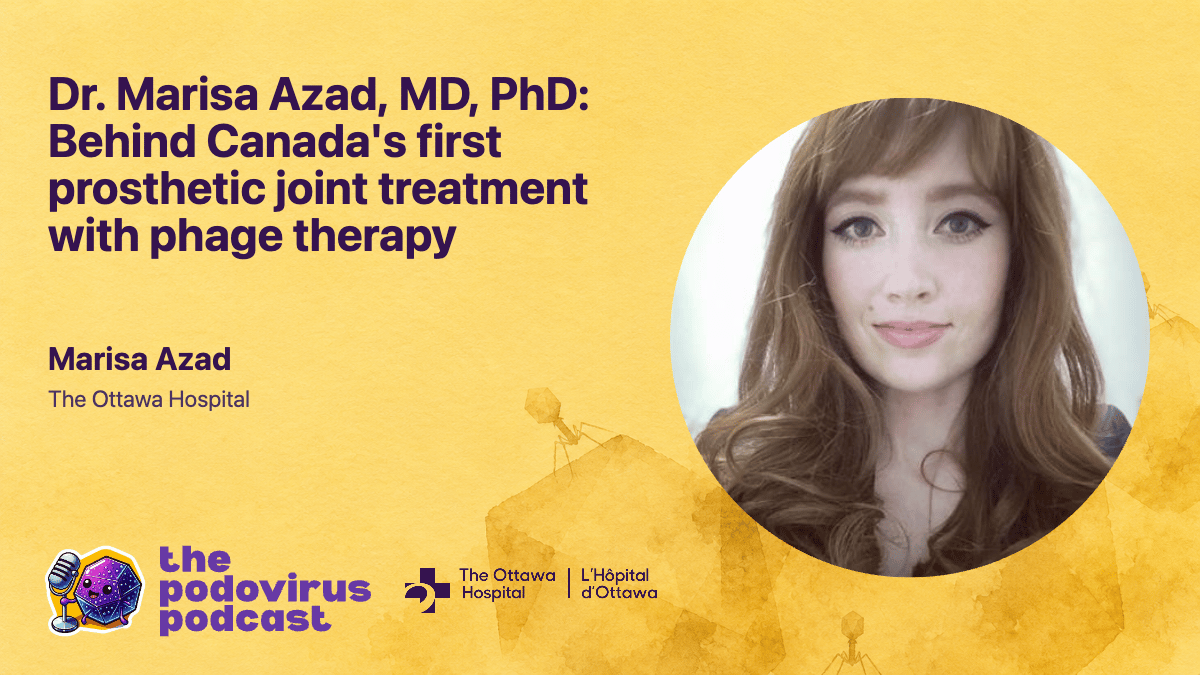
Dr. Marisa Azad, MD, PhD: Behind Canada's first prosthetic joint treatment with phage therapy
The conversation
Episode notes
Dr. Marisa Azad, an orthopedic infectious diseases specialist at The Ottawa Hospital, explains how a patient with a repeatedly relapsing hip implant infection led her into phage therapy. Listeners learn how her team approached finding phage, delivering treatment and building a single-patient study into a foundation for further trials.
Azad reports that the first patient had no infection relapses, complete wound healing and improved mobility after treatment, describing a successful single-patient outcome that prompted plans for further trials.
Her team chose the single-patient clinical trial route to support future studies, then developed a core protocol that could accommodate differences between patients rather than require identical treatment.
After the first case, Azad planned shorter delivery into the joint because pelvic catheters can fall out or introduce contamination, alongside pharmacokinetic research to inform treatment decisions.
Episode timeline
- 0:00 The hip implant infection that led Azad to phages
- 5:21 Single-patient trials and compassionate access
- 13:27 Delivering phages into the hip
- 24:51 Hospital approvals and sharing phage resources
- 31:36 Making personalized treatment easier to access
- 37:56 Designing trials for different infections
Learn more
Transcript
AI-transcribed and edited for readability. May contain errors or omissions; check the recording for exact wording.
Select a word or timestamp to listen. Use arrow keys to move between words.
- Jessica Sacher
Hello everyone and welcome back to the Podovirus podcast. So we are here today, it's just me today with Dr. Marisa Azad. She is at The Ottawa Hospital in Canada. As you all know, I tell you all the time, I'm Canadian, so I like to make sure we have Canadian representation. And we met, I don't remember how, but I was put in touch with her. She is doing phage therapy for patients in Canada; she's one of the first.
And that's what we're gonna talk about today is kind of her experience. And as we've been doing in this sort of phage therapy series, figuring out from the clinicians, from the CEOs, from whoever is building in the phage space or trying to move things forward. What are they dealing with? What are the actual hurdles that are most important right now and preventing them? In the clinician's case, what's preventing you from being able to treat more patients?
And what are your wishes? And then maybe the universe will hear them on this podcast. And people will kind of take strides toward fixing those things or working together to fix them. So maybe I'll pass to you, Marisa. And just if you want to give us a little bit more of an intro about how you kind of, you know, got into phage therapy and about yourself in general, because you had also a life before phage.
So yeah, welcome.
- Marisa Azad
Thank you so much. It's great to be here. I love your podcast. So I guess I'll start a little bit about myself. And before I entered into the world of phage therapy, it was quite serendipitous, actually. I'd always been fascinated with phage therapy. My specialty is in orthopedic infectious diseases, so I did an advanced ortho ID fellowship at the Mayo Clinic, as well as a postdoctoral fellowship.
I did my PhD in microbiology before that. And I sort of was thinking about phage therapy in the periphery until I encountered, a patient in my PJI clinic who was septic from a particularly serious hip infection or a periprosthetic joint infection, aka PJI. And this poor patient, she had relapsed so many times with staph epidermidis in the hip. And by the time I had seen her for the first time in clinic, she was in a very rough spot.
She had something called DRESS, or severe allergic reaction to two major antibiotic classes: glycopeptides, beta-lactams. So I was unable to treat her recurrence of the staph epi PJI with any of those therapeutic options. And she also had, toxicities with one of the only antibiotics that we could use, daptomycin. And she was septic when I saw her in clinic, and she was older, she was frail, very, very bad situation for the patient.
And, I remember thinking, well, you know, it's unacceptable to just tell this poor patient, there's nothing I can do to help you. And in the world of PJI, optimal treatment, we think, is to surgically cut out all of the infected hardware. But she had such extensive hardware, she had so many operations, approximately 20 total of the pelvis, so cutting out her entire pelvic area, that's not feasible and it has such a high morbidity and mortality.
So that's when I thought, okay, well, what about kind of pushing the boundaries a bit here and thinking about phage therapy? So that was my foray into the world of phage therapy. And my research team and I here, in collaboration with Cytophage Technologies and Dr. Brad Cook and Dr. Steve Theriault, we embarked on this journey here in Canada. Our group was the first to embark on this phage journey for PJI treatment, and thankfully it worked.
It was quite a process getting there in terms of regulatory hurdles, but we recently just published on this N-of-one phage trial and we have a successful outcome. This patient, thankfully, she has not had any relapses of infection, she has complete wound healing, there's no drainage from the incision sites, she's healthy, she has moved out of her home and she's living independently, and her mobility has improved.
And further to that, biochemically, her inflammatory markers have completely normalized for the first time ever. So
- Jessica Sacher
Wow,
- Marisa Azad
it's quite exciting. And my research team and I are using that N-of-one phage trial here in Canada as a platform for a multicenter phage trial, which I'm leading alongside Cytophage Technologies. So we're treating other patients not only in orthopedic infectious diseases, but I'm also interested in using phage here in Canada to treat other implant-associated infections, such as endovascular infections, graft infections and even, respiratory infections. So, my team and I are working with respirologists as well to try and apply this technology to that area.
- Jessica Sacher
Wow, amazing. Yes, and I remember seeing the story because that story came out all across Canadian mainstream news. And like, it's, you know, something has happened. When you're getting your phage news from, I'm getting them from my grandma and my mom instead of, like, my phage community. So I was like, whoa, we hit a level, what is this? And yeah, that was extremely encouraging to see. I wanna talk about—'cause I've been confused about this for a while.
What's? When we think about N-of-one trials versus compassionate use, can you help us understand the difference? And why does Canada do the N-of-one trial? Because I feel like that's not really what's happening in the US. They're just calling it the emergency IND or compassionate use.
- Marisa Azad
Yeah,
- Jessica Sacher
Okay,
- Marisa Azad
That's an excellent question. So the regulatory side of this world, as you know, is a quagmire. But I have to say that Health Canada has been excellent. They have really streamlined this process for my research team and I, and, you know, it was a journey for them too. So for us, there are two streams, so you can do the emergency access or compassionate use. But for us, because I wanted to do a multicenter trial and use this as a platform for that, I wanted to go through the N-of-one or OLIP route, or single-patient trial route.
And I, you know, I spoke to Health Canada about this when we started early on and we had our pre-CTA meeting. And I explained that to them and they were very helpful. And they said, you know, in this case, it would make sense to go more of a clinical trial route if you wanna keep going with this instead of doing these, you know, kind of one-offs here and there.
So that was the rationale for us.
- Jessica Sacher
Okay, So you could have the option, but this is kind of the choice that, based on the kind of paperwork and kind of like what you were establishing. It would set you up to do this for future patients with, like, presumably less work each patient.
- Marisa Azad
Exactly.
- Jessica Sacher
Is there? Does there have to be consistency in how you treat the patients? How? d? How does that work?
- Marisa Azad
So for us, we're setting up for more of an adaptive trial. So I have my protocol, and we're adapting it to each patient. So in phage therapy, as you know, and especially in orthopedic infections, no two patients are the same. There's so many factors you have to take into account when you're trying to design a patient-specific protocol. So we kind of have that personalized medicine component of it.
But as long as you have the skeleton protocol, you've shown that—I mean, we know the phage is safe, but you have to kind of show the rest of the world, or the regulators, that it's safe and your research team knows what they're doing. There's that trust aspect and it has really streamlined the whole process.
- Jessica Sacher
Okay, okay, awesome, so yeah. And it's very encouraging that Health Canada is supportive. And I feel like this has come up in a thread of some of the episodes you've recorded to date is that it's like, is FDA or Health Canada, or whatever equivalent, like the bad guy? Are they restricting this? And I feel like even back in 2017, when I first heard the FDA talk at the Evergreen phage conference and they were like, please, we want to help you, like, call us.
And it just is totally two different things you hear. And so it's good to kind of get that sense that it's not the regulator blocking you. But there is like a burden of proof kind of on you to show that you can make something safe. And you know what you're doing, and you have, like, thought this through. And it's actually going to potentially benefit.
- Marisa Azad
Yeah, it's such a good point. And actually, I've heard this from my collaborators across the country. It's really the local regulatory hurdles which are the biggest challenge. Health Canada, at least in my experience, they've been so, up-to-date, they're well informed of this technology. A lot of these individuals are scientists, so they've been very helpful.
- Jessica Sacher
Hm, so the local regulators is that like on the hospital level, or who are the local regulators?
- Marisa Azad
Yeah, it's, and I've heard this from my colleagues across the country. So you kind of have two separate regulatory hurdles you have to jump through. There's your local hospital-based ethics approvals you need to get, and then in parallel, there's Health Canada. So, yeah, and every institution has their own quirks, shall we say, when it comes to regulatory challenges. So, you know, you kind of have to really be well versed in that, especially when you're, working with multiple centers at once.
But we all we, we've gotten there in the end.
- Jessica Sacher
Okay, yeah.
- Marisa Azad
Yeah.
- Jessica Sacher
And I guess I just wanna touch back on the original patient case. And so, how did you—I think that you said Cytophage was the one who actually prepared the phage for you, right?
- Marisa Azad
Yeah, so Cytophage has been excellent. I know, you know, Brad, he's, he's amazing.
- Jessica Sacher
I love that.
- Marisa Azad
I really love working with phage. They're excellent scientists, they're, but not only that, they're just fun to work with, which is just as important, right? And so, yeah, my lab collaborated with their organization, their company, to prepare, the specific phage for our patients. Initially, we were thinking of a cocktail, we then kind of narrowed it down to a monophage preparation. I mean, that's a whole discussion in and of itself, cocktail versus monophage preparations. But yeah, it's, yeah, that's how we got our phage for our patient.
- Jessica Sacher
Okay. So you already kind of knew of them, or did you kind of have to cold email them and say, like, I have a patient, do you have a phage?
- Marisa Azad
So when I started my phage journey, you know, I spoke to my colleagues at Mayo Clinic, Dr. Robin Patel, who was my old mentor, she's fantastic, Dr. Gina Suh, who's amazing, and she's on her paper as a co-author. So I initially reached out to them and I literally googled phage therapy companies and I reached out to multiple companies around the world. And it was phage that pulled through. And I remember I met with Dr. Cook and Dr. Theriault, and it just clicked right away and I explained the situation to them. And the thing about their group is that they really cared about patients and that was important for me, and it just worked.
- Jessica Sacher
Yeah.
- Marisa Azad
Yep.
- Jessica Sacher
And was that the first case they were part of as well, like part of preparing for, like, a patient case? Yeah.
- Marisa Azad
Yep.
- Jessica Sacher
Yeah, 'cause they were working on the agricultural side, I think, for the first chunk of their time in the industry.
- Marisa Azad
Yeah, that's a that's a whole other cool area that they're working on. Yeah.
- Jessica Sacher
Yeah, okay. So they agreed to make phage for you. So then you would've had to send them an isolate. And were they the ones that found the phage as well? They just happened to have a staph epi phage on hand.
- Marisa Azad
So, our phage, we put out like a world call, like a phage call. So I've learned a lot about how this stuff works. So our phage initially came from Slovenia.
so, it was pretty cool to have this network where you can kind of say, look, I have this organism for this infection. Does someone have a phage that could potentially work?
- Jessica Sacher
you must have used the phage alert then, our phage detection system.
- Marisa Azad
Yeah, exactly, exactly.
- Jessica Sacher
I'm like, wait a minute, I do remember a Staph epi.
- Marisa Azad
It sounds familiar.
- Jessica Sacher
But, like, I didn't know you then,
- Marisa Azad
It's a small world.
- Jessica Sacher
That's so funny. Okay, I'm like, yeah, I think there's not any other global alert systems for phage finding, but if there is, great. Awesome, okay. And then, so, okay. So you found it in Slovenia and then that was shipped to the folks at Phage in Winnipeg at some point, and then they produced it for you.
- Marisa Azad
Yeah.
- Jessica Sacher
Okay, and then how did you decide how to administer it, and how did you administer it?
- Marisa Azad
Oh, that is such a good question. We're still in the wild, wild west, right? This is like HIV in the 80s and 90s. There there's a lot we do not know about phage therapy and clinical applications thereof. So I looked at what little literature we have for the treatment of orthopedic infections, and in Canada, no one's done this before. We used the protocol that we adopted to our patient.
She, you know, there there's some case reports of just giving one single dose of phage for PJI, and that's it. But if, you know, I wish I could show you an X-ray of her pelvis, it, the. The burden of infection is so immense. I wanted to prolong her intraarticular delivery of phage and give, adjunctive intravenous phage as well. So, that's what we did.
We, worked, closely with interventional radiology here, and our colleagues there, introduced a catheter into the predominantly infected hip, and I injected phage twice a day, into the hip. We wanted to go for about two weeks. But you have to be very careful because anytime you introduce a foreign body, especially a catheter, there's always a risk that you can introduce other organisms into the infected space. So, you know, I watched her like a hawk, my team and I watched her like a hawk. The nursing team here was great. I was a bit nervous in the beginning when I was injecting, the phage therapy. What's very interesting, though, is that my team and I noticed that she had quite an immune response. PR predominantly when we injected phage intrarticularly versus systemically, and I would've thought it would've been the opposite.
And the patient even commented on it. She had some rigors, chills during early administration phases, a bit of hypertension, interestingly, and then she kind of dipped and rebounded to hypotension. It wasn't a true anaphylactic response and thankfully she did very well. And, you know, these immune responses went down with each dose and we had a nice curve. Anyway, I'm getting all into the weeds here.
It's just something interesting that no one's really reported on before.
- Jessica Sacher
Yeah. I think that area is of huge interest to the phage field and it's starting to. We're starting to, like, triangulate on, like, what's missing to be done. And one of the big categories, I think, is the immune response. And I think there's been a lot of hand waving for a long time on, like, well, there's no immune response, they're silent, they're in the body.
And then there's like, Oh, well, obviously there must be neutralizing antibodies, so you can't dose, redose. And somewhere in the middle is probably the truth, like, probably it's phage by phage, it's probably different. And I know in Australia, when we were treating patients with phages, we started to collect that data. The serum samples that we were collecting and storing in the freezer. Right before I left, had a student, Erin Bosco. That was her PhD project: to start looking at all of those and see if there were antibody responses, at least in those patients.
And I'm pretty sure that it was very heterogeneous, like one patient would, another wouldn't, and a little bit phage specific.
- Marisa Azad
We need way more data.
Yeah, yeah.
- Jessica Sacher
Yeah, so Kieran, if you're listening, tell us how your research is going.
- Marisa Azad
Well, that's interesting. Another arm of my research is looking at the pharmacokinetics of phage. I mean, that also is a black box, right? You know, how often do we dose? What dose? How do we deliver it? I mean, looking at things like hydrogels, there's so much we need to look into here.
- Jessica Sacher
yes, yeah, now you're talking the language of the lab I just joined. It's like, pharmacokinetics and hydrogels, but it's all
- Marisa Azad
Nice that you're a
- Jessica Sacher
delivery. Yeah, yeah. And, like, what will help and what do we need? Like, what's a good profile for a phage? Like, how long should it last? And and like, sh, should we deliver it more slowly? Or, and what's the dose? I feel like, yeah, that's where the field is getting. But it feels like movement from like five, eight years ago, when it was feeling more like, okay, let's figure out what all the genes do.
I don't know,
- Marisa Azad
Baby steps.
- Jessica Sacher
I don't know. Yeah, yes. So I want to ask, how has your approach changed from the first patient that you treated to the ones that you're thinking about treating now, or the other ones that you have already treated? Have you learned anything that you're not doing anymore, or that you should have done the first time that you're now planning to do?
- Marisa Azad
Yeah, I think, I'm always wary to leave a drain in situ for more than a couple days. So, you know, especially if it's the pelvic region, they are very prone to falling out just in general, cause you're moving around. And plus it's a very dirty area, in terms of contamination, especially in older patients. And, they can inadvertently roll and pull it out, and, you know, do you reinsert it?
Do you leave it? So for me, I think, you know, for our next batch of patients, we're gonna reduce that intraarticular dose duration. And then in terms of what we're gonna do next, we're doing pharmacokinetics, that's something I'm really interested in. And then, yeah, things that I've learned from that first, single-patient trial. Really, it's the regulatory stuff and just little things like, you know, admitting the patient and ensuring that they have safe monitoring and getting everyone on board, you know, sending out a memo to the nursing team.
Little things that you don't think about until you actually go through it. I'm really good at that stuff now, too.
- Jessica Sacher
Yes, ah, yep, I feel like there's so many unwritten things, yeah, that I learned in Australia, too, like how to communicate with the hospital micro lab. Like when they get a new strain, like they were just writing like "phage" in block letters with a sharpie on the bag. And like, you know, there was no way to put in their system like that. It was going to our lab next, if it was kind of resistant. And so we were like, okay, we just would show up and find their office and be like, "Me and Stephanie. We're the two postdocs who are going to do this. Like, can we come up with a code that you write on this that, like, connects to the bug?" And they're like, "Yeah, yeah."
- Marisa Azad
That's a good idea.
- Jessica Sacher
Yeah, it was. People were amenable, but it was like, hard to find the right person the first couple times. And yes,
- Marisa Azad
it's the administrative stuff that gets you my yeah,
- Jessica Sacher
Yes, okay, so you're shifting your approach, but you're mostly you're still liking the intravenous route as kind of like the backstop to whatever you're doing.
- Marisa Azad
Yeah. And I, you know, the next set, where timing is important, that's something else I really learned about. So because we can't get phage therapy overnight yet, you know, we have streamlined the process drastically. And Health Canada has been very helpful and they know that patient lives are on the line, but it still doesn't happen overnight. The paperwork in and of itself, I think I aged like 20 years that first with the paperwork itself, my poor research team.
But we have all of it done now and it's just getting the timing right. So, you know, because, especially with orthopedic infections, things change so drastically. You know, I tell my patients, you know, do not stop your antibiotics until you know x, y and Z, or you know, things like that. But sometimes I've seen funky stuff where patients will get a viral, like a viral URTI, and then they flare despite being on suppressive therapy.
Like, there's not really any data in that, but that's something that I've seen in my practice, which is interesting, and they unexpectedly flare. And then suddenly we have a new organism, and the months that we took targeting that specific organism is now moot because now we have a polymicrobial infection. Or, you know, there was a there's a case we recently were working on with our colleagues in Concordia, where the patient unfortunately developed an ascending UTI and then became polymicrobial. So, you know thing, there are things that we cannot control. Bacteria don't care, they just wanna make their home, make their little microbial niche and thrive, things like that. I've gotten better at timing and predicting when I think someone's going to fail or flare.
That's kind of a gestalt thing.
- Jessica Sacher
Okay, yeah. I feel like our episode with Genessa got into a little bit of this. Like she was saying, one of the things she learned was how to better pick who was going to be like, able to benefit, given like these unique constraints and strange wizardry of timing and like of knowing the pathogen. And I feel like my Australian experience to go back to that again, like it was.
I was listening to the clinicians make their decisions, and it was interesting to hear them go back and forth debating whether, like, a given pathogen was likely to be the causative pathogen. Cause you kind of have to make a guess on that. It sounds like, based on what you've
- Marisa Azad
Sometimes
- Jessica Sacher
seen, and like, if there's multiple things there, but one of them's, you know, typical, yeah,
- Marisa Azad
or, like the dominant pathogen.
- Jessica Sacher
like something you have skin, yeah, And like, we talked last couple weeks back with the Biomex CEO, Jonathan Solomon, and he was saying, like, the whole head of the snake theory with Staph and diabetic foot he was really excited to try to prove out. And they feel like they have seen like that getting rid of just Staph seemed to help the entire infection, but that was a bit unknown. It still probably counts as unknown still, but it did seem to work in their trial.
And so, yeah, just, yeah, guessing is probably not called guessing in your field, you capital letter G like uneducated decision. Yeah,
- Marisa Azad
Yeah, you know it's so true. Nothing in science or medicine is ever 100 or ever absolute; it's based on probabilities. You know, I can't really explain it, but with orthopedic infections, you just—I just. It just makes sense. You just, you know. For enterococci, for example, it tends to be eradicated a bit more easily than other organisms. If you have polymicrobial infections, you know, depending on whether you do an anterior approach or a posterior approach with the hip, you know, different.
There's so many factors that go into it. And you see these like interesting microbial dynamics where they're trying to outcompete with one another, and sometimes there's cooperation. And then eventually you get this dominant pathogen, you know, pseudomonas or staphylococcus. But it depends on the host, it depends on the mechanism of infection, the pathophysiology, what immunosuppressants they're on, what surgeries they've had, blah, blah, blah. But it's a bit of an art form.
- Jessica Sacher
Yeah, I also didn't realize you had also a PhD in microbiology before you went down the whole medicine route. That's perfect.
- Marisa Azad
Long
- Jessica Sacher
Are you
- Marisa Azad
haul,
- Jessica Sacher
retired?
- Marisa Azad
but worth it. Yeah, I did a combined MD PhD at Mac, McMaster University.
It was a lot of fun. But when my friends were studying for exams, or, you know, relaxing at the bar, I would be in the lab, slaving away with my enzymes, my acetyltransferases.
- Jessica Sacher
yeah, yes, yes, well, I think it's culminating so well. And it's so rare that you can have one person with both sides and one like the clinical and the microbiology, the deep microbiology experience. And hm,
- Marisa Azad
yeah, it's, as you as you know, it's, it's. It's important to have, and it's fun to apply it to medicine. And it just gives you a different lens to approach infections by. You know, I tell my patients and my residents and my learners, bacteria are like humans, you know, there's bacterial ecology, there's microbial ecology.
They're just trying to survive, like the rest of us anyway.
- Jessica Sacher
Yeah, yeah, that's awesome. So I guess I want to go to the next couple of questions that we tend to ask people. So we're trying to. We'll eventually put out some comparison of everyone's answers, I think. But what is it that you need the most at this point? Or what if you had a magic wand to wave? Like, what's the challenge that you just wish you could just get past at this point?
- Marisa Azad
I think, you know, that's a very interesting question. I think there needs to be, well, okay, number one: regulatory hurdles, they need to be streamlined more, but we're getting there with Health Canada. Honestly, I can't say enough positive things about them, but I think locally that needs to get up to speed. So there's a lot of misinformation about phage. It's very safe. There's so much data on its safety.
That's one thing that we have, right?
- Jessica Sacher
yeah,
- Marisa Azad
So I think that kinda needs to be far more supportive of experimental therapies, not just phage therapy, but CRISPR and all of this other cool emerging technology that can literally save lives or potentially save lives. We need support to do that. Number two, maybe I don't know if anyone else has said this, but we need more collaboration, you know, you know, some of my colleagues who've been working in infectious diseases for 40 years, they, you know, they've commented that the phage world,
It's kind of like, like I said before, like HIV in the 80s and 90s, it's the wild, wild West. And it's really important that people work together. And, you know, something as simple as making phage libraries, you know, I know multiple labs that are making their own phage libraries. Why don't we just have a central giant repository where everyone feeds all of this data into one site? We all use it, we all work together. That's a very, you know, kumbaya, let's all hold hands. I mean, science can be very cutthroat, unfortunately, that's just the world that we live in. With any new emerging technologies, it's important to focus on patient care, it's important to focus on why we do research.
I think it's really fascinating, you know, I'm an artist as well, not to get off on a tangent here, but you know, art, science and medicine, these things all go together. And you just, you gotta be creative with it, you gotta have fun with it and just work together. As cheesy as
- Jessica Sacher
I love
- Marisa Azad
that
- Jessica Sacher
it.
- Marisa Azad
sounds, I think that is how you really push things forward together. Like, like, as a whole, like, as. And this isn't just for phage therapy, it's for science in general.
All right, I went on a little diatribe there.
- Jessica Sacher
I like it. Yeah, well, I. I've been thinking about art and science lately too, because I think there's been this separation of the two for so long. And at least when you talk about careers, and are you going to art or science? And science is the opposite of art, that's what makes it science, like. And I have been talking to some of my students lately and just saying, like, I actually think you should see a career in science as a bit like a career in art.
Because it's like, you kind of get this. It's hard to get, yourself set up to do it, but if you can, like, get a source of funding so that you can, like, creatively kind of play in the space and figure out what works and what doesn't. It's kind of like these patronage models of a long time ago and how science started, too. Like you would, you know, if somebody would support you to paint or to like, create, like same with the science.
Like it was just people who had that, like that setup and it wasn't for everyone. And it's not like a right, and it's not really a direct function for society right now. Like, we must discover this thing today, it's like it should be considered more like a bit of an art or setup, like a patronage model. And that's what we're all doing. Like when we have, when we're working in a lab, we have, like, gotten this space and a bit of funding to just.
But then we are allowed to be completely creative. And like, we should support that in that category. And yeah, and acknowledge that, yeah, it's not like it's maybe, it's not like lucrative and super function driven. And then because of that, that's when such cool stuff can spawn out of it. But if you kind of try to make science feel more like what it isn't, where it's like, it has to be done this way and one step, and then the next, and everything has to map back to, like, use today. Then, if you did that to art, which has happened, of course, with, like, the commercialization of it on one stream,
- Marisa Azad
yeah, mass
- Jessica Sacher
if you did that,
- Marisa Azad
production, yeah,
- Jessica Sacher
yeah, you kind of ruin it, but you can also have that channel and that's great, and I don't think you ruin it. I'm not like making a moral judgment that you ruin it, but like the thing that you're doing, the creative, like open ended version of that, can't like re. It kind of suffocates in that model. And so I think we should just like, see science like that, and also medicine, like with this experimental stuff.
Like it is this like creative shelter, little space where you kind of get some leeway from the regulator to be like, "Hey, nothing works. Why don't you come up with something? We will support you, we'll go slow and like, make sure it's safe." But then, but you, sh, we should all like, see the privilege that it is to kind of get to be creative. And I don't know, like, yeah, the working together and being like, really open minded about how to do it.
In like these like special little spaces where we're not behold behold to these, I don't know, like, that are the way it should be done. I don't know, that's my
- Marisa Azad
I love that.
- Jessica Sacher
rant.
- Marisa Azad
Yeah, no, let it out. No, that's great, that's great. And you know, I agree. And science, like art, it should be free flowing. You know, we, We have the never ending, you know, hamster wheel of getting grants and publishing. But you gotta, you can't forget why you went into science in the first place. And I love that parallel you drew between the tortured artist and the tortured scientist. I mean, you gotta suffer a little bit, you know, a little bit, not too much, but you know, it's anyway. I wish there are a lot of. We're getting way off topic, but
- Jessica Sacher
totally, that's okay, I'll allow it.
- Marisa Azad
yeah, you know, I mean, academia, and there's a lot of things that need to change, I think, to promote that creativity and to promote that collaboration, but that's a whole other discussion.
- Jessica Sacher
Yep, yeah, totally, yeah. I just I've been thinking so much about how, like compassionate use and N-of-one phage therapy, and just everything with phage therapy fits into the world. And this is like the best place I see it. Instead of like shutting it down and saying, oh, it's, it doesn't fit the standard mold very easily, it's personalized, so therefore we shouldn't do it. And it's like,
- Marisa Azad
Wait,
- Jessica Sacher
I, Yeah, I think it's like a hugely interesting space for the. And if it did fit the paradigm better, it would be so much. It. It would be hard to innovate in that space and it wouldn't be so open to creativity. So maybe it's like drawing us in. And you're an actual artist on the side. I'm not. I just
- Marisa Azad
Everyone can be an artist. Don't be so hard on yourself.
- Jessica Sacher
Yeah, as a podcast, art, yes, yeah,
- Marisa Azad
There you go.
- Jessica Sacher
Okay. So more collaboration and more working together, and I think, yeah, creative thought, I like that. So for the future, where do you wanna be in five years with what you're doing, and what do you see, maybe where you want and what you actually think will happen?
- Marisa Azad
Ooh, ooh,
- Jessica Sacher
Pick one, pick both. Yeah,
- Marisa Azad
Very much. You're just kind of living in the moment, not to sound
- Jessica Sacher
thank
- Marisa Azad
like
- Jessica Sacher
you.
- Marisa Azad
a hippie, but at the same—but at the same time, I really do think about the future a lot in terms of what's next. I like to build things, I want to make this more readily available to people. Just like you said, you know, oh, personalized medicine, you know, when there's a will, there's a way. And my team and I were already beginning to show that we can create an adaptive protocol and we can make this faster.
And I think in five years, my team and I, and people like you and our colleagues at Mayo, we're gonna keep pushing this technology forward, making it more readily available to those who need it the most. And answering a lot of those empty tick boxes for optimizing this technology. For not only orthopedic infections, but a variety of other in infections that are often chronic, recalcitrant and debilitating.
So for me, I just wanna keep doing what I love. And I. I don't know exactly what that's going to look like, but we're, you know, we're building a network, around the world and working with, you know, good people like you. Yeah, I don't. I don't really know if I answered your question, but maybe just keep doing what we're doing.
And I know that we're gonna be successful in some way. I just, that's just my personality. When I get obsessed over something or really focused on something, everything kind of just fades away in the background. And I just have to do it. And for me, this is just something I never thought I would end up doing. Another tangent is that I never thought I would go into medicine. But it just kind of like things just kind of present themselves and you just kind of go with the flow. And my personality is I like to push it and see how far I can progress this area.
- Jessica Sacher
Yeah, yeah, I love it. Yeah, I'm similar. Yeah, it's like,
- Marisa Azad
I can tell.
- Jessica Sacher
when people, when people are like, What do you? what's your five year plan? Like? I? I have this question and I'm like wincing as I ask it, and I'm like, "Ugh, I hate this question." 'Cause I would much rather just like, just run at something, until I decide that it feels like enough. And I feel like put. Sometimes putting, putting a plan together, it limits more than it expands. Maybe I don't make big enough goals or something,
- Marisa Azad
no, No, no, I completely agree. It limits.
- Jessica Sacher
But like, yeah, Yeah, yeah, I— And it makes it hard to run at it. Because I'm like, "Well, I can—I've already imagined the HM."
And like, I would rather leave that open ended and be like, "Imagine the outcome," but I'm not actually imagining it. Like, it's, it's bigger than my imagination and that's what's exciting, but we can kind of... Yeah, yeah.
- Marisa Azad
yeah, You know— what, you know— what?
- Jessica Sacher
So...
I Yeah, go ahead.
- Marisa Azad
But you know, you talking about that, I can see how passionate you are. And another thing that I really want to do is support other women in research. I think that is critical. This job is hard in and of itself. Women have to work twice as hard as our male colleagues in many aspects of academia, science and medicine. It, again, it comes back to that collaborative, supportive spirit.
You can be hyper focused and the best scientist in the world, but if you are not particularly kind or supportive of women in science... I mean, this is so, like, it's 2025, and that also is very important to me. And that just hearing how passionate you were there just really kind of reminded me of that goal, or that part of my life as well.
That's important.
- Jessica Sacher
Yes, I love it. Yeah, yeah, it is. It's still an issue. Yeah,
- Marisa Azad
That's a whole other podcast discussion, too.
- Jessica Sacher
Yes, we've covered phage therapy, art, science, women in
- Marisa Azad
Many, many rounds.
- Jessica Sacher
science. But yeah, it's kind of all tied together. And it feels like any one of those things can be like at the forefront of your daily challenges. And it just kind of like, isn't one... Like, I wish I could sometimes just, yeah, work on like one thing and not be like life stuff. Like, I'm planning my wedding right now, and it's like,
- Marisa Azad
You are?
- Jessica Sacher
Yes, and so I'm—
- Marisa Azad
Congratulations.
- Jessica Sacher
my whiteboard, thank you, my whiteboard has all this like flowers related stuff. And then like, also like, figure out if we can deliver, genes with phages. And just like the... I feel like it's not talked about enough. How, like,
- Marisa Azad
Love that, though, that
- Jessica Sacher
Yeah, and
- Marisa Azad
duality.
- Jessica Sacher
it's on one whiteboard, 'cause like, I can only have one list, but it's kind of like, what? Like, Everyone's list must be so heterogeneous in their own ways. But I feel like we represent ourselves as one facet in any given context. And so it's like, that's for another, you know? I talk to my friends about the wedding stuff and like my scientist people about the science, but that's not really my like real life, I guess. It's like only one piece. So
- Marisa Azad
Exactly. We have all these facets to us and we're juggling all these balls. And you know, it's a lot of work, but
- Jessica Sacher
yep, thank
- Marisa Azad
congratulations, that's very exciting.
- Jessica Sacher
you. Yes, okay. So moving on to my questions, and we will, yes, we will tie this up soon. Yeah, so I guess if you had to say what research is actually left. And I know that you talked about the pharmacokinetics and the immunology. But since I think a lot of our listeners are phage researchers, what would you say is actually like a burning area that they should be working on?
If you had, if you were the one that got to decide, like, are there areas that people, you know, it's actually a solved problem from your view as a clinician? We don't need to study anymore; we need to study this. How do you think about that?
- Marisa Azad
I think that we really need randomized control trials to answer a lot of these big clinical unknowns for phage therapy. But getting there is hard and you have to actually know what you're doing with PJI orthopedic infections. It's such a heterogeneous patient cohort, difficult to design trials just because of that. But I really think, like, I have so many questions to ask, both as a microbiologist and as a clinician, about phage therapy.
You know, something as simple as what is what, it, what disease, what infectious diseases? Should we be applying this technology to improve patient outcome? And how do we do this? You know, how do we deliver it? You know, we've already talked about things like dosage, monophage versus cocktail, preparations, infusion rates. Like, there's so many things we don't know. I think, really, we just need big trials once we kinda answer the little questions.
So for the pulmonary cases that I'm looking at now with my team, you know, do we do… Like, there's nebulization. I mean, that's a whole other set of research that we could be looking at. And then you have to take into account pulmonary anatomy. Do they have stents? Do they? How severe is their disease? Can the phage actually penetrate these aspects of the lung? There's so much we don't know.
I can't really answer that question, cause I would just rant for about an hour.
- Jessica Sacher
Yeah. I wonder, like, sometimes I think about whether, sometimes I think phage therapy, we know enough to, like, move forward, like, you know. And yet, on the other hand, yeah, you can rattle off like a million things we don't know. And I try to put them in categories of like, well, if we knew this thing, would that like change what we're doing? Or like, stop us or help us?
And mapping things back to that. Like, has there been something that you've found, you read a paper, or you talked to somebody and you like, use that in your practice? Or like, I don't know, how do you rank things like that?
- Marisa Azad
Like, practice-changing
- Jessica Sacher
Yeah, or like,
- Marisa Azad
things
- Jessica Sacher
what's just like an example of something that actually like, do our research papers matter?
- Marisa Azad
That is another great question. So I remember when I was doing my PhD, I like, I love biochemistry, I love microbiology, you know, I would focus on this tiny subunit of this resistance enzyme.
And I remember when I was very young and naive, I was like, you know what, this paper is gonna be huge, it's going to affect so many patient lives. But then I went back into medicine and I'm like, wait a minute. There's such a disconnect between the basic science and the patient. And that's one of the reasons why I wanted to be a clinician scientist is to bridge these two worlds. And, you know, something that I'm also really interested in is biotechnology, bioengineering, new implants
that can prevent biofilm formation from happening in the first place, which is at the crux of not only PJI, but so many other implant associated infections, even non implant associated infections. Like, you know, you can get biofilms forming in solution; you don't even need an artificial surface. So I'm getting, I'm getting off on another tangent, but yeah, I just, there's such a disconnect between what we do in the lab and what the patient has to suffer with.
And I really want to make my research not only translational, but to improve outcomes for patients. It's very generalized, but any time I do a paper or like a study in the lab, I always kind of think of that in the back of my mind. Because it's such an important point. Yeah.
- Jessica Sacher
Yeah, yeah. And it's hard because acetyltransferases and patient experience. Like I studied one protein in my PhD, it was, you know, glycosylation and a phage protein that seemed to, you know, maybe bind to one of these glycosylation proteins. And like, how, like. That was, you know, a point in my PhD where I was really depressed about everything. Because I was like, wait, this is never going to help anyone.
But some people do a really good job of, like, keeping the two things, the two scales, kind of like,
- Marisa Azad
they're both
- Jessica Sacher
connecting
- Marisa Azad
important,
- Jessica Sacher
the two scales. Hm,
- Marisa Azad
And, you know, and it's fascinating talking to, like, a pure scientist versus a pure clinician versus both. Cause they look at the world differently, they approach problems differently, and I try to learn from all three of these individuals. And it affects how I practice medicine. And, you know, it's these little discoveries in the lab that can lead to these big randomized control trials and can lead to a new drug 20 to 50 years later.
if you're lucky, but, you know, there's always that hope and that trajectory. And you know, what is that saying, you know, we stand on the shoulders of giants. That's what science and medicine is, and it all comes down to working together and building off of our colleagues' work. And, you know, when I was doing my PhD, I didn't really know, I didn't really kind of absorb, until I went fully into medicine again,
was that, you know, bacteria, proteins, molecules, they behave very differently in a little Eppendorf tube or a petri plate, or a rat versus, or a poor little monkey versus a human being, versus a population of human beings.
So it's, there's just that huge progression that we as researchers have to keep in mind as well. So sometimes I'll look at these really fascinating basic science papers. Massive impact factor, Nature, Science, super sensationalized. But I sit back, and, you know, the PhD side of me goes, oh, that's awesome, you know? But then the medicine side goes, okay, well, but I know that we're a long ways away from this positively impacting patients.
And we don't even know if this is gonna work in a human being because it's just a whole different ballgame. You know, you have your ADME, PKs, you have your, you know, stability of the molecule. Do you co-package it? How do you deliver it? You know, the drug side of it, the manufacturing side of it. I've learned a lot about with that, with these phage studies we're doing as well, so that's a whole different discussion, too.
- Jessica Sacher
Yeah. How do you not go insane? Like, how do you balance? Cause you run a lab and you treat patients like, what is that? How much brain space are you switching between the scales? Are you trying to make them coalesce so that it's less, you know, crazy making? Or what does it feel like to do both of those things?
- Marisa Azad
Yeah, it's not easy, there. I get bored very easily and I'm always—I think you're similar, like there's just always something going on in the background, like a million tabs are open, and they're in. In my mind, it's just one entity. But I do need to kind of switch gears a little bit, between seeing patients, you know, it's seeing patients. There's that whole emotional aspect of it that doctors tend to forget about over the years. You know, this is a human being; you're not just throwing drug X or Y or Z, or, you know, doing surgery
A, B, C. The human being, they're suffering greatly and they are looking to you for help. That is important to me. So I put that side of it. But then with every single patient encounter, like I saw a patient this morning with a unfortunately a missed, knee infection for at least a year, and she was pretty sick. But I just explained to her the microbiology of it.
So I brought in that bench science.
And she said, wow, you know, I didn't know that these little critters are acting like this and behaving like this and it, and it helps them. So I kinda like to marry the two worlds together every day.
- Jessica Sacher
Yep, wow. And is your lab like near where you treat patients? Is it like connected to the hospital?
- Marisa Azad
Yep, it's in the cancer center.
- Jessica Sacher
Cool.
- Marisa Azad
Sure, walk
- Jessica Sacher
Wow. Yes. I've been to Ottawa a couple times and it's a nice place. And I did a five-week research visit.
It would've been in the school of medicine, so maybe that's near where you are.
And yeah, anyway, another tangent, but good place. And it was. I always, like, joke that my all my PhD work, all the papers, came from like that five week stint in Ottawa, and so it's like a
- Marisa Azad
the same thing about
- Jessica Sacher
special place. Yeah, it was late in the degree, things needed to happen, and I generated a bunch of data. And like, I don't know, because of some awesome, collaborators, they let me come hang out with them for five weeks. So yeah, a nice, supportive environment over there.
- Marisa Azad
Yeah, we'll have to come visit again sometime.
- Jessica Sacher
Yes, I know. I haven't been back in a while and you should come visit us down at Stanford if you want.
- Marisa Azad
I would love to.
- Jessica Sacher
Yes, we're doing all kinds of PK studies. We're trying to get grants for more of them, and we're still working with Genessa and so we're trying to, yeah, like, get grants for clinical trials. I feel like that's like the next frontier, and I feel like, yeah, companies are starting to do more, but you kind of have to have the investigators at all these places. Like, kind of also push them forward. So I think there'll be lots of room to work together. And hopefully, the shifts in government are going to have something positive for this field. I don't know, like there's nobody saying anything positive. But I have hope that any shakeup on the regulatory side, there could be some openings that we could kind of find that could help. Like, maybe
it'll be easier to do phage therapy in a sense, if there's some pathway that, you know, people have the right to get more options. I don't know.
- Marisa Azad
Yeah, more alternative.
- Jessica Sacher
So fingers crossed.
- Marisa Azad
Yeah.
- Jessica Sacher
Yeah, yeah. And I think we should see this as an interesting turning point and not be almost sad.
- Marisa Azad
It's an interesting time in the world.
- Jessica Sacher
yes, yes, exactly. And in Canada too, it's all shifting at once. It's all connected.
Yes, well, thank you so much, Marisa. This has been very delightful and I like that we took this a few different directions than my standard questions. But I don't know, yeah, the human side is what's like, I mean, we're human beings driving all of this, so it has to be a part of it. And it's hard to find space for those conversations as well. So
- Marisa Azad
yeah, absolutely,
- Jessica Sacher
you know, make it happen.
- Marisa Azad
It was great talking to you. I'm glad we connected. And let's chat again soon.
- Jessica Sacher
Yeah, I'm excited to keep up with what you're doing and send me all your news and we'll just blast it to the phage community. And yeah, I'm just so happy that you're doing this in Canada.
- Marisa Azad
Thank you.
- Jessica Sacher
Yeah, that's awesome. Okay, great. Thank you.
- Marisa Azad
Thank you. Bye.
- Jessica Sacher
Bye.