Tags

  1. Seeking collaborators for in vivo lung infection studies

    Dr. Swapnil Ganesh Sanmukh
    I am Dr. Swapnil Ganesh Sanmukh, presently working on my postdoctoral project (funded my MSCA-COFUND) entitled "Isolation of bacteriophages and lytic enzymes for targeted treatment of chronic bacterial lung infections". I am looking forward to have collaborations for in-vivo studies. Please email me at swamukh1985in@rediffmail.com

  2. Community Q&A: Removing phages from liquid?

    Question: Hello phage people, does anyone have an improved method to physically remove #phages from liquid broth? Thank you! — @PetrovicFabijan

    A subset of the answers to date:

    • We use Amicon filters in my lab to concentrate phage and we’ve noticed that’s there’s a significant amount of phage in the filtrate with the 100 KDa membrane. To remove phage, a different cutoff might be more suitable. —@Z_Doust

    • High protein binding 0.1 um filters —@raw9371

    Check the tweet thread for more answers as they come in!

  3. The Phage Page on Facebook

    Have you checked out The Phage Page on Facebook? Run by Prof. Gail Christie of Virginia Commonwealth University, this page is a fantastic place to find phage news, research and commentary. We get lots of our "What's New" articles from Gail's fantastically-curated page! This week, there's been an especially large number of news items posted!

  4. We've already sent out two emergency phage alerts this week! If you can help, we're looking for Acinetobacter baumannii (patient in India) and Pseudomonas aeruginosa (patient in Australia). Please email staff@phage.directory ASAP if you can send phages or receive the patient's strain to test your phages.

    Many, many thanks to the 11 labs (from 11 countries!) who've offered to help so far! We're incredibly impressed with the phage community right now!

  5. After a successful phage workshop in Ghana this summer, the nonprofit Phages for Global Health is beginning preparations for a workshop in Tanzania January 12 - 25, 2020. The call for applications will begin in early Sept. Subscribe to the Phages for Global Health newsletter for more info and updates!

  6. Community Q&A: Storing phages?

    Question

    Any advice on how to store phages/ viruses? I know there are quite a few methods for long-time storage but I'd like to hear your advice. Thanks! 😀 — @LeptihnLab

    A few of the answers:

    "Easiest way that our lab uses is to make a high titre lysate. You can clean this via ultra-centrifugation into SM buffer, and store long term at 4C. Option to add 0.1 volume chloroform if concerned about sterility. Most phages will keep for decades using this approach [...] See our methods paper on this" — @JeremyJBarr

    "Will depend on phage and phage-host system. -80 glycerol stocks of phage - needs testing for phage. Or -80 stock of cells that are infected .Or in SM buffer @ 4 if above dont work .Some phage are sensitive to this as well. Can ad CHCl3 to lystates for storage -check CHCl3 first!" — @milja001

    "One thing we do is use a modified version of Graham Hatfull’s (@GHatfull) approach for BRED where we extract the genome with phenol chloroform. Can be used later to electroporate back into the host if the phage is unstable. Works good for med genomes <90kbp" — @Phage4Lyfe

    Check the tweet thread for more replies as they come in!

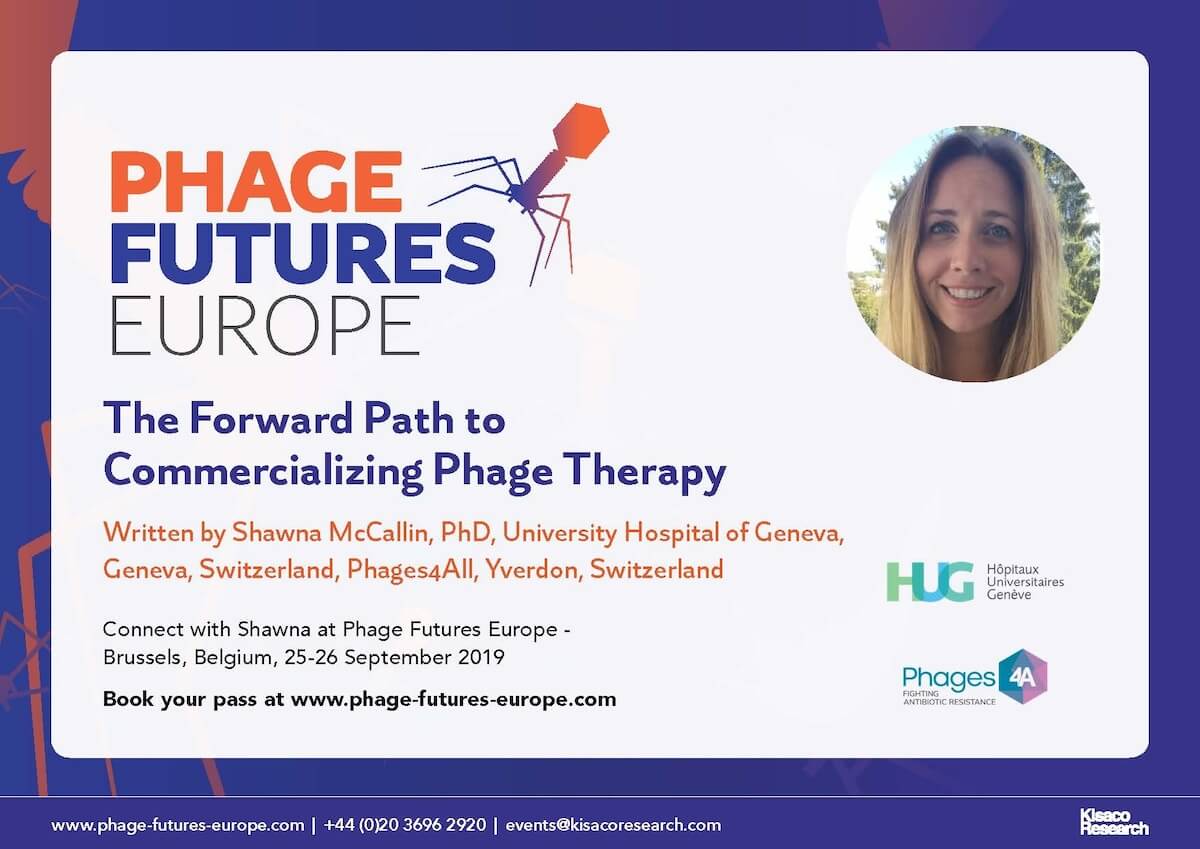
  7. What's the path forward when it comes to phage therapy? According to Shawna McCallin of the University Hospital of Geneva and Phages4All, clinical data is the priority, but it won't be enough.

    "The recent bankruptcy of Achaogen, a biotech producing a clinically-proven antimicrobial, is reason to heed caution that proof-of-efficacy is not enough to ensure viable commercialization.”

    Read Shawna's perspective piece here, and chat with her in person next month at Phage Futures EU in Brussels! (Use registration code PD10 for 10% off!)

    Shawna Kisaco Poster

  8. The journal Viruses will be awarding two travel awards for Postdoctoral Researchers and PhD students. Each award will consist of 800 Swiss Francs for travel to a virology conference in 2020. Apply here by Oct. 31, 2019!

    To help you find a phage conference to spend this on, check out Phage Directory's Events page!

  9. Student project: Phage Field Expert Survey

    Olympia Alvarez and Taehoon Ha — California State University, San Marcos

    We are MPH graduate students from California State University, San Marcos, and this survey is for our capstone project on phage therapy. Due to the limited human clinical cases in the literature, we were advised to interview/survey phage experts in the field. The questions pertain to how/whether phage therapy is done in your area, and your thoughts and recommendations regarding phage therapy. We hope to collect responses between now and early/mid September.

    Survey: https://www.surveymonkey.com/r/B6K8BK2

  10. A new paper published by Zachary Storms and colleagues in the Sauvageau lab at the University of Alberta describes a method for high-throughput quantification of phage virulence that can be applied to phage screening, evaluation of phage strains, phage mutants, infection conditions, susceptibility of host strains, and phage cocktail formulation. This paper was published in the preview edition of the new Mary Ann Liebert journal, "PHAGE".