


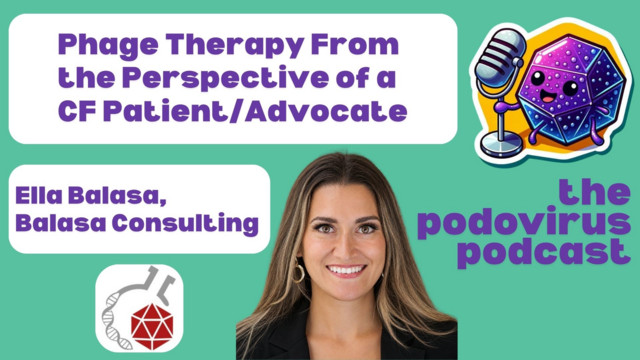
Phage Therapy From the Perspective of a CF Patient/Advocate
With Jessica Sacher and Joseph Campbell
Now playing
Join the conversation
Audio from the Podovirus publisher. Open the episode on Spotify ↗
The conversation
Episode notes
An interview with Ella Balasa!
Transcript
Read transcript
AI-transcribed and edited for readability. May contain errors or omissions; check the recording for exact wording.
Select a word or timestamp to listen. Use arrow keys to move between words.
- Joe Campbell
All right. Today it's a great pleasure, uh, to welcome Ella Balasa to the uh, Podovirus podcast. Um, once again, today I have a co-host, uh, Bekah Dedrick from the CF Foundation. Bekah, do you wanna quickly introduce yourself?
- Bekah Dedrick
Yes, hi, I'm a director of research at the Cystic Fibrosis Foundation, in charge of the anti-infective research portfolio. And I just wanna say that all views are my own and not those of the Cystic Fibrosis Foundation. Good to see you, Ella.
- Ella Balasa
Thanks for having me.
- Joe Campbell
Great, okay, so Ella, thanks so much for joining us and, uh, please introduce yourself and your organization.
- Ella Balasa
Yes, um, hello everyone, I'm Ella Balasa. I have cystic fibrosis, which is a rare genetic, uh, lung disease that affects multiple organs. Um, and I am currently a patient advocate. I have my own consulting company, um, where I am supporting, um, industry and patient organizations and researchers to bridge the gaps and bring patient voices and perspectives into, um, creating better treatments, solutions, better healthcare, um, and hopefully ultimately bringing, um, you know, phage therapy to patients who need it most.
- Bekah Dedrick
That's awesome, thank you, uh, Ella. Um, can you describe your own experience with phage therapy? I know that, um, you've talked about it in the past, but can you talk more about it with our listeners?
- Ella Balasa
Yeah, so I mean, I kind of have to backtrack a little bit and talk about my disease progression, um, with cystic fibrosis and what that has kind of looked like leading up to my treatment with phage. So, um, in my mid 20s, at that point I was struggling with really resistant lung infections. Um, I had advanced lung disease, with FEV1 less than 30 percent.
And, you know, with that comes, you know, increasing exacerbations, multiple rounds of IV antibiotics every year. Um, you know, over three-week courses trying to treat these infections. And really, the daily burden of disease and the mucus that was in my lungs, um, was very difficult. Um, at the time, I was working in a microbiology lab, um, as a lab technician. And really, that's where I saw, like, my value as this patient who could, like, bring this voice to researchers and really bridge these gaps.
But all that is to say that I was not able to work as much, I mean, I had to spend more time at home doing airway breathing—you know, clearance—throughout the day, multiple hours a day. Um, and like I said, these infections just were becoming worse and worse, and so in 2019, um, I also caught a bad virus, so I had RSV and that just exacerbated the, um, infections I had with Pseudomonas.
And I was really, really sick. My FEV1 had dropped to like 18 percent, so I was on oxygen constantly. Um, as I said, I just really couldn't even breathe to wash my hair in the shower, you know, putting my hands over my head made me out of breath. So I didn't realize at that point like how sick I really was; however, I realized and I knew that, you know, I was…
I was taking all of these intravenous antibiotics, but I wasn't feeling any relief in symptoms. I mean, I was even on colistin IV, um, and I think there was at least another, uh, intravenous antibiotic and some oral antibiotics as well. And, you know, just the volume of mucus and infection that was, you know, perpetuating in my lung was just unsustainable. In the sense of, like, I didn't know what would happen to me.
And so around that time, fortunately, I just happened to come across a brief documentary where another patient with CF was being treated with phage, um, at Yale College of Medicine, um, with Ben Chan's lab. So they had treated this person who was living in Texas at the time. And when I saw that and I found out about it, I said that I needed to try this…
You know, I was willing at that point to, um, explore this option. I mean, I've always been somebody that's been open to trying new therapeutics and new remedies. Um, you know, being open to science as I, you know, kind of understand, that's research, and that's how we get to new therapeutics and new treatments for patients. Um, and so I contacted their lab directly and kind of explained what was going on, sent samples, um.
And then a few weeks later, they had found some phage that would be, um, that would work against the Pseudomonas strains that I had. And then it, you know, really came down to me. First, I took this then to my cystic fibrosis doctor and I said, "You know, what do you think about this? I mean, I've been on these antibiotics, nothing is really working, you know, and what are we gonna do?"
Um, and at the time, you know, he really didn't have much to say. I mean, he was like, "This is experimental. There's not a lot of data to back this up." I mean, again, this was in 2019. There had been already a few cases in the US of patients being treated, but, you know, really minimal at the time. And so, um, you know, my doctor was like, "Well, you know, do what you wanna do."
Um, and so I really took it upon myself, you know, as somebody who felt, you know, that I'm in control of my own care and my disease, and I know about my condition. I really made that assessment for myself of whether I was going to do this treatment or not. And so, um, having communicated directly with Ben Chan, I was, um, you know, really feeling to some degree as comfortable as I could, given the risk at the time.
Especially that I was facing such a severe exacerbation on top of already, you know, having very advanced lung disease, um, but really it was this risk assessment where I was like, "Okay, well, I could not try this. And maybe who knows, I mean, I may be transplanted in the very near future, because I have no idea if I could even fight off this infection at all."
Or we try this, maybe it doesn't do anything, and maybe I still have to go down that road. But there's also a possibility that it could help in some way. Um, and so I ended up going through with the treatment, went up to Yale, got phage therapy, inhaled for one week. Um, so that was the course of treatment at the time.
Um, and then after that, I was able to clear that particular exacerbation, um, and I did start some other antibiotics, and fortunately, after starting the treatment—after the week, I had sent some more samples back to, um, Dr. Chan. And he had said that it changed the profile of the bacteria, um, the resistance profile.
And so it was now susceptible to some of the other antibiotics that they just like, happened to put me on. And so it was really just by chance, um, that really worked out like that, and I was able to clear that infection very quickly after that point. Um, so again, it was this combination of phage and antibiotic synergy, um, really helping to clear that. And so after that, I stayed infection-free for over six months or more.
Um, you know, again, I was still really sick. I mean, I didn't, like, see a huge improvement in my lung function, necessarily. Um, but again, with advanced lung disease, that's, you know, the state of the lungs, um, but all that is to say that, you know, really, truly, this treatment helped to clear that infection, that acute infection that I had.
And so I really wanted to be this voice and bring this to the attention of both the Cystic Fibrosis Foundation at the time, um, and then more broadly to researchers. And, you know, especially the phage community themselves, and say, "Hey, I'm another example. Like, you know, please pursue this further and let's research how we can develop novel therapeutics for treating resistant infections."
I'm one person that has struggled with this and dealt with this, but I'm one of many and one of many more that will come in the future.
- Bekah Dedrick
And did you feel like, as a patient, did you have unrealistic expectations of what the phage would do? I'm just trying to think if clinicians or phage, uh, suppliers, uh, that are doing compassionate use therapy, um, need to sort of frame what the expectations are better for patients. What's your thought on that?
- Ella Balasa
You know, to be honest, fortunately, I did not have an expectation when I was going through it because I just had no idea. I think I was in such a sick state, um, to be honest, that wasn't even the first thing I was thinking of. I was just thinking, can I get through this particular infection? Can I get better to my normal state? Um, and so that was really the focus.
And so, that being said, though, you know, since that time, the more that I've been involved in the phage world and space, you know, what I've heard from other people in just conversations is that, yeah, there is some narrative around, "Oh well, phage can eradicate these infections." And something that I wanna emphasize is that at least, and this is, uh, you know, niche, because this is in a cystic fibrosis lung, in a more advanced disease lung, right?
You know, when I talk about this to people that don't really understand, or I'm trying to explain my case, I compare it to an alternative to some degree to antibiotics. So, you know, an antibiotic is going to treat an exacerbation or an infection, get you back to baseline, but you're still…
But the cystic fibrosis lung is very habitable for these infections and these bacteria, and so this habitable environment, you know, it doesn't mean that it kills every single bacterium and that none is gonna come back. And that there's not gonna be continued colonization, and that there's not gonna be future flare-ups of those infections as they sort of regain strength, you could say, And so, you know, again, I hear those conversations where it's like, "Oh well, this can eradicate the infection. It, you know, can just be this, like, magic solution."
And in some cases, you know, depending on the type of infection, depending on the route of therapy, that can be the case. And certainly, I've heard about those cases, which is amazing, um, but it is very dependent, case by case, and also, I do believe, by the type of infection that you're dealing with.
- Joe Campbell
Uh, so sort of following up on that, if I heard you right, you said that you were then, um, bacteria-free for, uh, six months, you said after the phage. So I guess my impression is that you had probably been on antibiotics for a long time, um, before that. And I'm just wondering, had you had a six-month period where you were bacteria free during the time when you were getting antibiotics?
- Ella Balasa
That's a great question. Um, no, it would have been around, I'd say, every three months that I was on intravenous antibiotics, so granted it wasn't like a huge difference. But still, I did feel a longer duration of, you know, no flare-up, not even needing like any oral antibiotics or anything at all. So at the time, that was a win, for sure.
Um, and maybe it was even, you know, seven to eight months, but it was around that timeframe. Um, that, you know, I was able to stay infection-free, you could say, or exacerbation-free. Um, but yeah. But as I said, leading up to that point, I mean, when I was very sick with RSV and then getting phage…
All of that started in, I would say, early November, um, and then was on intravenous antibiotics all the way through, uh, the end of January—into early February—yeah, the end of January.
- Joe Campbell
And when the infection returned after the six months, did you get a combination of phage and antibiotics, just phage? What happened?
- Ella Balasa
So at that point, I wasn't able to get phage again. Um, interestingly, actually, um, I had this treatment with phage at the end of January of 2019, and then, um, Dr. Chan was able to get another round for me. So then, you know, I cleared that infection, and then in the end of May, um, he was able to get me another, um, treatment course, which I completed.
And again, at that time, though, in May, I wasn't dealing with an active exacerbation, so at that point I felt pretty clear. Um, but I was still like, "Yeah, I will certainly, you know, try the phage." Um, I didn't really feel any different. Um, it wasn't worse or better, just sort of the same after that course of treatment. Um, could it have still been, you know, effective?
And like, maybe that's what caused that longer duration of, you know, not having to take the antibiotics, um, could be. It could have been that middle time period, where it also just helped to, like, clear more of the infection if it was coming back. Um, but yes, at that point, I didn't feel that I had like any noticeable symptom difference, right?
Because I think I wasn't experiencing an exacerbation, so it didn't feel that much different from my baseline. Excuse me. It's like with you, you know, the same thing: if I'm gonna be taking antibiotics and if I'm clear of, you know, infection, I'm not coughing all of that much, so I'm not gonna really feel that. So, um, anyway, but after that, you know, when I did get the exacerbation again later in the year, um, I wasn't.
I hadn't been able to access phage anymore at that point. So, um, that was kind of—at least with Dr. Chan, that was the treatment that I received from his lab.
- Bekah Dedrick
So the treatment that you received in January and then you received another treatment in May. Were those the same phages that you, um, were given, or were they different? And then when you say you weren't, I guess, eligible again, was that because they couldn't find phages that infected your strain? Hm,
- Ella Balasa
No, at that point, you know—and of course, it's understandable—you know, he's really focused on trying to treat a number of patients and trying to also work on getting his lab set up and doing research. And, um, you know, just didn't have the bandwidth, you know, at that point to continue to treat me. Which is understandable, um, and so that was, you know, sort of the reason behind that. Um, regarding your question as far as whether it was the same phage in May: Um, I'm trying to remember. I believe I had sent another sample at that point, um, and it may have been.
I know it was a cocktail the first time, so it could have also been. I think it was also a cocktail combination. Um, and maybe it was only one of the same ones, but I'm not sure if it was all exactly the same. I don't remember.
- Joe Campbell
Great, thanks so much for sharing that and glad it seemed to have worked for you. Um, can you just dive in a little bit about your experiences as a patient advocate?
- Ella Balasa
Yeah, um, so really, as I said, like, after this experience, I wanted to raise awareness. Um, twofold, really, one, I wanted to raise awareness of how important it is for patients to be, um, you know, to self-advocate. And to be knowledgeable about their disease, about research opportunities, about ways by which they can have autonomy or control of their own care.
And, you know, through the example of what I shared, like about my own experience and kind of, like, navigating getting phage therapy for myself, really, without the oversight of my physician, as he was just like, Yeah, I mean, do what you think you need to do. Um, and kind of just the complexity of that. But then also, yeah, raising awareness of the fact that, one, it's important for patients to self-advocate, but two, really, the alignment of stars that had to occur for me to actually get this phage.
Whereas for many patients, that just doesn't occur, it just doesn't happen for a multitude of reasons. You know, one being they don't even find out about these things, right? So I'm in this world, sort of, I'm in this space, and so that's one. I found out about it, two, I was able to communicate and have the, I guess, confidence, or, you know, uh, ways by which I could communicate directly with these researchers.
And have these kinds of conversations and understand for myself, um, so that's another thing that had to align. And then, you know, really, being able to travel up to Yale and having a support system like my parents, you know, to transport me there and to be there with me and stay in a hotel room and all of these things, you know.
So that's some, you know, familial support, resource-intensive as well, so, um, I wanted to bring awareness to that fact. And then also, as I said, like, really, to raise awareness of what phage therapy is. And to make it more visible as a potential solution or treatment for patients that are dealing with antibiotic-resistant infections. And to really push for the future of medicine where we can explore this.
And, um, you know, that it could be viable. And so, um, this led me down the road. At that point, I was already, um, doing some blog writing and really connecting with both the Cystic Fibrosis Foundation and the CF community. Um, as I said, I was doing writing and sort of advocating in the written form.
And so I published an article on the HuffPost about this phage experience. Um, and so that sort of gained quite a bit of traction, cause I was really pushing it out everywhere. Um, at the time, too, I had started being involved in a couple of research committees with the Cystic Fibrosis Foundation, one being the infection, um, research committee that had just started at that time. Um, and so, really, you know, tried to raise awareness within, um, the CF, you know, within the CF Foundation as well.
Um, and, uh, you know, with leadership. And also that following year was also the inaugural ResearchCon. So this is a conference for patients to connect with researchers and understand what research is happening in cystic fibrosis. And so, um, I was able to share my own experience during that, um, during that meeting as well, so that was a really great experience. Um, and then it just really, from that point, started to branch out.
And, you know, I continue to get opportunities to speak at conferences. Um, obviously, like, be a part of various different documentaries highlighting my story, um, you know, written pieces as well. And then also broadening from that and really just being a voice, as I said, for patients who, you know, don't have that voice for themselves. And share their perspective. And think about how, both, you know, researchers, even clinicians, and even, you know, nonprofit organizations can consider the patient.
And what we need, um, and how treatment could be transformed or made better for our experiences moving forward. So, whether that is in the development of a clinical trial design, and you know whether that's in phage therapy, or, you know, a gene therapeutic. Or whether it's thinking about how to, um, develop better clinical care practices and thinking about what patient-reported outcome measures are important, right?
Because FEV1, you know, a measure of lung function, is just one number and it doesn't tell a full story. Yeah, my lung function being currently 28 percent doesn't tell the full story of what my quality of life is, or how I'm able to live my life on a day-to-day basis, just from that one number. Cause, you would think I'd be very, very ill, which I am, but I also can live a great life.
And so, um, you know, all to say is that these are things that I want to highlight and bring forth to, again, both researchers and industry more broadly. Um, to make sure that we're collaborating together, and, you know, that patient stories are integrated and are considered when, you know, both raising awareness about phage and then also in, you know, developing new treatments.
- Bekah Dedrick
And so, following up on that, what do you feel has been your biggest challenge that you've faced as a patient?
- Ella Balasa
Um, oh, gosh,
Are you asking, like, in the sense of, like, a personal health struggle, or do you mean more, like, from the lens of communications with providers, or with, like, my work?
- Bekah Dedrick
I mean, I'd be interested in hearing both.
- Ella Balasa
Okay, um, I mean, you know, personal health struggle-wise, I'd say this: the sickness that I experienced around the time of getting phage was probably the most sick I have ever been in my life. Um, 100 percent. And looking back now, you know, years later, um, it is scary almost to realize at that point, like, how much I was fighting for my life, um, and without really even realizing it then, um, you know, the fact that I could barely breathe to move around my house, um, just means my lungs were so incredibly damaged and weak, um, and really could have gone into respiratory failure.
Certainly. Um, and uh, so, you know, looking back, it was definitely a very, very scary experience during it, obviously as well, but it was, you know, I was in such a fight-or-flight mode that I couldn't even allow those thoughts to really take over my mind. Because it was like, I just have to get through this, um, and survive and do whatever I can to make that happen.
Um, and then, you know, from a broader perspective, I think sometimes I think that the patient experience or patient stories are elicited. Like there is interest in hearing our perspectives and thinking about on a high level, like, Okay, how can we make, you know, healthcare better? I'm just gonna say broadly, how can we make healthcare better? By listening to the patients and integrating what they're, you know, advising, or what they're, you know, the stories that they're sharing.
Well, how can we improve upon our, you know, care practices, or how can we improve upon a clinical trial design by thinking about what patients need the most or where their burdens lie? Um, but at the same time, I think sometimes, um, that feedback isn't quite integrated, or there isn't, you know, there's already an agenda. And maybe companies or organizations already, like, kind of think a certain way as far as what they, um, you know, think is best in the development of their drugs or whatever it is.
And then there is kind of that surface-level, oh, thank you, you know, as a patient, thank you for your story, or thank you for your input. Um, but then it's often not really integrated, or, you know, really, that collaboration doesn't exist. Um, and so I think that's where I've found some frustrations or feel like I'm kind of sometimes just like spinning my wheels, or just like telling my story.
But then it's kind of like, Okay, well, I don't know, not necessarily—there's not always a point, or, um, you know, and I don't always feel like it's impactful to the degree that I would like it to be. Um, so again, I don't have like, necessarily, you know, specific examples here right now, but I guess, just at a high level, I think that that's important to think about. Um, you know, how can, uh, we innovate with patients together? And, you know, that even comes down to, um—and then maybe we'll talk about... You might have these questions moving forward, but, um, you know, in thinking about how we can get phage therapy to, um, you know, to market, right?
As we're like, going through these clinical trials, and you know, I think we're really trying to keep phage in the framework of the way the FDA is used to getting data, and especially, um, you know, to make sure that we can get to approval. And I think like phage therapy is such a personalized type of medicine and it should be viewed that way. It's difficult. And I think within the framework of the way that, you know, drugs have been approved by the FDA,
it's not fitting well into that. So that's why we have the, you know, like BiomX, that's why we have these like companies that are unfortunately, like, failing, you know, to meet endpoints and are not moving forward in their research as we would hope in phage, because, um, there are these bottlenecks. And so I think, like in these instances, really getting, you know, that patient... Both, obviously, from the scientist's perspective, too, but also the patient's story.
Saying like, Okay, these are, you know, this phage has really helped, or I, you know, got phage from expanded access. And like, this is how I experience this. This is why this type of personalized medicine approach could be more effective. So, like, having these stories directly, you know, to regulators and to the um, many of, you know, the researchers, biotech companies, you know, like, really early on.
And having that early integration, um, could have a, you know, I think, a downstream benefit.
- Joe Campbell
So, sort of moving on to—since you're a patient and an advocate—um, discussing your biggest challenges as an advocate. And I guess one thing I'd particularly like you to touch on is, I mean, you have an advantage in that you have a strong biology background in your formal education. And, uh, you know—so just talk about the challenges you've had as an advocate.
But maybe touch on, like, when you're talking to a CF patient who has no biology background, how do you help them understand better what is going on with phage therapy?
- Ella Balasa
Yeah, I mean, as I said, like, after my treatment and after I published that story with the HuffPost and kind of got invited to speak at a number of these panels, I really got reached out to quite a bit by other patients who just either wanted to know more about my experience, or who were, you know, struggling in similar ways and wanted to know how they could access phage, or who they could reach out to, or what they could do.
Um, and I know it is a trying process, meaning that it requires a lot of effort in the sense of, um, you know, the advice I would give is that it requires tenacity, um, and then it requires that, you know, you not be afraid of a no. Or, you know, if you reach out to, you know, find contacts like, don't be afraid to email researchers directly, or, you know, physicians who you may not necessarily know.
Or even with your own CF physician advocating in that sense, because increasingly now, um, CF care providers are, um, more aware of phage and the potential for it, um, but still maybe don't have a lot of other familiarity. So, you know, maybe taking, you know, taking some of this knowledge to them too, if that's the case. And saying, Hey, these are some phage cases, this is where it's happening, you know, and like, do it.
It requires some of that research on your own, if your physician is not aware, or, you know, you maybe have to redo some of that legwork. That would help not only you as the patient, but also your care provider by, um, expanding their awareness too. Um, and then there may be opportunities for them to connect with, you know, these different academic institutions that are conducting phage research and maybe provide that kind of direct physician-to-physician contact.
You know, as like, that's always somewhat of a better in, but, um, you know, I would just say that it's great that, you know, people have reached out to me and are asking me questions. Because, you know, that peer-to-peer connection and really being able to share that from a personal standpoint, um, is what, you know, also provides people more of that trust.
Or just like that, like confidence that, okay, if this person did something like this, then I could pursue this too, and it could help me, you know? So that's the way by which, um, you know, we can not only help to spread awareness, but have other people who need phage therapy to be their own advocates as well. So that's really what I'm hopeful for, what I push for.
- Joe Campbell
So, when you've been talking to, like, a CF patient. And let's say they contact Ben Chan, but they have no biology background—the patient. And then, you know, Ben tells them something. Do they ever, like, come back to you and say, "Hey, Ella, Ben said this. Can you kind of break that down for me?" And have you worked then with phage, with, um, people like Ben
to make the message more understandable to the layperson, for lack of a better term?
- Ella Balasa
You know, I haven't had an opportunity like that, but I would love to. Um, no, there hasn't been an instance where, um, you know, I've been really involved in that communication, you know, in another person's case. Um, where they have come back to me, like, during... I mean, I've gotten some updates on, like somebody who's going through the process, but not necessarily these, like, "Oh, I don't understand this," meaning while they were actually actively going through the process.
Um, you know, and on the side of the, um, researchers, like, I would certainly welcome, um, you know, any kind of outreach from them to ask me whether there's, you know, any material, like, I mean, you know, creating materials about phage, or, you know, kind of Q&A questions that would be helpful for them to address with patients. Um, you know, that would be fantastic.
That really goes back to what I was talking about before, with, you know, integrating the patient into understanding, like, okay, how can we make this experience better? How can we mitigate, um, their confusion, or, you know, help to address questions, or just make that experience better and more impactful overall, right? Obviously, the phage itself is hopefully going to be improving their life, but also on that side of building that comfortability.
Because it is a risk and it is scary. Um, and I think that is huge, being that it is, you know, still, in large part, I mean, it is an experimental treatment and there is, you know, a lot of unknowns. And especially for individuals who don't have that understanding, or really, you know, maybe they're, as I said, when I got my treatment, it was such a fight or flight point …
It was such a dire point where I wasn't really thinking as much about, okay, well, what could really be the risk here? And that wasn't stopping me because of the acute state that I was in. Um, and the necessity. But I think that if I were in a state where I was kind of like, Oh, well, you know, I'm okay, right?
I'm doing okay right now. I could stay at this, you know, stay with this health. And I don't know if I wanna get something that could make me worse. Then that's something that I would really think about and consider and make sure that I felt comfortable with what was going to be happening. So having those conversations with patients is really important.
- Bekah Dedrick
Yeah. And I know I've talked to other patients that have had their clinical isolates sent for phage testing for compassionate use therapy. And you know, some of the feedback that I've heard is that, you know, they thought that they would get a match, they would definitely have a match, right? Um, they don't understand that some isolates, you know, maybe we don't have a phage that infects them.
Um, and then also the turnaround time, how long it takes to potentially find something and then manufacture it. So I'm just wondering, you know, when you have patients that, um, email you, uh, and ask you, uh, what they should expect, you know, what sort of, um, contingencies do you tell them? Do you tell them about time and not being able to find a match? And just sort of setting expectations? And I think that along the lines of eradication, I think a lot of patients think this is going to cure me.
Um, and, um, you know, and I think what we've learned, at least with chronic infections in the lungs of people with CF, is that, you know, cure may be really hard to reach with just phage alone, right? Um, just because, you know, the infection has been going on for so long, and the lung is a complicated environment. Um, and because of potential airway damage that has already occurred. And so I'm just trying to think about, you know—what can you tell patients? Um, what do you tell patients when they reach out to you, exactly?
- Ella Balasa
Um, well, it's been a little while that I've been reached out to about phage specifically. But um, you know, I definitely, you know, think setting expectations is incredibly important. I mean, I would hope that they would hear that from the physicians as well, and not just from me. Um, because that is an extremely important conversation to have with the patient before starting on this process and this journey.
Um, but yes, definitely emphasizing that, um, and you know, emphasizing that, yes, it's not curative necessarily, especially for cystic fibrosis. That's something that I've really talked about quite a bit, um, and the timeline too, you know, it's the timeline, actually, in my experiences, has been variable. So, I mean, I hadn't talked about this. But I did receive, after my treatment with, uh, Dr. Chan, phages from Baylor College of Medicine in the last
two or so years, maybe, um, two or three years, um, and so, while the experience with Dr. Chan actually happened within a matter of three weeks, maybe so very quickly, um, the experience with, uh, the TAILOR lab was a much, much longer duration, you know, it was six or more months, uh, between the time of sending the isolates to actually accessing the phage therapy.
Um, and it was a cumbersome experience, to be honest, because, um, it had to be administered. My CF doctor in Richmond at the time, where I was living, like, didn't wanna really go through the IRB process and have that, you know, have the phage just sent there and all that. And like, through the healthcare system. So I had to do it through my transplant center, um, Duke, and so that required me to travel there every week and it required quite a bit from me.
Um, and on top of that, you know, that time span between, you know, giving the isolates and then actually getting the phage itself. Um, especially patients like myself, who have more frequent exacerbations, you know, require those antibiotic courses, maybe even within that duration. Um, it can—I think it really can—complicate treatment in the sense of like, you're not necessarily, you know, after an antibiotic course, you're not necessarily working with the same bacteria that you had before you sent those isolates the first time.
- Bekah Dedrick
Yeah, the isolate could have changed.
- Ella Balasa
Uh, the bacteria—that's what I meant.
Um, and so, you know, I feel like that can be a detriment sometimes to these phage therapies.
- Bekah Dedrick
Timing of collection, sort of thing. Yeah, makes sense.
- Joe Campbell
Um, so, I guess we've touched on a lot of these questions that we'd written out ahead, sort of in the course of it, and that often happens. But I guess, on top of what you've already said, do you have specific advice to a patient who's considering phage therapy?
- Ella Balasa
Um, really, on top of what I said, it's, you know, just really being educated, being tenacious. Like knocking on those doors, you know, because that's the only way that you may be able to have access to it. Because, you know, most of the time, a CF physician is not going to come to you and say, Oh, do you wanna try phage therapy? Um, you know, unless you're maybe at UCSD or one of, you know, a couple of these other, um, care centers where they actually, you know, have a phage lab and are doing the kind of research.
So, um, I would say it's, um, seeking out, you know, contacting people like me, people that have had it in the past, contacting, researching about it, contacting these researchers directly. Um, and yeah, just—not just knocking on the doors and saying, Hey, this is my case. This is what I would like, this is what I need, like, here's what's going on, um, and really just being that self-advocate as much as you can.
- Bekah Dedrick
Awesome. Well, thank you so much, Ella. This was great to hear about your experience as both a patient and an advocate, so we really appreciate it.
- Ella Balasa
Thank you.
- Joe Campbell
Yeah, I guess if we could, sorry, a little bit more follow-up. Um, what do you think are the biggest challenges we need to, um, overcome for phage therapy to reach its full, um, potential for CF patients? I mean, you've touched—again, you've touched on many of these, like, you know, the difficulty in getting an isolate and um, but maybe you could talk about, do you think, uh, there's a way to maybe work with something like the CF Foundation to, you know, educate physicians about this option? Um, you know, because you alluded to the fact that if you're not maybe lucky enough to be treated at UCSD or somewhere like that, that it doesn't even come up unless the patient advocate advocates for themselves.
- Ella Balasa
Yeah, I mean, I think that's a great point. Um, uh, Bekah, maybe you can answer a little bit too. Something I have pushed for within the CF Foundation is to, um, have more education, I mean, around research, like new research that's happening. And I know that there is, and not to go down the whole route of what the CF Foundation is doing.
But I know that there is ResearchCon, right? Which is like that education day about different research that's happening. But again, these are like high-level things, um, a great way to educate patients, but conversely, right, the education of the physicians, too. I mean, I know that all the physicians in the network are pretty well connected in the Therapeutics Development Network.
Um, but that being said, I think there are opportunities and room for specifically bringing awareness to—you know, where is phage therapy happening across the country? What kind of, like, infections are being treated at these different care centers? How many patients have been treated thus far? So kind of more of these, just, like, stats, some contact information, right?
Just like stats, awareness, contact, kind of like generalized overviews for physicians, for them. Yeah, exactly, to be educated. So that it's not as onerous on the patient themselves to have to take this to their physician. And, you know, that's also difficult for some patients; that's also a difficult dynamic. Because, you know, as a patient, I feel confident in my own knowledge and my own care.
And have lived with this disease for 34 years. Like, I know that I can be that voice for myself. But it's very hard for a patient who maybe, you know, is younger or doesn't have that kind of experience, or doesn't really know their body or their health that much. Or feels that, you know, their physician knows everything, and they're just there to get the care.
It's much harder to have those kinds of conversations with a provider. Um, in that kind of dynamic, and so, you know, having the providers or the CF physicians equipped with the knowledge already really then provides that avenue by which the patient can already learn about it, can feel more comfortable in those conversations. Um, at least when there's some awareness. So, um, yeah, I think that there's a lot of opportunities to bring about more conversation and awareness, both from a community perspective, um, and from the physician perspective, too.
And I do think the foundation is, um, well positioned to, you know, be sort of those bridges, um, especially for, you know, within both communities. Um, on top of, you know, what kind of the awareness, uh, that's already happening and such. I mean, I actually, I pulled this up on one of my tabs before, but right after the phage therapy research, uh, or experience that I had with Dr.
Chan. I did write a blog on the CF Foundation website. Um, it was, like, me and, at the time, um, Ann Field, and I forget what her role was exactly, but um, it was kind of a researcher and a patient talking about phage therapy. So it was kind of like interview-style. Um, you can link that in the YouTube afterward if y'all are interested. But um, yeah, so that was like a great opportunity where it could, you know, it was community-facing, um, but really had this, like, level set between, you know, the patient and the physician, and the researcher talking together, you know.
And so really, it's nice to have that, um, where you can have that open dialogue between patient and researcher.
- Joe Campbell
And I guess, just sort of to close, do you wanna comment a little bit on what makes you the most optimistic about phage therapy in the future, and what sort of makes you the most pessimistic about the prospects of phage therapy?
- Ella Balasa
um, I'll start with the pessimistic, cause I don't wanna end on a negative note. Um, I think that, you know, I kind of alluded to some of these things before. But I think the drug development process and the regulatory approval and the framework by which we're trying to fit phage into the existing drug approval process. And, you know, using, um, like, developing one phage, you know, for treating all patients in a clinical trial the same way is just not it.
The design of that is not the best suited for how phage actually works, or how we can actually most effectively use phage for patients. Because, um, you know, I think, and that, you know, at least I am not a scientist, I am not a researcher. Just from my limited knowledge and what I understand, um, you know, having like a personalized cocktail or personalized treatment approach, depending on, you know, both the different strains of bacteria that exist in the lung.
Or, you know, I'm just talking about CF now, but um, the different bacteria that exist, you know, the method of treatment, whether that's inhaled or intravenous, right? Like, there's maybe different pathways that are best suited. Um, and so all of this is so variable, patient to patient, and I think the most effective phage therapy treatment approach requires constant checks as treatment is going along, seeing how the isolates are.
You know, the bacterial isolates are changing their sensitivity or resistance profiles, like how that is affecting the infection. And then adjusting the different phage approach as treatment progresses. And so I think that that's very hard to do in the way by which we're trying to get phages approved on the market. Um, and of course, I know that there's engineered phage, and, you know, using other methods, um, you know, of phage.
And I think that those are really exciting and innovative, um, and that kind of leads me to what I'm most optimistic about: I think that we have such amazing scientists and researchers and innovators that are really thinking, um, you know, outside the box on how we can, you know, use technology, use phage, use innovation to bring new therapeutic approaches.
And, you know, kind of coming at it from so many different angles. And you know, obviously we're talking about phage here, but you know, I think there are so many other exciting methods of treating infections that are coming on, you know, through the pipeline now that are, you know, these novel approaches that we can really use to effectively, uh, treat and eradicate infections, um, outside of, you know, the standard, traditional antibiotic approach.
And so I'm really optimistic for these therapeutics in the future, and, you know, hope that these solutions will be available in the near term. Um, for patients around the world.
- Bekah Dedrick
And I think you were involved in getting phage at a pivotal time, right? Um, and I think that, uh, the field itself has grown a lot since then, since 2019, we've made huge strides, um, and a lot more compassionate use cases, a lot more clinical trials. Um, and it seems that there are, you know, many organizations trying to, uh, further develop phage, um, in sort of utilizing that drug development scheme, or trying to, uh, fit within that, um, in some way. And so I think, you know, as you were saying, you know, I think it's positive. I think we're making great strides and hopefully, you know, it'll eventually, in, you know, X years’ time, be available to more patients.
Um, so, thanks for your advocacy,
- Ella Balasa
Thank you,
- Joe Campbell
Yeah, um, I think, yeah, just thank you again. I mean, you know, I think I met you three or four years ago at a phage conference and you gave a very nice talk. And it's always great to see, you know, passionate advocates. But you, I mean, are great in that way, but I think that your scientific training makes you a little bit more nuanced.
Um, which I think is helpful, you know, like letting people know what the expectations are and aren't, and you know, that's important, cause I think sometimes...well, I think you do a great job, um.
Thank you so much for spending some time with us. Um, I really enjoyed the conversation.
- Bekah Dedrick
Me too. Thank you, Ella.
- Ella Balasa
Thank you both.