


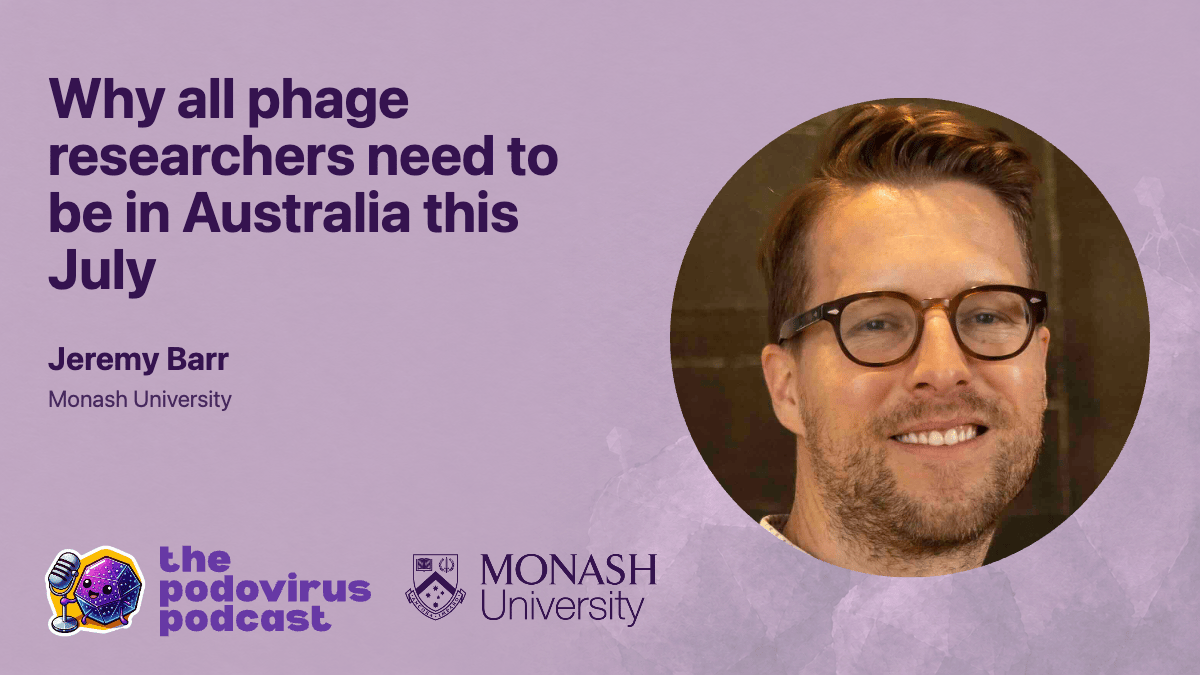
Why all phage researchers need to be in Australia this July
The conversation
Episode notes
Monash University professor Jeremy Barr joins Jessica Sacher to explain how the 2024 Viruses of Microbes meeting in Cairns was taking shape. Listeners learn why the organizers chose tropical Australia for a July conference, how they planned to support early career researchers, and how conference conversations can open doors to collaborations.
Barr recommends arriving with a plan for whom to meet and what knowledge or potential collaborations to bring home, giving students a concrete case to make to their supervisors.
To give PhD students and early career researchers more speaking opportunities, organizers planned the meeting’s first parallel session, with twelve presentations across two rooms on Tuesday afternoon.
A planned Monday morning workshop would cover communication, grant and cover letter writing, and verbal presentations, with limited places making separate workshop registration an important step for interested attendees.
Episode timeline
- 0:00 Introducing Jeremy Barr and five years of conference planning
- 6:19 Why Cairns in July, from regional connections to reef visits
- 13:40 Building the scientific program from over 470 abstracts
- 18:12 Communication training, opening lectures and a rainforest dinner
- 22:10 Making the case to attend and planning whom to meet
- 30:04 Accommodation, early career speaking slots and travel scholarships
Transcript
AI-transcribed and edited for readability. May contain errors or omissions; check the recording for exact wording.
Select a word or timestamp to listen. Use arrow keys to move between words.
- Jessica Sacher
All right, so hello, Jeremy. We are getting to discuss Viruses of Microbes, the one that is upcoming in Australia. So, I'm so excited to talk to you today. And also for you to be the very first podcast guest on a nonexistent podcast that will exist after this. So, bear with us on the, you know, attempt at winging this and seeing what podcasting is like.
And if the phage community would like us to, we’ll keep going. So, yeah, I'm here with Jeremy Barr. So Jeremy is a professor at Monash University in Australia. And he is the one kind of spearheading this VoM conference coming up, along with his large group of helpers. So welcome, Jeremy, how are you?
- Jeremy Barr
Thanks, Jess. I'm doing really well and want to give a big thanks to Phage Directory, to you and Jan. Shout out for being your inaugural podcast guest. Hope it continues, hope there's many more. I'm doing well, exciting times. There's a lot going on. We're a couple months out from Viruses of Microbes, which is both truly exciting and truly terrifying at the same time.
- Jessica Sacher
Yeah,
- Jeremy Barr
It’s been a lot of years of planning and work, and it's all sort of coming together pretty quickly. But yes, very excited, doing well and thankful for the opportunity to chat today.
- Jessica Sacher
yeah, I wanna touch on the long years of planning, because I feel like this is a special meeting, or maybe it's not exceptional in this, maybe it is. But do all meetings like require years of prep, or when did you start prepping for this?
- Jeremy Barr
Yeah, so we started prepping for this. I'm not gonna get the exact year, I want to say 2018 or so. I think I got an email from ISVM, and that's the International Society for Viruses of Microbes. They are the organizing body behind the Viruses of Microbes meeting, and I got an email from them. I wanna say it was in about 2018, asking if I, you know, if myself or someone would consider putting their hand up to host a meeting, a VoM meeting in Australia.
And I remember at that time, I wrote back and said, not right now. Very interested, but I just didn't think it was the right time for me. And I think I'm quite thankful. I said no initially, because if I said yes, I think we would have been one of the COVID meetings. And shout out to Joanna, the Portugal team and the Georgia team for all the changes they did in their meetings through COVID.
But I think I got a follow-up email, and I think it was late 2019. And that was to put in a bid to host the 2024 meeting. And that time I felt like, Yes, this is a great time. I think, I'm ready. I think Australia's a great place to put our hand up to host this meeting. And so we sent off an application in 2019.
There was a lot more involved than I first thought it would be in terms of the application. There were a lot of details. We had to sketch and plan where we were gonna host the meeting. You know, even a preliminary budget for something that's sort of three, four years away, and that was exciting. It was exciting times, it was a lot of prep work.
And then obviously a couple months later, COVID happened and the world changed. And I thought, Oh, my god, what have I done? I've agreed to host an international meeting and we've just got into a pandemic, but it's all sort of worked out. And yeah, now we're a couple months out from the actual meeting itself.
- Jessica Sacher
Wow, okay, so wow, yeah, like five years in the making, we're okay. And yeah, this will be the third in-person meeting since COVID. Is it possible there was Portugal and there was Georgia two years
- Jeremy Barr
exactly,
- Jessica Sacher
back to back?
- Jeremy Barr
so we've had a bit of a reshuffle. So 2020 was meant to be Portugal, and that got shuffled and pushed back to 2022 due to COVID. And that was a phenomenal meeting. I think that was a great meeting for a lot of people in the field, really, you know, first time people reconnecting. It was my first in-person meeting since the pandemic started, and that was a great meeting.
But I think the follow-on effect from that was that Tbilisi in Georgia was meant to be 2022. And they very graciously decided to push their meeting back one year to allow the Portugal team to have their meeting. So we had 2022 in Portugal, 2023 in Tbilisi, and our meeting wasn't really impacted. We stuck with 2024. I guess one slight knock-on effect of this is that we've had three VoMs, over three years, and this is traditionally a meeting every two years, so the next meeting will be in 2026.
But it’s great to see us sort of get through the pandemic and now we're here. And we've had three amazing, hopefully soon to be three amazing VoM meetings.
- Jessica Sacher
yeah, yeah. And it's so exciting that this one's, not in Europe for the very first time. Is that right?
- Jeremy Barr
Yes, that's correct, first time outside of Europe.
- Jessica Sacher
Wow, so people are gonna. We're gonna see if they get on a plane and come down to the land down under. Where I just left, sadly, after two years of awesome Aussie adventures, and I almost made it to Cairns or Cairns, as I'm told to say it. We were, well, so that's where the meeting's hosted for everyone listening. And yeah, that's where the Great Barrier Reef is.
And Jan and I were about to go there at Christmas, just before leaving Australia. And a cyclone hit and we had to cancel it, like two days in advance, and it was devastating.
- Jeremy Barr
Yes,
- Jessica Sacher
And so we still haven't been there. And yet then we left Australia. And now, we will not be able to come to this meeting because of just the transition period being like, just the wrong time point. So ugh, my frustration of missing this is strong. But maybe you can tell everyone else who might be thinking about going, what is it like up there? And yeah, what's the deal?
Is the Great Barrier Reef still standing, and what will it be like if you go?
- Jeremy Barr
yes, so it’s going to be incredible hosting the meeting in Cairns, and you did get it right the second time. So for all the internationals, it's not, it's not. It's a silent I and a silent r, I suppose so, Cairns is how we say it, and this is the first VoM meeting outside of Europe, which was a bit ambitious.
You know, part of the goal of this meeting is to broaden the reach of the VoM meetings and ISVM. We've got a lot of opportunity to connect and network with some, you know, additional researchers, scientists, companies in our geographic region. You know, pushing a lot from southeast Asia, of course, Australia, New Zealand, India, China, Japan, South Korea, you know, a lot of our neighboring and supporting countries.
So I'm really excited and we've had some great interest from researchers in those regions. Cairns itself is a beautiful location, and I chose this location for a couple reasons. And I think, you know, the first one was it's an international tourist destination, it's really a place that I think everyone should visit. I'm sad you didn't make it up there.
It is known, you know, it is in the tropics in Australia, so it is known to get the infrequent cyclone and tropical storm. The one thing I'll say about our meeting is that it is in July, which is the traditional time for VoM meetings, and July is winter in Australia. And so another reason I hosted in Cairns is I live in Melbourne, which is down the very southeast corner in Australia.
And I didn't necessarily wanna bring everyone to Melbourne in winter. It's quite rainy and cold. I hope you come and visit, but maybe not the best time for a traditional European summer conference, but Cairns in July is honestly the best time to go. Yes, it’s the winter season, but it stays beautiful and warm. It’s an average temperature of about 22 to 27 °C. I'm not gonna be able to do the Fahrenheit conversion in my head for the Americans,
- Jessica Sacher
Me neither.
- Jeremy Barr
But it's warm, quite temperate. It’s the quiet season, so we don't get a lot of storms in June and July, and it's the best time to go and visit and see that and the Great Barrier Reef. The Great Barrier Reef is still there. Yes, we've gone through a number of bleaching events, I think there's another major bleaching event that just happened this summer, which is, you know, always really sad to hear.
But I've been multiple times out on the reef. It’s truly a spectacular experience, and I'd really encourage anyone who's coming along to at least take a day to go out and visit the Great Barrier Reef. It's an amazing area. And Cairns is just such a unique location, just situated right on the shores of the Barrier Reef. You've got the rainforest, it's a great destination.
- Jessica Sacher
Awesome, perfect, okay. So no cyclones are gonna happen, guaranteed.
It is winter, so yeah, we never should have planned a trip during Christmas. That's the wrong time, but we realized we ran out of time, so we had no choice. But anyway, so what do I wanna ask you? Cause I have so many questions. So I guess, like, maybe you could paint a picture. What is the conference centre gonna be like, and what is the vibe gonna be like during the conference?
It’s almost a week long, I think for these meetings, and where are people staying, you know? Cause sometimes, yeah, I feel like that could change every meeting, so what’s it gonna be like?
- Jeremy Barr
Yeah, definitely. So, the VoM meeting is traditionally a sort of four, four and a half day meeting. So we're gonna start late in the Monday afternoon and finish on Friday afternoon. Cairns itself isn’t one of our capital cities. It’s a regional city, so it’s not a huge city. The conference is gonna be hosted at the Cairns Convention Centre.
I actually went to my first ever conference in Cairns during my PhD. It was an ISME conference at the convention centre, and it’s a brilliant location. They've just gone through a big renovation. There’s a big focus on environmentalism, big outdoor green spaces. It's, you know, you can expect a sort of world-class conference centre, big, open auditorium, flat floor space for our posters, vendors and our sort of lunches and morning teas.
Cairns city itself is a bit more relaxed. It’s not a major urban city in Australia. There's definitely a city center, there's, you know, beautiful esplanades, there's lots of walking spaces, lots of greenery. You know. Not as dense. It's a bit quieter, a bit slower, sort of more relaxed lifestyle. The conference venue itself is right, sort of near downtown Cairns.
So it's very close to the bars, which is, I think, one of the most important things in the meeting. So there'll be lots of opportunities for post conference drinks and foods and catch up with everyone. It's a very walkable city, there's also some public transport, and of course, there's Ubers and taxis to get around, so it should be quite accessible for everyone going along.
- Jessica Sacher
Amazing, one thing that actually went back to the cyclone when that was happening. We saw on the news there were crocodiles that were being rescued because of the flood. And so what is the crocodile situation? And are there going to be crocodiles right beside us at the beach, or are we pretty much okay?
- Jeremy Barr
So it's a great question. I can pretty confidently say that there won't be crocodiles right beside you. But crocodiles are native and endemic to that Cairns region and to much of northern Queensland. You know, a good tip you don't go near open waterways in Cairns. It's probably a good thing for all international people to know. You'll see signs saying crocs in this area don't go by the riverbank.
It does sound a little scary, but, you know, it's well designed and you shouldn't have those opportunities. Actually, one of my trips to Cairns, I actually got on a jet ski and we went up and we did this tour up into the estuaries. And so we're on jet skis, riding through the sort of the creeks. And you go through the mangrove swamps, and the kinda tropical rainforest around that area.
And I remember coming around river bends and you would just see crocodiles sort of on the edge of the shore and they'd scuttle into the water. I can say I did fall off my jet ski multiple times and I lived to tell the tale. So they are, you know, you definitely need to respect them. You should get an opportunity to see some crocs while you're up there, something to be aware of.
- Jessica Sacher
So cool, yeah. I remember when we were looking around at places to stay, there was like that Esplanade thing. I think it was like a big public sort of swimming area, almost like a pool beside the ocean. Because you can't really, you don't, yeah, no crocodiles allowed. So I know that they've, you know, got infrastructure to support living the beachy life without getting eaten.
- Jeremy Barr
Exactly, definitely. There's a nice croc-free pool that everyone can access,
- Jessica Sacher
Amazing. Okay, so we'll flip from crocodiles back to science and back again, presumably. So, science. What is the scientific program shaping up to be? And have you guys—is it all finalized, and is it a secret? Or are you allowed to give us some hints about who we’re going to hear from, and what topics?
- Jeremy Barr
Definitely, so I can give you some insight into the scientific program, so the program itself is all semi finalized. Invites for oral presentations and poster presentations have just been sent out in the last week. So we've got a scientific program. We're just waiting for all that to be—all the talks to be accepted. So I can't give you too many details yet, but I can tell you a little bit about the structure.
So four and a half day meeting, we've got four incredible keynote speakers and presentations coming along, which I'm really excited about. We've got eleven or twelve invited speakers, so one invited speaker for each of our symposium topics across the meeting. For each of our symposium topics. We have between three to five selected talks from the abstracts.
We had our scientific organizing committee and also our local organizing committee helping in reviewing all the abstracts. We had over 470 abstracts submitted for the meeting, which was incredible. It was also a real challenge to review. I have a lot of respect for everyone who's built scientific programs in the past. It's a lot of work, a lot of stress. But I'm really excited for how that program's shaped up.
We've got a really diverse meeting, we've got a really good mix of gender, geography, career stage, industry, academic presentations. It's gonna be an amazing meeting, and we should have a full program up on our website, in early to mid May.
- Jessica Sacher
Early to mid May? Okay, so probably this will come out in about two weeks, so probably early May. So any day now or week now. When you hear this, you can kind of keep an eye out on the vom2024.org. We'll also blast it in Capsid & Tail, for sure. Wow, 470 abstracts. Okay, so are you no longer stressed that people aren't gonna come to the meeting cause it's so far away? Seems like they will be there.
- Jeremy Barr
I hope people will be there. Still a little bit stressed. I'd be lying if I didn't have, a few reoccurring nightmares where I, you know, wake up in the middle of the night and think no one's gonna attend the meeting.
We do have early bird registration approaching, I believe that's closing on the 17th of May. And that's really a key deadline. So I'd really encourage everybody, who's planning to come along to the meeting, you know, get your registrations in by that early bird deadline. So you secure the best rates that you can for the meeting.
- Jessica Sacher
yep,
- Jeremy Barr
And yeah, hopefully we’ll have a better idea of numbers and what to expect after that.
- Jessica Sacher
awesome. As an organizer, What was something that went wrong as you’ve been doing this? Somebody, you know, back out, your caterer canceled on you, or what? What's like the most stressful thing so far?
- Jeremy Barr
Hm, yeah, it's, look, I would say, knock on wood. Nothing yet has gone incredibly wrong, nothing's gone wrong that I can really point my finger to, it’s been stressful throughout, it's been a lot of work. It's been a bit of a mix of sort of slower, really long term planning, mixed in with some really kind of high intensity periods.
You know, when our abstracts were due and we had to go through abstract ranking and selection, that was a really intensive period. I will give a shout out to our amazing local organizing committee. Big shout out to Ruby Lin, who’s co-running the meeting with me, along with all of our organizing committee, across Australia and New Zealand. They've just been incredible to work with, real pleasure to work with, and I'm just really proud to have worked with everyone in that committee.
They've all really taken on different roles, you know, taken a bit more leadership, taken some of the pressure and time off me, and so that's just been really, really great to work with that team. And it's taken a lot of that stress off. It's been a great experience, you know, I'm really glad I put my name up for this.
And we've decided to organize this meeting. I will be excited when the meeting's concluded, for sure, but it's been a great experience. And yeah, I'm looking forward to it.
- Jessica Sacher
Yeah, yay, okay, I'm checking through my list of questions. Oh yeah, okay. So what kind of fun things do you have planned for the evenings? Or is there sort of a dinner, or like any kind of events that everybody's gonna do together?
- Jeremy Barr
Yeah, absolutely, so we’ve got a few sort of events planned and I think a really exciting social program. So, as I said, the meeting's gonna formally start on the Monday afternoon. And maybe the first event that I want to give a bit of a plug for is on the Monday morning. We've got our pre-conference workshop. We got funding from the Australian Academy of Science to run it.
And it's gonna be run by an organizer called Shane Huntington. Shane is a scientist, but he is also a communication expert, and he's gonna run, about a three and a half hour workshop on communication.
- Jessica Sacher
Oh yeah,
- Jeremy Barr
It’s going to start with sort of a masterclass in communication. And I would really emphasize that this is such an important technique, and this is really pitched to our PhDs and our early career researchers, our ECRs. You know, communication is effectively everything you do in your science: you're either communicating verbally, you're writing and communicating your work, you know, presenting at conferences, of course, and so Shane's gonna start with that communication masterclass.
He's then gonna give a session on how to write an effective grant and cover letter, to sort of apply for jobs, apply for funding and try to give our PhDs and ECRs a bit more training as they move through their career. And then, of course, it’s going to finish with a communication session on verbal presentations. You know, a number of our students will be giving either posters or talks at the conference, so that's gonna be an amazing, meeting, the workshop, sorry, encourage people to have a look at that.
It is limited on numbers, so if you are interested, I'd really recommend you register sooner rather than later for that, for the conference and also the pre-meeting workshop. I can then say, in terms of our social program, so we've got our opening ceremony on the Monday night, that's gonna have two incredible keynote speakers. We've got Colin Hill from University College Cork in Ireland, and we've got Jill Banfield from UC Berkeley.
And also here at Monash University, giving keynote opening lectures, which I'm very, very excited about. And following that, we've got a mixer event, drinks and food at the conference centre, which will be great. And then, of course, we've got our big dinner, which is going to be on the Thursday night of the conference. It's gonna be following a day dedicated mostly to phage therapy. And we're gonna be having this up in a place called Rainforestation Nature Park, and attendees are gonna be picked up.
They're gonna be picked up from the conference centre on buses. We're gonna have buses running in shuttle loops. It's about a 25- to 30-minute drive up into the Daintree rainforest, so you'll be going on some windy roads through the tropical rainforest and we'll be dropped off. In this rainforest nature park, this is an open park. It's gonna be a private function for our event.
It's gonna be a more of an interactive setting. So rather than sitting down at a table, you're gonna be standing up, you're gonna have food and drink and be mingling with people. I can give you a heads up that there'll be some Australian animals around, there'll be wallabies and emus you'll have a chance to feed. I'm sure some koalas will make an appearance, maybe some snakes, some of our lizards, and there's also a tour you can do, so you can get on a World War II army truck and go through a guided tour through the Daintree rainforest. You actually drive through creeks and tracks and really get into the rainforest proper.
So it's gonna be a really different event, but I think it's gonna be a really exciting event.
- Jessica Sacher
Wow, yay, okay. This is what I was hoping for, that we're going like into the wilderness, and
- Jeremy Barr
Exactly, you're going right into the rainforest. Yeah,
- Jessica Sacher
Oh cool, okay, yay. So I'm guessing there's a lot of students that are trying to hope that their PI will send them to this meeting. If you were them, what would you be? How would you be making that case? Or do you have any tips for people to just, you know, make the convincing case to their PIs? At this point, like, I need to go to this meeting,
- Jeremy Barr
Yeah, absolutely, so I can say a few things. Firstly, I'll say I went to my first Viruses of Microbes meeting. It was in Zurich. I'm gonna guess it was 2014. I might get that year wrong. And I was a, you know, early-career postdoc, and it was an amazing meeting. I don't think I knew many people, I maybe met a couple of people at Evergreen before that, but it was one of my first phage meetings.
I think I went on my own in terms of the lab, and, you know, I met a lot of people and it was a great networking opportunity. And so what I would say to students, to ECRs who wanna come along to this meeting and need to make that case to your PI. Yes, the science is incredible, and you'll see some amazing presentations.
From, you know, some really leading researchers in the field, and also some emerging early career researchers. But I'd say the more impactful part of the meeting is the networking and connections and collaborations that you make. You know, connecting with researchers, meeting people in your field, meeting your peers, you know, people at a similar career stage who are gonna grow in that field with you is incredibly valuable.
It's also really rewarding. It's one of the things I enjoy most about these meetings is reconnecting with friends and colleagues. And so I would make that case to your supervisor that, yes, we're gonna see amazing science, but I'm actually gonna go there and network, I'm gonna connect with people. You might wanna have a very targeted approach. I'm gonna go and speak to this keynote speaker or this invited speaker.
And we will have an opportunity for the ECRs in a sort of closed meet the speaker event to give them that time and opportunity to meet some of our speakers. And I would also come up with a bit of a plan, you know, if you're going to this meeting, you know, what do you really wanna get out of it? Who do you wanna meet?
What information or knowledge or potential collaborations do you wanna bring back to your group? And I think there's lots of opportunities there. And it's one of the most important things you can do at a meeting is broaden your connections and your collaborations, and that can really pay dividends for your career as you move
- Jeremy Barr
forward.
- Jessica Sacher
That's awesome.
- Jessica Sacher
Yeah, I totally agree. Actually, I was at that Zurich meeting and that was my first VoM as well,
- Jeremy Barr
It was, as well,
- Jessica Sacher
we did get the year right. It was so fun. So do you have any, personal stories for yourself? Where, like, what's something cool that came out of a conference? Like a collaborator that you met that led to something, or like a good friend, that you still work with to put you on the spot?
- Jeremy Barr
absolutely no, no, I mean, I've got so many of those stories. And I'll maybe give a few examples. You know, I, and I really will emphasize this point. I think the most important part of going to these meetings is the networking and the collaboration. It’s incredibly important. And so from meeting people at these, at these meetings, you know, I've had, you know, follow up Zoom calls and meetings to discuss potential collaborations and research ideas.
I've been invited to come on to grant applications. We've, hosted people in our lab that have met me at meetings or met people in our lab at meetings and have come out and visited our lab for, you know, weeks, sometimes a couple of months. I've done the reciprocal when, particularly when I was a postdoc, I went across to a few other groups internationally, I spent some time in Europe, obviously I was in the US for a little while as well.
And a lot of that came off the back of meetings and just meeting people. So, you know, it leads to new research ideas, I think it can lead to publications, grant funding opportunities. It's so incredibly important, and I'd say most people are really open to this. You know, I have people come up to chat to me at meetings and wanna discuss science and potentially visiting our lab, or starting a new project idea, or being involved in a grant application.
And my answer is almost always, you know, yes, I'd be happy to be involved, happy to chat to you further. So don't be afraid, especially if you're an ECR. You know, have that chat, say hello. I really remember people if people come up and say hi to me, introduce themselves, or they give a really great talk or a poster presentation. It's something that sticks with me from those conferences and from those meetings, and so use that, leverage that, it's a great opportunity.
- Jessica Sacher
Yeah, yeah,
- Jessica Sacher
I love this kind of thinking about like making a plan for your
- Jessica Sacher
conference before you go. Like, such good advice. Cause I feel like whenever I used to go to conferences,
- Jessica Sacher
I just kind of show up and I think I was oriented toward
- Jessica Sacher
just like, listen to all the talks and that was the point of a conference. And so, taking notes on those and making sure I, you know, went to them all. But I remember there was one meeting, I don't know, I went rogue from my advisor, I think at that point, and I went around. I think it was Evergreen. And I went around with my abstract book.
And like, at the end, where everyone's names are listed, I went around and was trying to check off everybody's name. So I was trying to meet everyone. And then I was made fun of to no end by my PI and fellow grad students. Cause they were like, ugh, what a Jessica thing to do, and so that's. But then I realized, like, that was the most valuable thing I did. Way more than just, you know, whatever the talks, even though that's what led to the meetings with the people. Cause then you have something to ask them about, but it wasn't like the point.
- Jeremy Barr
yeah, I would absolutely echo that, and I would add on, you know, one of my favorite parts of the VoM meetings, are the poster sessions, and you know, the talks are always great and amazing. But you know, the talk is very sort of one way, someone's speaking at you and you're sitting back and listening versus the posters. You know, you're meeting people, you're having those one-on-one discussions.
There's so much science, there's so much diversity there, in what's happening, and I really love that. So I really make sure I have as much time at the posters as I can. And we'll be having, you know, three dedicated poster sessions at the meeting. It's a great opportunity. So, yeah, I really echo your thoughts there.
- Jessica Sacher
What are your tips for students when they have, like, a famous professor they wanna talk to? Like, how are they supposed to just go up to them? And what should they say, or what should they do?
- Jeremy Barr
Yeah, you know, I would say, everybody here is a person, and I'm gonna go out on a limb and say that everybody would be more than happy to chat and say hello. I totally understand it. It can be intimidating to, you know, go up to this person. You've read all their papers, you've seen all the amazing work they’ve led and their groups are leading.
But don't let that stop you from saying hi to people. You know, there’s a lot of time in these meetings, over coffee and lunch and drinks and poster sessions. You're gonna see these people walking around, you're gonna see them, you know, interacting, and make some time. I would say, take that step, you know, put your nerves aside, and go up and say hello.
And that's all it takes. You know, you know, hello, my name is. I'm doing this research, you know, big fan of your work. And just have a chat. They're normal people, they're excited about science, you know, I always take those opportunities to speak to as many different people as I can at these meetings. So don't be afraid. You know.
No one will say no to saying hello and talking about themselves for a couple of minutes. So ask them what they're doing, you know what their thoughts are, and make sure you introduce yourself.
- Jessica Sacher
Yes, so for housing, what's the housing situation? Are people staying in hotels? Is the conference centre connected to hotels, or is there some student housing or things like that? Shared student places to stay?
- Jeremy Barr
Yep, so there's lots of different accommodation options in Cairns. On our website, we've got a few of these listed. So there's several hotels, so there are hotels very close by to the conference centre. We've tried to find some hotels with different price points, from sort of both high end, medium budgets and a couple of sort of lower end budgets. I'd also say people can look at Airbnb and other kind of apartment rentals.
There's a number of self-service apartments, Airbnbs, you know, rooms and fully units and houses that people can book. So some of these could be good for larger labs looking to go, or if you've got a group of people that you're wanting to stay with. So there should be a good diversity, of accommodation options available. Most of that will be walkable, so if you're staying within, the Cairns sort of downtown city center, most of the hotels will be within about a five minute walk to the conference.
There are some accommodation options that are a bit further out from Cairns itself. Some of them may not be walkable, but there are buses available, and there's also taxis and Ubers that you can get around fairly easily.
- Jessica Sacher
Cool. It's always good to know if Uber exists in a place and no one knows
- Jessica Sacher
anything about Australia, so we need to tell them it's a civilized place.
- Jeremy Barr
Yeah,
- Jessica Sacher
Yes, okay, I have maybe just a couple more questions, first, one more on the kind of just the demographic. So how many people are you expecting, and how many countries? Do you have a sense of where people are all coming from yet? Or any stats?
- Jeremy Barr
Yeah. So I think at the moment, and let's say we're about a month out from early bird closing. We've got about 200 registered delegates for the meeting. We're expecting that to increase as we get to our early bird registration. In terms of our abstracts, I mentioned before we had, over 470 abstracts submitted for the meeting, and these were really diverse, you know, I think we had, well, 40 to 50 countries, from people submitting, lots of ECRs, lots of PhDs, and maybe one other aspect of the meeting I'll give a shout out to is really promoting PhDs and ECRs.
This meeting's traditionally always been a single stream, meaning everyone is present in the same session, which is great. I really enjoy it, but I think one of the downsides to that is that PhDs and postdoc ECRs don't get as many opportunities to talk. And so we're doing one thing differently at this meeting, and on the Tuesday afternoon we're gonna have an ECR focus session.
It's gonna be a split session, it's gonna be the first split session in the history of the VoM meeting. And we'll be splitting the meeting in half, there'll be two presentation rooms. And the reason for this is to give PhDs and ECRs more opportunities to speak. So we'll have twelve presentations from PhDs and ECRs in that split meeting. Really, to increase that cohort that's presenting at the meeting.
- Jessica Sacher
That's awesome. Yay, yeah, I feel like Australia really does a good job at focusing on early career researchers. Like that was definitely something I sensed when I was there, just, and there's so much more like intentionality behind like training and things like that. So I'm glad to see like it seems like the meeting kind of has that focus. As well.
- Jeremy Barr
I'm doing, yeah,
- Jessica Sacher
Yay, are there? How about, funding opportunities? Is that? Maybe that's all passed, or those kind of deadlines that haven't been keeping up? But are there scholarships that still can be applied for, or how does that go?
- Jeremy Barr
Yep. So our travel scholarships have closed, and we've actually already selected our travel scholarships, so they've all gone out. That was incredibly challenging as well, I think the abstracts and building the program was really tough. Going through and selecting and awarding our travel scholarships was also really challenging. So they have all closed in terms of our meeting so far.
But we funded travel scholarships across low- to middle-income countries. We gave away some scholarships associated with care, relief and bringing and supporting families, an Indigenous scholarship. We had a focus on our geographic region, so, Southeast Asia and surrounding countries, and also student scholarships. So we've got a number of people we've been supporting for the meeting to come along to VoM 24.
- Jessica Sacher
Awesome, okay. So the only deadline left for people to kind of keep in mind is the early bird. Is that right?
- Jeremy Barr
Correct, that's the main one coming up.
- Jessica Sacher
And that was May 17th. Yes,
- Jeremy Barr
Yes,
- Jessica Sacher
Cool, awesome, okay. I think I've hit upon everything I really wanted to talk to you about. Except what is
- Jessica Sacher
something people don't realize about Australia?
- Jeremy Barr
What is something people don't realize about Australia?
- Jeremy Barr
You know, obviously Australia is very big, it's very far. I've had multiple people tell me how far the flight is but I'm very happy to hear your experience on those flights. But you know, Australia's a really large and diverse country. I think, you know, 95 percent of our population lives on the coast, and 90 percent of our population live in capital cities, and we've got some incredible capital cities, you know, Brisbane, Sydney, Melbourne, Adelaide, Perth are all amazing places to visit, they're incredible places to live.
We've got great food, coffee, wine. It's really a great country. And I would hope that everyone that comes along to the VoM meeting, takes some time to explore Australia. It's a beautiful place and I'm really excited to bring everyone along to the meeting and to see Australia,
- Jessica Sacher
Yeah, oh, I'm so excited for everyone. Yeah, I totally echo that. I feel like our main takeaway from Australia was like, the food is just better than almost anywhere we've lived, for sure. Like, no one, you don't realize that that Australia is a
- Jessica Sacher
foodie place, but I think it is.
- Jessica Sacher
Of course, you do hear about the coffee, but yeah, I was expecting the coffee, I wasn't expecting the food. So yeah, amazing. Thank you so much, Jeremy, for talking to me today, thanks for organizing this and spending five years of your life making this happen. Everybody needs to, if they can, to see if they can go to this meeting. And it'll be your chance to go see Australia, and then you'll all be moving there for two years, like I did, or more.
Cause we almost didn't leave. So thank you and
- Jeremy Barr
And thanks to Phage Directory for hosting us.
- Jessica Sacher
thank you.