


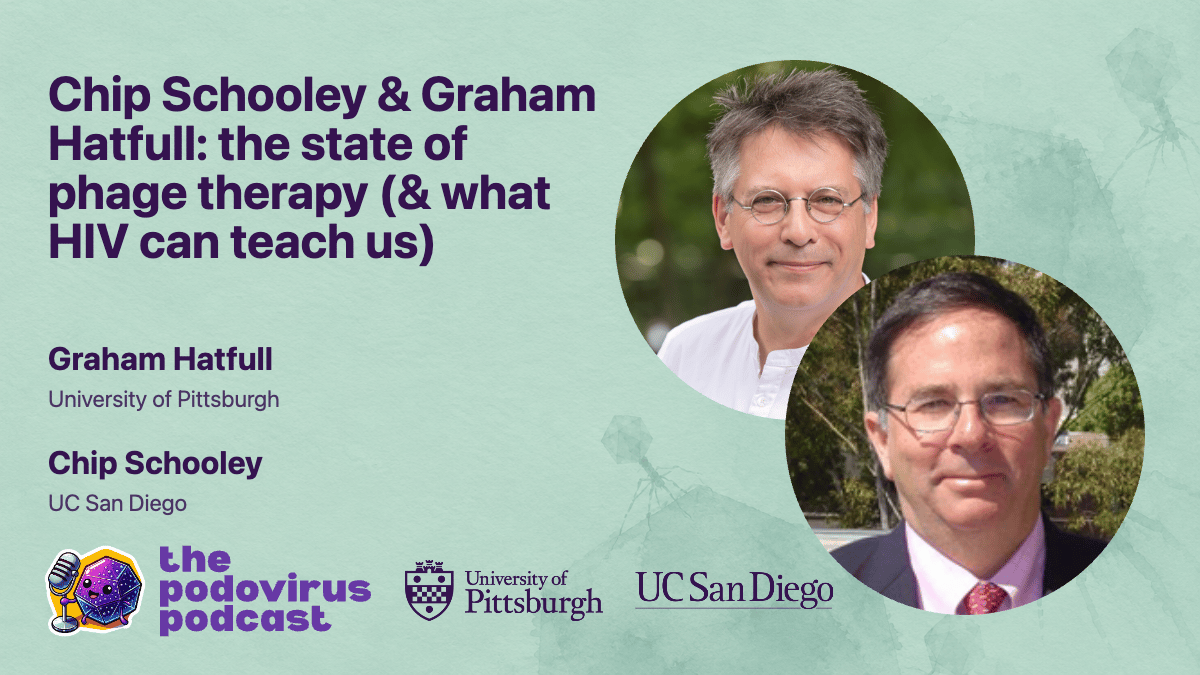
Chip Schooley & Graham Hatfull: the state of phage therapy (& what HIV can teach us)
The conversation
Episode notes
Physician Chip Schooley and phage biologist Graham Hatfull explain how studying what happens during treatment could help researchers design better phage trials. Drawing on clinical experience, phage biology and lessons from HIV research, they describe what trials could reveal about dosing, resistance and why a treatment succeeds or fails.
Schooley argues that phage assays need reproducible results across laboratories and testing against clinical outcomes, because bacterial growth conditions in laboratory media differ from those at infection sites.
Hatfull explains that resistance could weaken bacteria enough for a single phage to remain useful, while Schooley cautions that such benefits may depend on the patient’s immune system.
Schooley’s HIV example illustrates how a laboratory strain can mislead development, with patient isolates proving 100–1,000 times less susceptible to soluble CD4 before becoming more susceptible during laboratory propagation.
Episode timeline
- 0:00 Introduction to Schooley, Hatfull and the conversation
- 4:01 Building a conference around science and collaboration
- 20:20 Making phage assays reproducible and clinically informative
- 37:48 Designing trials to learn about dosing, resistance and immunity
- 49:13 Choosing shared phages without overlooking biological diversity
- 59:01 Phage therapy on HIV time and the prospect of designed phages
Learn more
Transcript
AI-transcribed and edited for readability. May contain errors or omissions; check the recording for exact wording.
Select a word or timestamp to listen. Use arrow keys to move between words.
- Jessica Sacher
Welcome everyone to Podovirus. We are really excited to have today, Chip Schooley from UC San Diego. He is one of the co-founders of the IPATH Phage Therapy Center, and we have, Graham Hatfull, a professor at the University of Pittsburgh. And so if you've been in the phage field or the phage therapy field for any time, you probably know both of these. And so therefore, we barely gave them any introduction in this episode. We just launched straight in.
But, I encourage you to look up their work. Chip Schooley has been instrumental in getting phage therapy off the ground. He was the treating physician in the Tom Patterson case in 2016, and Graham Hatfull has, as probably everyone knows, he runs the largest collection of phages in the world. There's almost 20,000, I believe, many of them sequenced, phages.
that he's been able to get through the SEA-PHAGES program that he created, getting, students in, I think 200 universities gathering phages as part of a classroom project, and every year we get more phages out of that. And Graham’s work… He’s been one of the people instrumental in getting phages, tested in the clinic. And he's kind of the king of Mycobacterium phages, as we mostly know him.
And so Chip and Graham co-hosted, along with other organizers, a phage conference in Washington, DC, this October, 2025, a couple of months ago. And so Joe and I, we attended the conference. And we really wanted to talk to these guys about, what their thoughts are on where the phage field is at, why they thought we needed this, conference, which was a bridge between the phage science and the phage, clinical side. And so we're excited to share this conversation.
It was extremely interesting to me. We got into a lot of examples, tangible examples of what makes a good collaboration across phage biologists and phage-interested clinicians. What we can learn from the HIV field, which Chip brings a lot of background in. That's actually his background, working in that space and being there when, everything changed on how we figure out how to treat HIV.
And so I really enjoyed hearing his perspectives on where we are as a phage field relative to where the HIV field, is and was. So what year are we on HIV time? Are we in the 80s? Are we in the 90s? And I think you'll enjoy hearing Chip's thoughts on that. And both he and Graham have just so much to share from their wealth of experience working with phages.
And seeing what we actually need to do next, what we need to test in the clinic and how we're gonna do that, especially how we're gonna involve the biologists. Because, as we hear, these complicated diseases and infections… You can't do trials that are gonna get you very far unless you really bring in the biology of those organisms, and that's hard. So enjoy the conversation and thanks so much for being here.
All right, you take it away, Joe.
- Joe Campbell
Okay, it's a great pleasure today to have Graham Hatfull and Chip Schooley. We're mostly gonna talk about a conference that they ran at the beginning of October in Washington, DC, on phage therapy, but we may touch on some other topics. So, first, I'd just like to thank Graham and Chip for agreeing to talk to us. And we'll start by asking them what their motivations were and how the conference came about, and what their motivations were for wanting to have it.
So I don't know which one of you wants to go first.
- Graham Hatfull
Chip.
- Chip Schooley
Okay, I guess I'm elected. So, there are several motivations behind this. The first is that, we have had a number of what one might call predatory conferences about phages in the US, which have been mainly run by commercial meeting companies, that, have programs that are designed, mainly by sponsors, of the meeting, and including the for-profit companies that run them.
And you end up with some things that are interesting, but a lot of things that really aren't that interesting and that often turn out to be infomercials. We thought it was time because of the rapid, increase in interest in research in phage therapeutics, to have an academic phage conference in the US that, was broader than, some others that have been held.
Because we wanted to include, the whole spectrum of researchers, starting with people in the laboratory, and concluding with people, on the implementation end of things, hoping that by getting everyone in the same room, we could accelerate research in the field. So it was an effort to really develop a truly multidisciplinary one, and one in which this, programming would be determined by people actually working in the field.
Selecting from material that was submitted by people working in the field in a peer-reviewed sort of a format. So this was heavily, peer-reviewed science, and every aspect of the program was controlled by a program committee that, consisted of about a dozen people, who reflected the same spectrum of activity I've talked about, running the program committee. Graham, what else do you think about?
Why this was pulled off at this point in time?
- Graham Hatfull
Well, I think that, well, so first of all, let me say it was a great delight to work with Chip to try to develop this program and the conference. Chip and I have worked together, on some therapy-related cases over the years. And you know, it's a great, partnership from my perspective, because Chip has all of the deep clinical knowledge about both infectious diseases and the use of phages from his experience, and I have none of that. But some interest in the basic biology of phages, and so that, made a good position for us to come from.
And clearly, you know, it feels like the topic of bacteriophages in general is kind of hot at the moment and has been for a little while. It's not just the renewed interest in the therapy, but also in, you know, the appreciation of the genetics and the microbiology, these dynamics between the phages and their hosts, so these are hot areas, and those span both basic biology through to the potential clinical applications.
And it's my sense that those, um, subdisciplines haven't always sort of worked closely together over the years. Um, and yet I think that they have much to gain from, uh, sharing their insights. The potential clinical applications are sharply, uh, factored by all of the basic biology that we're learning. And likewise, um, the folks that are working on the more basic side of the biology.
It's helpful for them to appreciate what implications that has for potential clinical, interventions. And so this seemed like a good place to try to bring the entire spectrum of the biology and the translational work together. And to do so as a major conference in North America, not competing with other phage conferences, of which, obviously, one of the common ones that's been running is Viruses of Microbes, which runs every other year and has been commonly, in Europe, notwithstanding the Australian meeting.
And so, by running this in alternate years to VoM, we thought would be a good forum for inviting everybody, but especially to have those folks who are predominantly working in North America and can't always get, to the meetings overseas.
- Jessica Sacher
Yeah, awesome. It was a fantastic meeting.
I was just gonna say that, yeah, I think the marriage of phage biology and phage therapy with a scientific lens, I have never found that, like, to happen so well in a conference. And so it was, I think it was short, two or three days, but it was just like, Wow. We actually finally had the spectrum from the scientific lens of like, what is happening with the phages before the clinic, during the clinic, and what people are actually measuring now, in the body as phage therapy is happening.
So, yeah, yeah, it was completely different than any phage conference that I've been to. And yeah,
- Graham Hatfull
No, that's a good, interesting perspective. I mean, that's essentially what we were targeting. And you know, the attendance, as Chip said, we'd always like to have had more folks. It was about 250, which, under the circumstances, I think was certainly a very good core group of people from, like, 17 different countries. And I think that the quality of the science throughout all of the keynote, the oral presentations and an amazing array of posters was really spectacular.
And I think that, I got a sense from many, many people that they walked away feeling like they really learned a lot. And although it was kind of relatively brief, Jessica, and relatively intense,
- Jessica Sacher
Too short.
It was perfect.
- Graham Hatfull
Yeah, but too short, you know. It was very good.
- Joe Campbell
It was great. I mean, I guess we were gonna ask you about what you thought the achievements were, and maybe what you hoped. And I'll just add a personal anecdote that at the bar the first night, I was standing next to a junior faculty member and someone from a biotech company, and the junior faculty member was constantly, you know, grilling the person from biotech.
in a friendly way about, you know, what aspects of my research would be most useful to you in designing your phage cocktail? Which I guess is probably music to your ears and exactly what you would hope would happen, other than maybe me being in the way. But anyhow, so sort of that's a lead into what were the things you hoped to achieve? And you know, do you feel like you mostly achieved them? And were there things that maybe you felt like didn't happen, that you were hoping happened, or would happen?
- Graham Hatfull
Well, I can just add one and then go to Chip that I think that, just for myself and for our group. We have, I think, a couple of new collaborations and new experiments that we're doing that we probably should have started doing a long time ago, but weren't smart enough. So now that we've heard other people, showing us the way, we have some guidance, so that's kinda like new experiments for us and new collaborations. And I don't think that's just us. And I think that's exactly what you want to have come out of these kinds of get-togethers. Chip?
- Chip Schooley
I think that really is the most important thing. It was really fascinating to see all the data presented. But the real goal of the meeting is to accelerate the field and have people who don't normally talk to each other, listening to one another, what they're, other people are doing. But also in these one-on-one discussions, getting into more deep details about, boy, I never thought about how that might work.
Could we test this in humans? This concept that you've been working on in the laboratory, or, I've been working therapeutically. But the problem we have is emergence of resistance. Are there ways we could more, predictably and scientifically design cocktails and antibiotic synergy? Work in vivo, and use in vitro studies to predict that, what kinds of things could you do to phages to make them, more, capable of doing what you'd like to see happen clinically?
Can you bust up biofilms better? Better payloads, those kinds of things. And when you understand the power of synthetic biology, which was a lot of what this conference is about, you can start dreaming about not just having to go out and look for different phages in different mud patches, you can think about even starting from cool air, rocks, and water and making one that you want. So a lot of that kind of opened the I think people's eyes about, how the field right now is wide open about what you can do, with some of the simplest organisms on the planet.
when you actually think about, their genetics, but that behave in really complicated ways, and being able to understand, how they behave, and to assess, in therapeutic situations, what, what their behaviors are all about, we hope, will, both, move the field in a way that we'd like to see it. Toward, an AMR solution.
And we also hope the people who came to the meeting as basic scientists, started thinking about, oh, here's some other things I can do, that might really be interesting and really applicable, and redirect research on that end of the spectrum, too. So I think the forward-looking part of it was the thing that, excited me the most. A lot of new collaborations, a lot of new, just introductions, people that you hadn't met before, but you read their papers, And those sorts of experiences are the way, collaborations develop. So I was very pleased with that part of it.
- Jessica Sacher
I would love to ask just to get more tangible on some of these collaborations. Like, when, we have sort of the phage therapy side and the phage biology side collaborating. Like, maybe is it a clinician on one side and a researcher on the other who's making the phages, maybe designing the phages, and then a clinician who's able to help maybe get a clinical trial off the ground, or what has been an example collaboration? How did it work
either in the past or one you're gonna start, that you think is, like, a really great type of collaboration in this field?
- Chip Schooley
Well, the third part of that collaboration is actually, the commercial part, because clinicians can't start clinical trials, without the support required to do it. You have to have someone who's trying to develop a product that can then be generalized and used, in medicine, and. So a lot of what also happened was, I think, some of the biotech companies started thinking more concretely about hypothesis-based, testing of engineering phages in ways they hadn't thought of before.
And those will get to the clinic, in clinical trials that will be done by clinicians. But we also from past experiences with other diseases, understand that it's important to have industry be science-based as well, not just commercially based, because when they start trying to think about how quickly something can get approved without understanding the biology with a complicated situation like that, you're more likely to be swinging for the home run and missing.
And getting them to the table and understanding some of the complexities of this, I think, helps design better clinical trials, so that if they work, we know why, and if they didn't, we know why as well, and that's how you plan the next one. So I think those kinds of interactions are ones that you're gonna see more and more, coming to fruition.
- Graham Hatfull
I just perhaps add, Chip, that, I thought that a useful part of the conference, and a helpful emphasis, is a sense of just thinking critically about where the opportunities and challenges are in the translational, possibilities. And that hard-nosed assessment hasn't always happened in the past. And it's kind of what's needed in order for the field, I think, to have a firm sense in the reality.
And part of the way that I think that was facilitated was we had these, workshops at the sort of pre-meeting workshops, essentially, which were very well attended. And I think, did a really good job of kinda setting the stage for where those opportunities and challenges are. And you know, that I don't have a specific example of a particular, you know, trial or an outcome or a case, but I suspect, it's that those workshops stimulated a lot of conversations.
- Joe Campbell
Yeah,
- Chip Schooley
I agree with you about that. I mean, I think one of the workshops that we, put on about, clinical trial design, was one that, will have far-reaching implications as people look to the future. Vance Fowler, who doesn't work specifically with phages, but who runs the Antibacterial Resistance Leadership Group and has been designing trials for antimicrobial agents designed, for resistant organisms, gave a really nice talk about some of the challenges in putting together clinical trials.
that tell you something about, how something, benefits, a specific clinical condition, and what sorts of clinical trial designs are ones that should be thought about going forward. That was followed by a talk, by a pair of people from the FDA who talked about the kinds of regulatory, issues they would like to see in clinical trials. So they can use data, to move trials, move phage access beyond one-offs of academicians.
trying to treat one patient at a time to actually being able to prove products and get this to scale. So I think that workshop, was one that, will have far-reaching effects, moving forward.
- Joe Campbell
Yeah, I agree. I mean, I'm a big fan of Vance, I mean, he's brutally honest, as anyone who's dealt with him knows. But, you know, I think, you know, he's at least started out reasonably skeptical about the use of phage, but he's willing to change his mind if data encourages him to do so. So that's always great. One thing I wanted to dig in with you guys.
You know, one of my favorite people in the phage field is Robin Patel. And Robin, as usual, gave a nice talk on in vitro assays. And I guess I was wondering, since we have both of you here, what you guys think of the state of our in vitro assays for phage efficacy? And where, you know, Jessica mentioned, like, where we hope to be in five and ten years.
And so maybe just start out with your thought of where we are now and where you would like to see the field of that in vitro testing get to in five to ten years or 15.
- Chip Schooley
You know, right now we're kind of in a cottage-industry, phase of things. We have, two general approaches that, laboratories use. Usually most laboratories use one or the other, predominantly, spot-based assays or assays in which, bacteria grow in liquid phase and various aspects of metabolism are measured. And. There really are several stages that we need to go through to get from where we are now to where we need to be.
Stage one is assay standardization. One of the things that Robin presented was a nice study done, looking at, both methods, in three different laboratories, with a panel of phages, and a fixed, panel of Pseudomonas bacteria. And if you looked at, the level of agreement, when the same phages were measured in the same laboratory on the same day with the same bacteria, it wasn't bad.
You do it on two days, it got a little bit worse. You do the same, what you think is the same technique in two different laboratories on different days, it gets even worse. And then when you start trying to compare the results of the spot assays with assays that were done in liquid phase, it gets even worse. So it almost gets down to throwing a dart at a dartboard to be cynical about it. So the first thing that has to happen is we have to understand what we're measuring, and so things can be reproduced in different people's laboratories. Once you get that done, then, the next stage that is really critical is to see how well those assays predict outcomes in clinical settings. The bacteria grow, in different ways when they're growing in log phase, in a liquid medium, than when they're kind of struggling to make it.
in a mucous membrane that, has limited nutrients, and that they're competing with others for survival before the phages show up. So, as with antibiotics, in which it took 40 years, frankly, to get from where we started to where we are now, it's gonna be a learning curve, in which we, first have to get to the point that we can say what I'm measuring is the same thing.
Graham's gonna measure, and then later, if so, so what? And that's gonna have to come from clinical trials. And that's why I think it's really important to have rigorous clinical trials in which these assays and others that come along can be applied, liberally, and pressure-tested in terms of how outcomes, clinical outcomes, are generated, to really decide, how best to move forward.
But it's a critical aspect of phage therapy, to be able to know which phages to use in which situations. And we're not close to where we need to be. Graham may be more optimistic than I am, but in terms of a glass-half-full person that he is, what do you think about…
- Graham Hatfull
I think that, so, a couple of things, and it's not that I disagree, just in general with what Chip said, I think that, there needs to be, you know, some caution in doing some of these in vitro assays for doing plaque tests, for example. You can have phages which look as though they form what appear to be fairly clear plaques at a fairly good titer or an efficiency of plaquing.
But if you actually look, I mean, it's certainly true for the strains and phages that we work with sometimes, but I think it's true for others. If you then ask the extent to which the phage efficiently kills the bacteria, it's quite variable. And so one single assay is unlikely to necessarily give you the answer, depending on what you're looking at.
And I think that's my other sort of real note of caution is that, yes, you want to have some standardization of approaches for exactly the reasons that Chip said, so that if multiple people measure that same phage against the same bacterial strains, they get the same result, right? And if not, that's just terrible, so that has to happen. On the other hand, I think we need to be very wary of thinking about this whole field of phage therapy as some singular entity.
It just isn't. It's a variety of types of infections, it's a variety of types of pathogens, and a variety of types of patients, right? And what is suitable and effective as a set of assays, for one subset of pathogen or infections is not gonna be true for another. And solutions and effective therapies that may work for some infections or for some pathogens may not work for others.
In fact, they're almost certainly not going to. And I sort of see this as, you know, thinking about phage therapy as a singular solution is a bit like thinking about cancer as being a singular disease. It isn't, right? And a lot of progress, I'm not a cancer biologist, right? But as I understand it, a lot of progress has been made really.
from breaking that down into separate types of diseases and then tackling them one at a time with very effective outcomes. And so I think that we should be mindful of that in the phage therapy world. Just because it's not easy to get good solutions for phage therapy for Mycobacterium avium infections doesn't mean you shouldn't be enthusiastic about it for, you know, Achromobacter infections or something else.
And so, allowing the field to work in ways where, it can avoid unnecessary simplifications and standardizations and allow innovations to work in different areas is also going to be an important part of the trajectory. Notwithstanding the need to make sure that you get reproducible data for reproducible circumstances in different labs.
- Jessica Sacher
That's really interesting.
- Chip Schooley
The point that Graham made is really critical, too. In the sense that when you look at antibiotic susceptibility testing, we set different breakpoints depending on where the infection is. There are different breakpoints for urinary tract infections, for antibiotics that get into the urine. And we're gonna have to understand that we may well have those scenarios going on with phages, which will be pharmacologically driven.
But there also will be ones that are gonna be related to the biology of phages that are not necessarily operative with antibiotics. And again, having a meeting like this in which people who understand phage biology are talking to people who are used to saying, well, the breakpoint is four, micrograms per milliliter, is the way you start breaking down some of the nuances that Graham spoke so eloquently about, and beginning to come to some really meaningful sorts of measurements that we hope can start helping target phage therapy in a more scientific way.
- Graham Hatfull
This is just a good example, right? Where Chip comes up with all this very relevant clinical mumbo jumbo that a basic phage biologist like me never thinks about in a minute, right? And this is a great illustration why you need to have this breadth of expertise thinking about these questions.
- Jessica Sacher
For the phage people in the audience, what's a breakpoint?
I mean, is that the difference between antibiotic-susceptible and resistant? I just kind of default to that in my head, but this is such a good example.
- Graham Hatfull
It’s probably where recombination happens between genomes, right?
- Jessica Sacher
What is it? What is this?
- Chip Schooley
Well, a breakpoint is a number, that, is taken from in vitro assays, that determine the lowest concentration at which you can reduce the replication of a bacterium by a specific percentage. It can be 50% or 90%, but the breakpoint, then has to be looked at in the context of the clinical situation.
So antibiotics that are used both for say, pneumonia, and for urinary tract infections, if you measure an IC50, the concentration at which 50%, growth is inhibited, of four, that might be something that's fine if you're treating a urinary tract infection, but it wouldn't work if you're treating a lung infection. So that the breakpoint really is context-dependent. And so what the laboratory will often report back is the MIC, the min. inhibitory concentration.
And the clinician has to say, okay, well, I'm treating pneumonia. And this is not gonna get there in the lungs, or it's not gonna get there in the prostate, even though on a plate, I can get there, so that, you have to, then, take that number and move it into the clinic. Now, with phages, we also have the additional, I think, very positive aspect.
The fact that, if they get to a place where they can find food, i.e., the site of infection, they replicate and amplify themselves. And so, you've got both a qualitative question about whether the phage will infect a specific organism under the conditions in which the organism is growing, and secondly, the amplifying impact of replication at the site. So that, thinking about, what dose to give is somewhat different from antibiotics, where you try to keep the trough concentration, the lowest concentration the antibiotic gets to in between dosing intervals at a specific level. With phages, you're gonna count in some cases on the phage being able to help you out there.
And that's gonna be another thing that's gonna have to go into the thought about how to decide which doses of phage should be used in different situations.
- Jessica Sacher
Thank you. Yes, perfect example, just highlighting, yeah, what Graham said, the benefit of bringing the medicine to the biology.
- Joe Campbell
If I could just follow up on the reproducibility of in vitro assays. And I guess we'll direct this to Graham first, ’cause he's maybe done this more. But from your experience, I mean, I guess one thing that occurs to me is that in most cases where labs are trying to repeat it, they're both gonna be doing their own phage prep. And even if they both get whatever ten to the tenth PFUs per mL.
So I guess the question is, fundamentally, in your experience, when you're trying to get reproducible in vitro assays in your lab? Graham, if you get two preps that are ten to the tenth and test them side by side. I don't know if you've done this, are your preps? I mean, how much prep variability is there, even when you normalize for PFUs per mL?
- Graham Hatfull
Well, I think that, you know, there's, I think if you prep a phage and you prep it up on many different ways and times and get it to some titer, they're pretty well behaved, and pretty reproducible. But in between all of those words are all of the potential pitfalls, right? If you're a lab that's working with a whole bunch of different phages, at, you know, with the multiple trillions of particles.
Where it takes only one particle as a contaminant, right, to end up, finding itself into your prep, that then you can, then that's where you see poor reproducibility. For example, you might find that a particular phage prep fails to infect, a particular strain because it has an efficiency of plaquing that's, you know, ten to the minus six or something.
And then you do another prep of that phage and you find it has an EOP of ten to the minus three. One reason why that can be different is because you only need a small amount of contamination of some phage that will break through that, that that system and then appear as though it's behaving differently. So I think that, you know, contamination and cross-contamination is a is a is a concern that should always be kept in mind.
and we all have to do the necessary QC to convince ourselves that we do the microbiology well. And we're always mindful of the kinds of events that can give what appears to be poor reproducibility, but contamination is one of them.
- Joe Campbell
Yeah, I mean, I guess one of the things—this is past experience of mine—but when I was at NIAID, I was running contracts where we were having contractors make preps of anthrax spores and infecting them into animals. And it turned out that you could get the exact same number of CFUs, but if you had a prep that had a, you know, x number of CFUs per mL,
but it also had a lot of spores that weren't germinating, then you could add the same number of CFUs and have a much harder time killing the animal than you did with something that had, you know, the same number of CFUs, but almost all the anthrax spores would germinate. As if the inactive spores were, I thought they maybe were acting as vaccines, but we never showed… The contractors never figured it out. But I wonder, like, is that a problem?
- Graham Hatfull
I think that's not a kind of problem that's seen routinely. You know, typically, what happens is you make a preparation of phage and you titer it on some strain, right, which gives you the PFU number. And I think in many cases, the PFU number, the plating units, is probably not that far off the particle number.
But that's not a thing that people routinely, evaluate. And in other areas of virology, those differences can be quite substantial, and they make a very big difference in the behavior of the phages and the infectivity and the dosages and things. I think for the most part in phage preparations, the PFU is similar to the particle number, at least in newly made preps.
Over time, of course, that can change, and then you have the potential that there could be complications that arise from having only a relatively small portion of the total particles that are actually infectious.
- Jessica Sacher
On that note, too. I remember at Phage Australia, we were deciding which EOP would be relevant when we were measuring a dose. Do we do it based on the reference strain, you know, like, or which titer would be relevant? So, yeah, you have ten to the nine per mL on the reference strain that you made it on, but on the patient strain, it's an EOP of 0.001 or something.
And so is the titer actually two or three logs less, or do we count particles? And we had to just kind of pick one, and we picked, “Let's go with the titer on the reference strain.” But that obviously introduced… and we're trying to do things standardized across patients. But that's already like, kind of blowing that out of the water, if you look at it that way.
But then the other alternative of getting ten to the nine active ones on every single patient strain, first of all, it was like, probably impossible to do to get that high sometimes. But also you're still not standardized because you have different levels of inactive particles every time. So I don't know the answer to that.
- Chip Schooley
But see, that's a great example of something that should be tested, in clinical trials. You measure both, and then you look to see, which, if either, is more predictive of behavior in vivo. And that's why we think these clinical trials need to basically be biology experiments in people, not just therapeutic outcome experiments in people.
- Jessica Sacher
Really good point. Are people doing those trials? Sorry, Joe.
- Joe Campbell
Oh, yeah, I guess I was sort of gonna ask a similar question related to that. I mean, Jessica raised one of the questions that we still have, and one of the things Jessica and I wanted you guys to talk about was, you know, what are the outstanding questions that need to be addressed in the clinic?
- Chip Schooley
Well, let me just make one little diversion here first.
- Joe Campbell
Sure.
- Chip Schooley
And plug the institute that you used to work in as it used to be when AIDS was here. One of the things that made that field move along is that the AIDS Clinical Trials Group had an extensive laboratory network with quality control, across these laboratories, that was very rigorous, and in which these biological questions were embedded in large clinical trials. We were measuring things that industry didn't care about because they were looking for clinical outcomes.
And understanding that part of the biology of HIV—it's also a complicated organism with its, latency and so forth, and so on. Understanding that aspect of things, accelerated the field. If this field is going to move forward, it's going to need to have the same sorts of investments from organizations, that, in addition to wanting to see short-term therapeutic outcomes, are willing to invest in the biology in those clinical trials.
So that we understand, how to best optimize the use of the phages, and that can only happen… That's not gonna happen with a biotech company that's living on fumes. It's gonna take the NIAID, it's gonna take BARDA and others that insist on having these questions embedded and paying to have them answered in a standardized way. So let's go back to you. Where were you?
With your question before I rudely interrupted?
Got in the way of your probing question.
- Joe Campbell
Oh no, I think it was completely appropriate. And I think the broad question is, what questions do you think clinical questions need to be answered? And I guess that's one of them, obviously. But what are the other things that you think that need to be answered so that clinical trials can be designed even better than they are right now?
- Chip Schooley
Well, you know, I think that, we need to pay attention to how antibiotics have been developed over the years. That antibiotic development paradigm is one that didn't just fall out of a tree. That’s developed over 30 or 40 years. And we need to pay attention to some of the early, phase, investigations, that go on there, looking at things like concentration of antibiotics at the site of infection.
Uh, we don't do enough of that in our phage therapeutic clinical trials. Um, uh, looking at, um, uh… We need to be more careful about our dose-ranging, uh, before we launch into clinical endpoint trials. We've assumed up until now that, um, if you can make a phage at a given titer, um, and um, be certain that, um, you understand what the, um, uh, impurities might be in your prep.
and keep the endotoxin levels, where it's relevant, below a certain level, then you can give as high titer as you want to. That may not turn out to be the case. It may be that when we get into production modes where we can get ten to the eleventh or ten to the twelfth phages, that might be actually, asking for trouble, because of things we're not measuring there in those preps that can cause local reactions.
And when you actually think about what goes on in theory with phages, with their doubling time, with their life cycle time, the difference between ten to the seventh and ten to the eighth is not that great. When you come back two hours later, if you get an infection going, so, we need to understand some of that, in terms of how we design clinical trials is the most important thing.
Getting enough phage to spill over, if you're giving them intravenously to the site of infection, uh, and then have the infection take off. And if that's it, do you have to keep doing that? And the only way to know that is to look at that in clinical trials, to look at, uh, persistence of phage at sites of infection in clinical trials in different types of infections.
So, you know, again, there's a ton to look at. Graham can, talk, as well about, with antibiotic, therapy, we see resistant organisms being selected. The antibiotics don't evolve, though, and phages can. And how do we think about that? In terms of when you're treating someone with phage therapeutics, we don't generally have, antibodies developed to antibiotics that we give, but we do phage.
Does that matter? How often does it occur? Does it matter more? Does it happen more if you're giving phages parenterally than if you give them topically? Does it always, seem to impair therapeutic outcomes? So far, it doesn't look like it always does, but sometimes it might. There have been some case reports in which antibodies developed at about the time that you began to see falling efficacy.
Those kinds of things are things that we need to understand, in the clinic, to be able to design around it. There are people who are trying to design phages that are less immunogenic. Can we actually do that? Do we need to do that? And the only way we can do that is start measuring some of these things again in our clinical trials. I'm sure Graham can think of another several thousand things we should be looking at.
- Graham Hatfull
Well, No, I think, I mean, these are terrific points. I guess I constantly come back to thinking about, what you need. And what you need to learn from any particular clinical trial is gonna depend on the infection and the pathogen and the phages that are available for them. And some, but not all of that is gonna translate between different infections and different pathogens. So it's not a unitary, you know, “Here's what we need in clinical trials.” It's what we need to learn in those particular instances. I would just say that, I mean, dosage is obviously something we desperately need to know something about. It's quite embarrassing, that we know so little about optimal dosing, in any phage cases. I would just add that, you know, our friend Paul Turner has taught a lot about trade-offs, right?
And trade-offs between, phage infection, phage resistance, and with antibiotic resistance and antibiotic susceptibility. And I think that broadening that out, there's likely to be trade-offs, generally speaking, between, phage sensitivity, phage resistance, to fitness in an infectious circumstance. And so that's an area that we know relatively little about, and we might wanna be aware of that in doing clinical trials.
For example, if we think phage resistance emerges, if it's discovered, if you find that the treatment doesn't work particularly well, or you get ongoing infection and you get resistant strains, in vivo. And the question is what's their fitness, right? And so that needs to be evaluated in animal model systems, which is simpler in some pathogens than others.
But understanding the incidence, the frequency of resistance, and the impact of resistance, not only on antibiotic susceptibility profiles, but on the fitness profile more broadly, is something that I think we need to pay attention to, partly because, I mean, apart from other things, it influences how you design the therapies. You know, one important aspect of using cocktails is in order to minimize the chances that the bugs will become resistant to a particular phage.
Just as the same strategy has been used for many antibiotic therapies, especially for mycobacterial infections. And but if resistance is not always as substantial, a problem, then that means that you might not need cocktails. Single phages may do perfectly well because resistance occurs, but there's a fitness cost, and so it actually doesn't impair the therapeutic outcome. So that's…
That's an example of, I think, an area that we really would like to understand more again, in a pathogen and an infection-specific manner.
- Jessica Sacher
On that note, Oh, go ahead, Joe.
- Chip Schooley
I was gonna add one other thing. Another aspect is the host, we know that, some of these fitness, trade-offs that phage make to exist, or that, bacteria make to exist in the presence of selective pressure of phage are doing things like dropping their capsule. That makes it a sitting duck for polymorphonuclear cells and monocytes to ingest them and kill them.
But that only happens if a patient has them. And so, these fitness trade-offs may be things that, doom the bacterium in people whose immune systems are working, but might not work so well in someone who's in the midst of a bone marrow transplant. So we have to think about it in the context of the patient, as well, and I totally agree with what Graham said.
We can't, learn, everything that we need to learn about phages, in a single clinical trial. But we should look at every clinical trial and say, what can I learn in the context of this clinical trial that would really be important, from the standpoint of understanding how to use phages. And if this thing fails, what made it fail? That's what we should be thinking about when we design a clinical trial.
What can I learn from this? And it'll be different things in different trials, and… But putting them all together, we'll see things in which you can start connecting the dots and begin to talk about, I hate to use the word, principles of phage therapy, as opposed to anecdotes and adventurism, in phage use. So, it'll take a while to get there, but I think, you know, we know how to do it.
We've done it with antibiotics, and we should, do it with phages.
- Jessica Sacher
On that note, I think it can be dizzying, the many dimensions that there are with phages, like how every phage is different, as you've been saying, Graham, like every bacterial context is different. We have all the different bacterial species, all the different strains, and everyone's using their own phage. Do you think we need… Would this benefit the field if we decided collectively to work on a smaller set of phages or a smaller set of indications?
But I'm thinking back to, like the T4, T7 days, where, you know, it was decided that these are gonna be the ones. What if we did that for therapy? And then we could actually reduce some of the dimensionality and at least be like, okay, maybe some phages, the immune system matters, but for this phage, we start to learn enough about it. What do you think about that?
- Graham Hatfull
I guess I'm kind of in two minds. I mean, I think that, you know, the early emphasis, and the decisions by the early, you know, phage group to focus on, a relatively small number of phages was obviously enormously beneficial in making rapid progress, with investigators focusing on a very small number of prototypes. But there was a cost to pay as well, right?
Which is the assumption that what we learned from those would be translatable to the phage field more generally. And of course, in some cases that's true, and in other cases it's not just because the diversity is so vast. And so, I think that we want to be sort of pragmatic about that. Where there's, you know, for Pseudomonas, you know, we don't work with Pseudomonas.
But from what I hear, I really think that there are some phages which might be at the top of everybody's priority list, right? And if that's the case, then, one could make an argument that the that, standardizing the use of some of those, if that's achievable, would be beneficial. Now, I'm also aware that when we start talking like that in these hypotheticals, we have to be mindful of, you know, of the.
academic institutions’ positions and the biotech industry's positions on their potential IP and the sharing of materials and stuff. I mean, those are some practical aspects that you just can't ignore in some kind of, you know, let's all do a rah, rah, rah, everybody work on this particular phage or two. But I think it's a good point, Jessica. And we should be mindful of opportunities that might arise to reduce the dimensionality, to make it more manageable. But I think I just feel like you wanna be flexible enough to move away from it as soon as you realize that you shouldn't have done that, right?
And so some practical decisions to be made down the road. But making, simplifying actions that can simplify in certain instances would probably be beneficial.
- Chip Schooley
I would just amplify the caution, though, about making things so standardized and so simple that you end up missing big, points. A good example of that happened with HIV vaccine development, back in the early days of vaccine development for HIV, when, HIV vaccines were promised in two years. The muckety-mucks in vaccine development decided that they wanted to work with the same strain in all the laboratories.
So they came up with a strain called IIIB, which, was easy to propagate and could be sent out and everybody would work with it. And so all of the assays that were done, with so-called neutralizing antibodies that were induced in animals were done with IIIB. And they were developing, vaccines that could neutralize, repeatedly, at high titer, the standardized, strain of HIV.
Several years into this, David Ho and I got involved in using, soluble CD4, which is the receptor for HIV as a therapeutic. And we, did our homework and looked at what the IC50 was and the IC90, and we looked at the pharmacology. And working with Biogen, we, did a phase 1 clinical trial in which we understood, what doses we needed.
Then we went to a phase 2b trial in which we, escalated the dose to levels that in the plasma should be reducing the amount of virus that we were measuring in the plasma. And the levels of virus were not declining, despite the fact that we had more than enough, we thought, virus—or drug in the plasma. David had the foresight, to take the isolates from patients that we were treating.
And he found that they were uniformly 100 to a thousandfold less susceptible to soluble CD4 than IIIB was. But that when you propagated these viruses in the laboratory over several weeks, they became as sensitive as IIIB. And it turned out that what was going on in vivo, where there was selective pressure against a neutralizing epitope of IIIB that was present in vivo, but not in vitro.
That allowed the virus to relax and be very susceptible to neutralizing antibodies and to CD4, that we were using, which is basically a neutralizing antibody. So we were measuring the wrong thing when all the susceptibility testing was done; we pointed that out. And it took the vaccine field two more years to redesign their clinical trials to use clinical isolates to test their antibodies. So, we need to be sure we're not doing that by getting so standardized everybody's looking at the same Pseudomonas or the same phage, as Graham just said, in a more succinct way.
- Jessica Sacher
Thank you.
Perfect. Hm.
- Graham Hatfull
And just as a brief follow-up, I just especially talking about the HIV field. I'm mindful—Chip knows this better than I do, I think— that I think that there was… One of the things that was observed, in the early days of HIV research, was an influx of good young scientists, often coming from other fields, to study in that area.
But the funding was made available. And that influx of people that think about problems in different ways was actually very productive, in understanding the virus and understanding the disease. And in some ways, we should think about phage therapeutics and the phage world in the same kind of way. We need new people that think in different ways. And because these are multidimensional, complex problems, that's exactly, Jessica, why you need to have people that come in and think differently.
And that was one of the things that was striking to me about the conference, that I really liked a lot, that, you know, there's folks like Chip and me who are, let's say, to put it nicely, closer to the ends of their careers than they are to the beginnings of their careers. There were many more people at the conference for which the opposite was true.
And I see that as something that's incredibly, healthy for the field. If there's a route to move forward in phage biology and in the potential clinical applications, that's what we need. We need good young thinkers that are moving into the field and bringing new perspectives that we're all gonna be able to learn from, in order to kind of to shape you know, what the future of the phage world’s gonna look like.
- Chip Schooley
No, that is a critical point. I mean, I think that, one of the things we saw in the early days of HIV was the excitement of young physicians in particular about this new field that was expanding rapidly. And all the scientific advances that were being made and the opportunity to work, in that area as physician scientists. One of the things that the NIAID did very effectively was support the development of physician scientists.
The AIDS Clinical Trials Group that was set up had enough money to help people get started on faculty positions. And they then became the people who moved the field forward, as they joined as assistant professors. That is critical these days, for fields like, phage biology and for emerging infections, and antimicrobial resistance. And the number of new people going into science and the number of new, physicians going into infectious diseases are dropping, every year.
The number of people who matched in the infectious disease fellowship match, which happens every year last week, was half, what we had at the peak, when people were thinking about HIV as a career to pursue. And I think it's critical that NIH and other, bodies that, help, look into the future keep those pathways open, because we're gonna need people, when, folks like Graham and I, move, to places we should have, moved to many years ago, moving along.
So we need this spigot wide open, and it's right now barely dribbling, if anything.
- Joe Campbell
Chip, you're already in Southern California.
- Jessica Sacher
One step. I think that's really important, and I think all these parallels to the HIV field are extremely helpful to just help us put the phage field in context. I was gonna ask Chip, like, what year are we? If this was HIV in the phage space, like relative to when things started, to where they are now? Where are we on that? If you can kind of see a parallel trajectory in the phage space, are we still kind of like before the exponential?
And in terms of funding as well, that's come in, like, how do you see us?
- Chip Schooley
Well, in terms of funding, I would say about 1856.
- Jessica Sacher
Okay.
- Chip Schooley
The you know, traditionally, I think the, I mean, I know the NIAID best. I think DMID has been underfunded, for years, and phage has been underfunded, within DMID. I have no idea how it will fare in the new administration. So I think to answer your second question, first, I think funding really needs to be readdressed in terms of the morbidity and mortality that AMR is causing and will cause, given the trajectory it's on.
Need to look to the future, from the scientific perspective, I think we're at about 1988. And by that, I mean, we knew by that time that people benefited clinically if you could reduce replication of the virus in vivo, and we had some tools that we could do that with. They're not the drugs we use today, but they were drugs that at the time were, we thought, were quite potent.
And they demonstrated the principle that if we could do that, more effectively and for a more prolonged period of time, people's immune systems would recover. And so over the next ten years, what we saw was progressively using our understanding of the biology to understand, error rates with replication, replication rates in vivo, to understand, how much, potency we needed, and how much, we need in the way of mutations.
That the virus had to overcome to become resistant to all the organisms in a cocktail. So the cocktails were designed on the basis of the biology we understood from measuring that in people. And that is what really moved us from 1988 to 1998, when people suddenly had a prognosis, with HIV, that was not that different from people who didn't have HIV. So we have the tools to do this, with phage therapeutics, we just need to do that.
And I think we can move even more rapidly than with HIV, because we have that example of using biological observations to refine the way we design clinical trials, and what we've learned from clinical trials, to refine what kinds of questions we can ask with the biological probes we have. We need everybody at the table, new people coming in, and I see a great future in this area.
- Jessica Sacher
Thank you so much. Awesome. Anyone else have any last parting remarks, or Joe, any other questions, as we hit the top of the hour?
- Graham Hatfull
I'm just gonna very briefly, Chip had said this earlier, but I feel, strongly about it that, you know, I think that, naturally occurring phages, have clearly proven of considerable interest and may continue to do so. But I think that what's most important about them is not the materials, but the information we learn from studying them. This field is gonna quickly move into synthetic biology, phage.
like bacterial killing machines made by design to do the things that we want them to do in the most efficient way possible, without all of the unknown facets. That's where the IP is going to lie, which is what's potentially going to drive the biotech industry. And I think that's gonna happen sooner rather than later, and I really think that that's what the future is gonna look like.
But the information is really, really important, and we need to get as much of that information as quickly as we can. And then deploy that for the synthetic biologists, to just go to town to make things that work well and bring us into the 21st century with new therapeutics for antibiotic resistant infections.
- Chip Schooley
And that's what happened with antibiotics. We, you know, penicillin came, out of Florey's pocket with mold. But what we do now is medicinal chemistry, in which we modify, scaffolds that we understand with specific, chemical changes to enhance their capabilities. So again, this, the parallels between, traditional antibiotics and phages are ones that we should, really take advantage of when it's appropriate.
And I think Graham's right on the money about that.
- Jessica Sacher
Thank you. Perfect. Anything to add, Joe? Hm,
- Joe Campbell
No, I think we're about at the end of the hour. And I will just thank, Graham and Chip for living up to my expectations of giving us a lot of thoughtful and insightful comments and giving us what I thought was a very interesting hour.
- Jessica Sacher
Yeah, thank you so much. What is the future of this phage conference? We should also end on: Are we gonna have another one in two years? And do you need some help, or what can our listeners and all of our phage researchers do to help you?
- Chip Schooley
Well, this one—we didn't give credit where credit's due—was put on by the International, Antiviral Society–USA, led by Donna Jacobsen. The organization is a not-for-profit organization that puts on an analogous meeting for HIV. And we based a lot of the structure of this meeting and the approach, on CROI, the HIV meeting that we've been running for years.
The plan is to try to do this every other year, off years for VoM, and to see the meeting grow, learn, as we have from this year's meeting about how to make the meeting better, in two years, and we're gonna need all the help we can get because we wanna have people, come. We wanna be able to make it affordable for young people in the field, and we wanna make it exciting so that, people come, to learn, and to refine what they're doing, and that's gonna take support from, you and from Joe and for everybody in the field.
It's a group effort. This meeting is just a place where the group comes together. It's a vehicle, it's not a destination, so let's ride it together.
- Jessica Sacher
Thank you.
- Graham Hatfull
The meeting was just run with a delightful sense of academic professionalism, which came from the IAS–USA and from Donna Jacobsen and her team. They were absolutely fantastic. That's what made it work, and that's what's gonna make it work again every two years, right, Chip?
- Chip Schooley
Right?
- Jessica Sacher
Wonderful. Okay, well,
- Chip Schooley
Two years in Tulsa.
- Joe Campbell
Tulsa.
- Chip Schooley
Tulsa, who said that?
- Jessica Sacher
Well,
- Joe Campbell
I don't know.
- Jessica Sacher
We'll go wherever it is.
- Chip Schooley
All right?
- Joe Campbell
I went to the Dylan Museum in Tulsa and that was fun. So
- Chip Schooley
Well, we'll have to keep an open mind.
- Jessica Sacher
Yeah, awesome. Well, thank you both so much.
- Chip Schooley
All right.
- Jessica Sacher
What a great conversation.
- Chip Schooley
Thank you.
- Joe Campbell
All right, thanks a lot.
- Chip Schooley
Talk to you later.
- Jessica Sacher
Bye.
- Chip Schooley
Bye.
- Graham Hatfull
Bye.
- Joe Campbell
Bye bye.