


Ahmed Heakl ✈️ NeurIPS Sydney
@AhmedHeaklAI
Today we introduce Looped Weight-Space Programming! 🚀
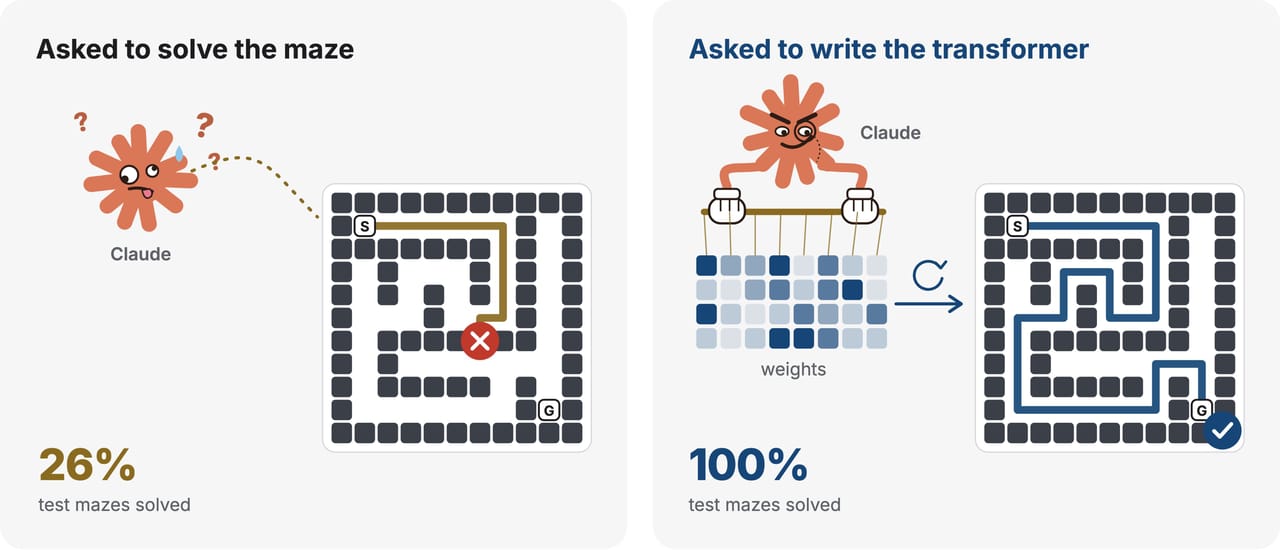
We asked Claude Opus 5.5 to solve hard mazes. It got only 26% right.
Then we asked it to write a transformer that solves them, setting every weight directly.
It took just 39 minutes and $19. No training.
The model it wrote solves 100% of our test mazes. 🧵
Ahmed Heakl ✈️ NeurIPS Sydney
1/ This builds on Weight-Space Programming by @rikiyatakehi @jayden_teoh_ @a1zhang & @lateinteraction, who showed LLMs can read and edit neural weights directly.
We asked something different: can an LLM write weights that implement a whole, reusable algorithm?
Ahmed Heakl ✈️ NeurIPS Sydney
2/ Claude wrote a looped transformer. One small block runs again and again, advancing a shortest-path search by one step per pass.
The same weights solve 100% of our 100×100 test mazes, even though Claude only ever tested it on mazes up to 45×45.
Watch on X
Ahmed Heakl ✈️ NeurIPS Sydney
3/ Could gradient descent find the same solution?
We trained Claude's architecture from random weights on the same mazes. It solved 0%.
The best trained baseline, Energy-Based Reasoners, reached 93.5%.
Curious to hear @ylecun's take on writing weights vs learning them.
Ahmed Heakl ✈️ NeurIPS Sydney
4/ Then we set a cap: fewer than 1,000 weights.
Claude wrote a maze transformer with 928, and it still solves 100% of our test mazes.
LDT, the best trained model on Maze-Hard, uses about 1,900× more weights.
Ahmed Heakl ✈️ NeurIPS Sydney
5/ Tower of Hanoi next, where reasoning models start to collapse around 7–8 disks.
In 27 minutes, for about $5, Claude wrote a 3,686-weight transformer that plays all 1,048,575 moves of the 20-disk puzzle with zero mistakes.
One tiny block, looped two million times!
Ahmed Heakl ✈️ NeurIPS Sydney
6/ Same approach on Sudoku-Extreme, GraphWalks with 1M-token prompts, and two BIG-Bench Extra Hard tasks: 100% on every test set we evaluated.
The weights are readable too. Given only the weights, a fresh Claude session worked out the whole algorithm in about 2 minutes.
Ahmed Heakl ✈️ NeurIPS Sydney
7/ Perhaps the most interesting part: interpretability.
What the transformer has learned is NOT a black box. Each weight is deliberately constructed to implement an algorithm.
We can inspect the intermediate states, trace each step, and understand exactly how it reaches an answer.
Ahmed Heakl ✈️ NeurIPS Sydney
8/ Our takeaway: an LLM that can't solve a problem directly may still write a tiny model that does.
Blog: https://mbzuai-oryx.github.io/LoopedWSP/ Demo: https://mbzuai-oryx.github.io/LoopedWSP/demo/maze.html Code: https://github.com/mbzuai-oryx/LoopedWSP
With co-first author @Python8723, Abdelrahman Shaker, Fahad Khan and @KhanSalmanH.
Ahmed Heakl ✈️ NeurIPS Sydney
@Python8723 @KhanSalmanH 9/ Claude Opus 5.5 is a co-author on this one, since it wrote every single weight by hand 😄 @AnthropicAI @claudeai